Crypto Adoption Is Working. So Why Are Most Tokens Falling?
Crypto products found users, companies found revenue, and a major Ether fund moved closer to paying network rewards as cash. Most large tokens still fell because using crypto and owning its tokens are no longer the same bet.

- Coverage
- Markets / Cash / Futures / Products / Business / Security
- Evidence cutoff
- August 14 · 12:30 UTC
Chapters
Crypto adoption worked. The value landed in a few specific places.
A user can trade through a good app, an exchange can add customers, and a fund can collect staking rewards without creating demand for every token. That separation explains the week.
- Most large crypto assets lost money.Bitcoin fell 3.48% and Ether fell 2.62%. Only 29 of 68 screened large crypto risk assets rose, and the middle asset lost 1.2%.
- Fresh cash did not arrive in force.Bitcoin funds lost a net $227.3 million across five complete U.S. sessions, while Ether funds gained $46.6 million. Stablecoin supply barely changed.
- The fight moved to the customer's screen.PumpSwap volume rose 54.7% while total decentralized-exchange volume fell. Pump and Fomo now compete to make crypto trading feel like a mobile social product.
- Fidelity proposed turning Ether rewards into brokerage cash.Its August 11 filing says the fund may stake up to all of its Ether under normal conditions and make quarterly cash distributions from the rewards.
- Bitcoin rejected a contested rule change.BIP-110 entered its mandatory-signaling window, but the minority branch stalled almost immediately. A proposal cannot become Bitcoin simply because its code exists.
- Strategy sold again, for a different cash need.The company sold 1,690 bitcoin for $108.6 million and used the proceeds to repurchase preferred shares. It still held 840,447 bitcoin.
- The fast rollup was business-heavy.Tether upgraded its audit evidence, Payward added funded accounts, BitMine added Ether, and a Trezor shipping vendor exposed customer data. The benefits and risks reached specific companies and customers first.
A customer can use crypto without making your token more valuable.
Imagine someone puts $100 into a crypto app. The app may earn a fee for bringing the customer. An exchange may earn another fee for executing the trade. A blockchain may collect a small network charge. The token the customer buys may receive none of that money.
That is what the market made visible this week. PumpSwap gained activity. Payward added accounts. Tether improved its financial reporting. Fidelity proposed packaging Ether's staking rewards for fund investors. Those developments show that real people and institutions are using crypto.
The same week, Bitcoin, Ether, and most large crypto assets fell. Broad demand stayed weak because adoption arrived through separate toll booths. The companies, applications, funds, and tokens did not share the money evenly.
The draft would turn network rewards into quarterly cash distributions.
Open source ↗ PumpSwap volume rose 54.7%.The product gained activity while its category shrank.
Open data ↗ Strategy sold 1,690 bitcoin.The second weekly sale funded a preferred-share repurchase.
Open source ↗ Tether published stronger audit evidence.KPMG U.S. issued an unqualified opinion on one entity's 2025 statements.
Open source ↗ Payward reported 6.6 million funded accounts.The exchange operator reached more customers while token prices fell.
Open source ↗ A shipping vendor exposed customer data.Trezor devices stayed secure; customer identities did not.
Open source ↗Crypto gained customers. Investors still had to identify which toll booth collected the money.
The average large token had a losing week.
Bitcoin fell 3.48% over the fixed window and Ether lost 2.62%. Solana and BNB rose a little more than 2%, but most investors needed the right asset rather than simple market exposure.
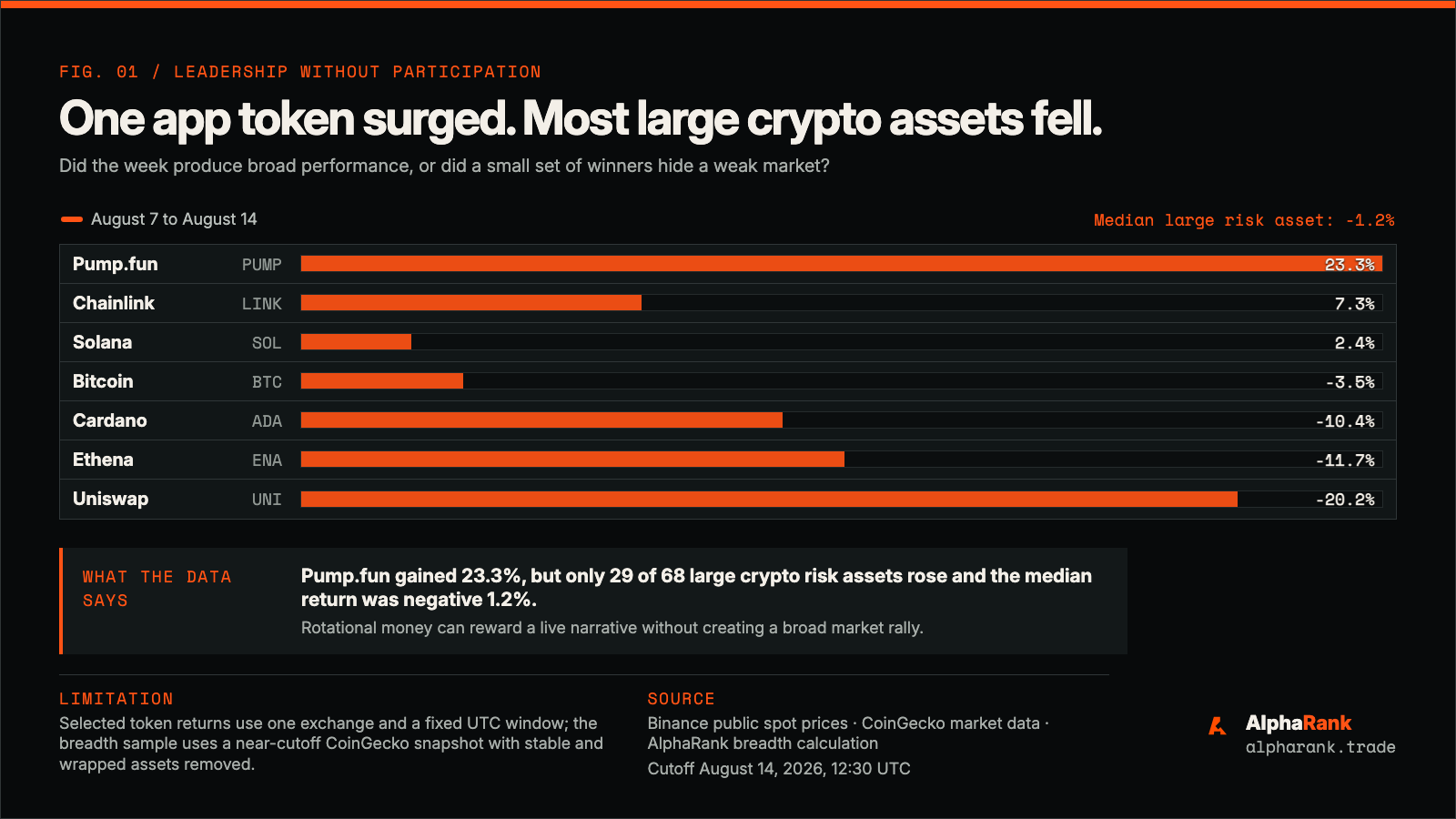
AlphaRank removed stablecoins, tokenized cash and credit funds, and gold wrappers from a large-asset sample. Of the 68 crypto risk assets left, 29 rose, 38 fell, and one was flat. The middle return was minus 1.2%. That is narrow performance: a few strong charts surrounded by more losers than winners.
PUMP gained 23.3% and Chainlink rose 7.3%. TAO, Solana, and BNB gained roughly 2% to 3%. Uniswap lost 20.2%, Ethena lost 11.7%, and Cardano lost 10.4%. Rotational money chased individual applications, infrastructure, and narratives. It did not lift the market together.
This was a narrow market. Altseason usually describes something much larger: retail traders return, gains spread, and euphoria builds across portfolios. A handful of winners does not meet that standard.
Strategy added supply for a second week. It sold 1,690 bitcoin for $108.6 million and used the proceeds to repurchase preferred shares. Last week's report established that the largest corporate holder can sell. The new information is that bitcoin now serves as an active capital-management asset, not only a permanent reserve. Strategy still held 840,447 bitcoin, so this was a change in how the treasury is used, not an abandonment of it.
More positions were opened, but the pool of ready cash barely grew.
Fund flows show demand through brokerage accounts. Stablecoins act like cash inside crypto. Open interest counts futures contracts that are still active. Together they separate new money from new bets.
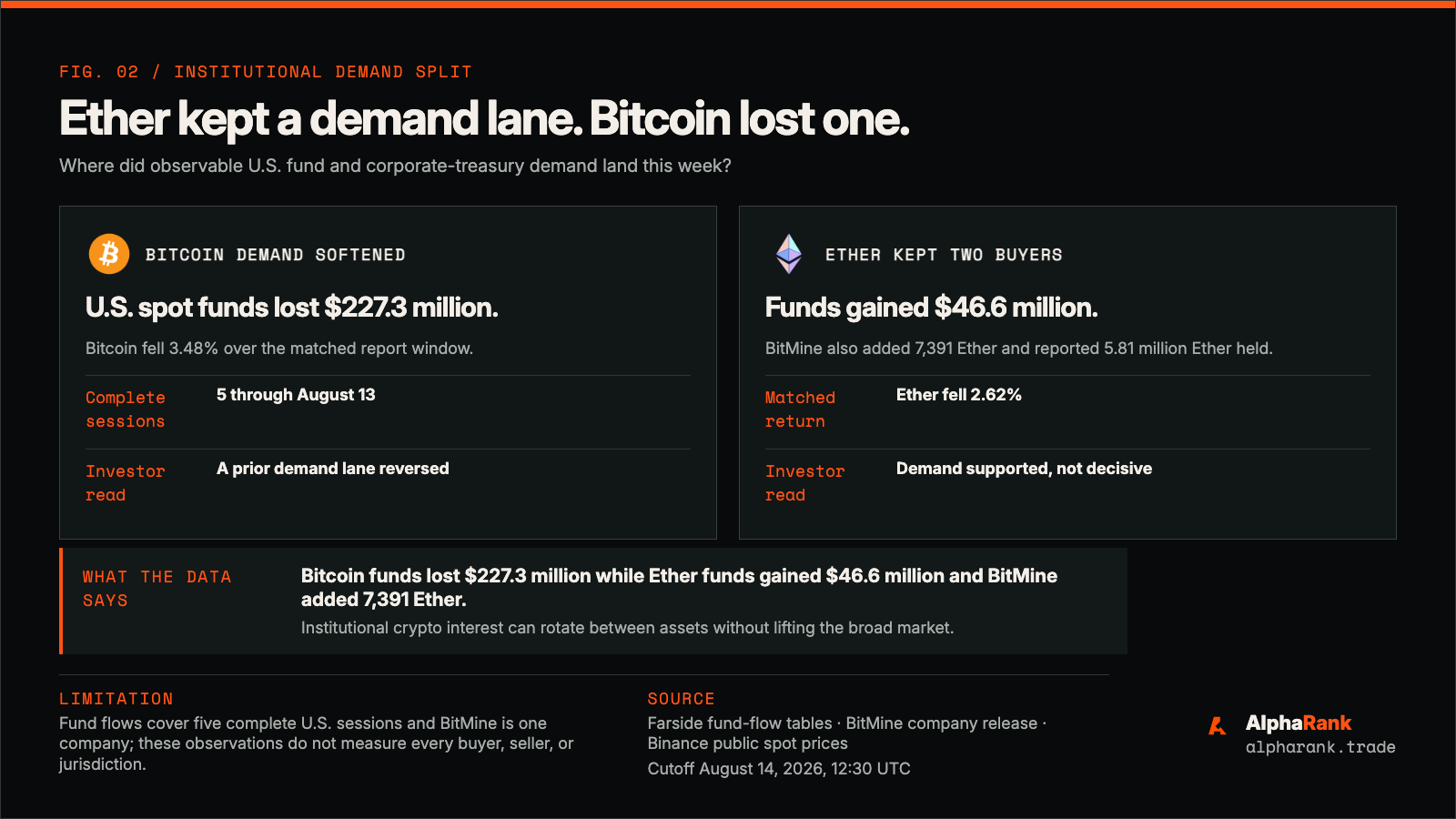
Across the five complete U.S. sessions from August 7 through 13, bitcoin exchange-traded funds lost a net $227.3 million. Ether funds gained $46.6 million. An exchange-traded fund, or ETF, is a regulated fund that can be bought through a normal brokerage account.
Stablecoin supply moved from $306.22 billion to $306.31 billion. The $92 million increase equals about three-hundredths of one percent. Crypto's internal cash pool was essentially flat.
Futures positions grew anyway. On OKX, Bitcoin open interest rose 13.3% and Ether open interest rose 7.4%. Open interest cannot tell us whether the market's net bet points up or down. The recurring fee exchanged between bullish and bearish traders stayed mild, which argues against an extreme one-sided position. It still left more contracts competing for almost the same cash.
Fidelity wants Ether's network rewards to arrive as cash
Fidelity amended its Ether fund registration on August 11. Under normal conditions, the draft says the fund may stake up to all of its Ether. Staking means committing Ether to help operate the network in exchange for rewards. The fund would pay 15% of those rewards to custodians and node operators, keep the remaining 85% for shareholders, and normally distribute the result as cash each quarter.
This is still a proposal, not a guaranteed payout. Staked Ether can take time to withdraw, operators can make mistakes, and rewards can change. The important shift is the path of value: an investor could buy a brokerage product and receive cash generated by Ethereum's network work without managing a wallet or validator.
The most valuable territory may be the customer's home screen.
A decentralized exchange, or DEX, lets a wallet trade through software instead of handing assets to a broker. Across tracked DEXs, seven-day volume fell 13.9% to $39.57 billion. PumpSwap moved the other way.
PumpSwap handled $4.00 billion over seven days, up 54.7%. Uniswap V4 handled $4.74 billion, down 22.2%, while Uniswap V3 handled $4.01 billion, down 25.2%. Provider coverage can change and volume is not profit, but activity clearly moved toward PumpSwap.
The private research network kept returning to a related fight. Fomo sells a social feed, one-tap trading, easy card funding, and a view of what other traders are buying. Pump combines token creation, trading, social features, a mobile app, and its own exchange. Both want to become the place where a customer discovers an asset and presses buy.
That front door matters because it controls attention and fees. A blockchain may process the trade, but the app that owns the customer can decide what appears on screen and where the order goes. Pump controls several steps: it can help create the token, attract the trader, and execute the trade inside one system. Fomo offers a simpler interface and a social feed that can send activity across markets.
PUMP gained 23.3% while UNI lost 20.2%. This was the week's clearest case of product use and token performance moving together. One week does not prove the link will last. PumpSwap needs repeat volume after the excitement fades, and investors still need to know how much product revenue reaches PUMP rather than the company or its users.
A fork failed, an audit improved, customers arrived, and a vendor leaked data.
Bitcoin's rules changed only for the people who chose the losing branch
BIP-110 proposed a temporary one-year limit on several ways people store large amounts of non-payment data in Bitcoin. Beginning at block 961,632, software following the proposal rejected blocks that did not signal support.
The main network kept accepting those blocks. The BIP-110 branch produced only a tiny amount of work and stalled almost immediately, while a public chain monitor showed the main chain continuing. The episode was technically a split, but not a second Bitcoin economy. Miners, exchanges, wallets, and users followed the chain with far more computing work and economic support.
Bitcoin governance is spread across miners, exchanges, wallets, and users rather than decided in one room. A rule becomes real only when enough of those groups coordinate around it. BIP-110's code defined a branch, but the market did not treat that branch as Bitcoin.
The next gains reached specific businesses
Tether said KPMG U.S. issued an unqualified opinion on the 2025 statements of Tether International. The statements reported $6.81 billion more reserves than token liabilities at year end. The audit covered one legal entity and historical statements, not every Tether company or current August conditions. It still raised the quality of evidence beyond a point-in-time reserve report.
Payward, the company behind Kraken, reported $508 million of adjusted quarterly revenue and 6.6 million funded accounts. The company counts distinct subaccounts rather than individual people. Customer growth was real, but its preferred measure of operating profit remained only $23 million.
BitMine added 7,391 Ether and reported 5.81 million Ether in total holdings. Most of that position was staked for network rewards. One corporate buyer kept accumulating even as Ether fell.
A secure device can still have an exposed customer
Trezor said a breach at shipping provider ShipMonk exposed customer data. Names, email addresses, phone numbers, and delivery addresses were exposed for 11,742 customers. Another 1,947 had a smaller set of information exposed. Trezor's devices, software, and funds were not compromised.
The danger moved from the wallet to the person. Someone who knows who bought a hardware wallet and where that person lives has better material for phishing, impersonation, or physical targeting. Self-custody removes exchange custody risk. It does not erase the data held by shipping, email, and support vendors.
The research network split over the same customer.
AlphaRank searched 6,742 ready long-form records and 484,963 collected X posts. Exact identities and private excerpts remain in the audit record. Public factual claims were checked against publishable evidence.
One group focused on access. Mobile apps, social feeds, easier funding, and better wallets now give ordinary users a much smoother path into crypto markets than the tools available in prior cycles. In that view, a fight among Fomo, Pump, wallets, and trading terminals is evidence that people may choose crypto products because they work well, not because they share an ideology.
Another group focused on ownership. A product can have customers and revenue while its token has no enforceable claim on either. For those analysts, user growth becomes investable only after they can trace the money from the customer to fees, profit, buybacks, burns, or a resource the token controls.
A separate market debate remained unresolved. The optimistic side sees exhausted sellers and improving products as the early stage of a bottom. The cautious side sees flat internal cash, divided fund demand, and narrow performance as proof that the market still lacks broad buyers.
Crypto products are getting easier to use.
- Mobile trading now feels like a consumer product.
- Stablecoin and exchange businesses reported real scale.
- Traditional funds are packaging network activity.
Does the token own the customer?
- An app can collect attention and fees.
- A company can own the profit.
- A token benefits only through a specific economic path.
Better products have not created broad demand.
- Most large assets did not rise.
- Stablecoin supply barely moved.
- Fund demand remained divided.
This is a source-blind synthesis of AlphaRank’s private research network. Exact identities, timestamps, and provenance remain in the internal audit ledger.
Follow one customer dollar until it stops moving.
A product story becomes an investment story only when the path from use to value is visible and repeatable.
Begin with participation. More than half the 68 screened large assets need to rise, and the middle return needs to move above zero. Until then, strong individual charts are rotational trades rather than proof that the whole market has turned.
Then check the cash. Stablecoin supply needs to grow by an amount that matters beside a $306 billion base. Bitcoin and Ether funds need several sessions of demand together. More futures contracts can create activity, but they are bets on future prices, not new cash today.
Finally, check who gets paid. PumpSwap needs to keep its users after PUMP's surge cools. Fidelity's staking proposal needs to survive review and show that rewards reach shareholders after fees. Payward needs to turn more funded accounts into durable profit. Token projects need a clear reason that product use benefits the token.
The bottoming case remains possible. If sellers cannot push prices lower despite flat cash and divided fund demand, the market may be quietly absorbing supply. That case becomes much stronger when participation broadens. Until then, adoption and broad token exposure remain different investments.
The proof calendar
More than 34 of the 68 screened assets need to rise, with a positive middle return.
Stablecoin growth needs to become visible beside the $306.3 billion total.
Bitcoin and Ether products need several sessions of demand together.
PumpSwap and social trading apps need repeat use after the week's excitement.
Fees, profit, rewards, buybacks, or burns must reach the asset an investor owns.
Sources & methodology18 public evidence surfaces · 1 source-blind synthesis · cutoff August 14, 12:30 UTC
Reader-facing claims link directly to the evidence they rely on. AlphaRank's private library was used to find connections, disagreements, and missing questions. Public claims were then verified independently. Private identities, excerpts, timestamps, and evidence IDs remain in the internal audit record.
- Matched spot-price windowsBINANCE
- Large-asset market participation snapshotCOINGECKO
- Global stablecoin supply historyDEFILLAMA
- U.S. bitcoin fund flowsFARSIDE
- U.S. ether fund flowsFARSIDE
- DEX and PumpSwap volumeDEFILLAMA
- Bitcoin and Ether open futures positionsOKX
- No-expiry futures fee historyOKX
- Fidelity Ether fund staking proposalSEC
- Strategy bitcoin sale and treasury holdingsSEC
- BIP-110 temporary data-limit proposalBITCOIN BIPS
- BIP-110 public chain monitorBIP-110 MONITOR
- Fomo trading-product documentationFOMO
- Pump trading-product documentationPUMP
- Tether entity audit announcementTETHER
- Payward Q2 operating resultsPAYWARD
- BitMine Ether holdings updateBITMINE
- Trezor shipping-provider incidentTREZOR
- AlphaRank source-blind weekly synthesisINTERNAL
Window. August 7 at 12:45 UTC through August 14 at 12:30 UTC. Later moves and revisions are excluded.
Returns. Matched Binance one-minute spot windows are used for named assets where available. CoinGecko supplies the broader snapshot.
Participation. The large-asset sample removes stablecoins, tokenized cash and credit funds, and gold wrappers. A 0.05-point band defines flat.
Positioning. Open interest and funding describe OKX only. They are not global market totals.
Fund flows. Totals cover the five complete U.S. sessions from August 7 through 13. The incomplete August 14 session is excluded.
Provider data. Stablecoin and trading-app aggregates use provider-defined coverage and do not establish direct causality.
Fund proposal. Fidelity's filing is preliminary. It describes proposed staking and cash distributions, not a final approval or guaranteed operating policy.
Bitcoin fork. The BIP document defines the proposed rules. Public monitor data establishes the branch result; it does not measure every user's preference.
Product claims. Fomo and Pump feature descriptions come from the products' own public materials. They establish available interfaces, not user quality, retention, or profitability.
Company metrics. Payward and BitMine figures are company-reported. Adjusted measures and account definitions are not standardized.
Audit scope. Tether's announcement concerns one entity's year-end 2025 statements. It does not establish current conditions across every related entity.
Private research. Evidence IDs, identities, timestamps, and context remain in the internal audit ledger.
Use. Observations and scenarios are research, not investment advice or recommendations.