Markets Finally Got Relief. It Came for the Wrong Reason.
Inflation cooled and employers cut jobs. The Federal Reserve can wait, but borrowing costs, Treasury cash, and global risks still constrain markets.

- Coverage
- Global economy / Interest rates / Money flows / Markets
- Evidence cutoff
- August 12 · 15:15 UTC
Chapters
The Fed can wait. Borrowers still cannot relax.
Inflation cooled, but employers stopped adding jobs. That makes another Federal Reserve rate increase less likely. It does not make mortgages, corporate loans, or market funding cheaper today.
- Hiring went backward. U.S. payrolls fell by 23,000 in July, and May and June were revised down by a combined 103,000. The slowdown began earlier than the first estimates showed.
- Inflation opened the door to a pause. Prices excluding food and energy slowed to 2.5% from a year earlier. The Fed has less reason to raise rates again, although energy can still restart the problem.
- The rates that reach borrowers stayed high. Long-term Treasury yields rose over the week. A Fed pause does not automatically lower mortgage rates or the cost of financing a business.
- Markets did not confirm an easy-money boom. Growth stocks and gold rose, but long bonds barely moved, the dollar held firm, and Bitcoin was lower at the evidence cutoff.
Employers stopped adding jobs before mass layoffs began.
The United States lost 23,000 payroll jobs in July. May and June together had 103,000 fewer jobs than first reported. A slowdown that looked recent had already been running for months.
The Bureau of Labor Statistics reported gains in health care, but losses in local-government education, retail, and finance. Temporary layoffs rose by 153,000. Average hourly pay grew 3.2% from a year earlier. But after consumer inflation, hourly earnings fell 0.2%. Workers with jobs did not face a pay collapse, but their purchasing power still slipped.
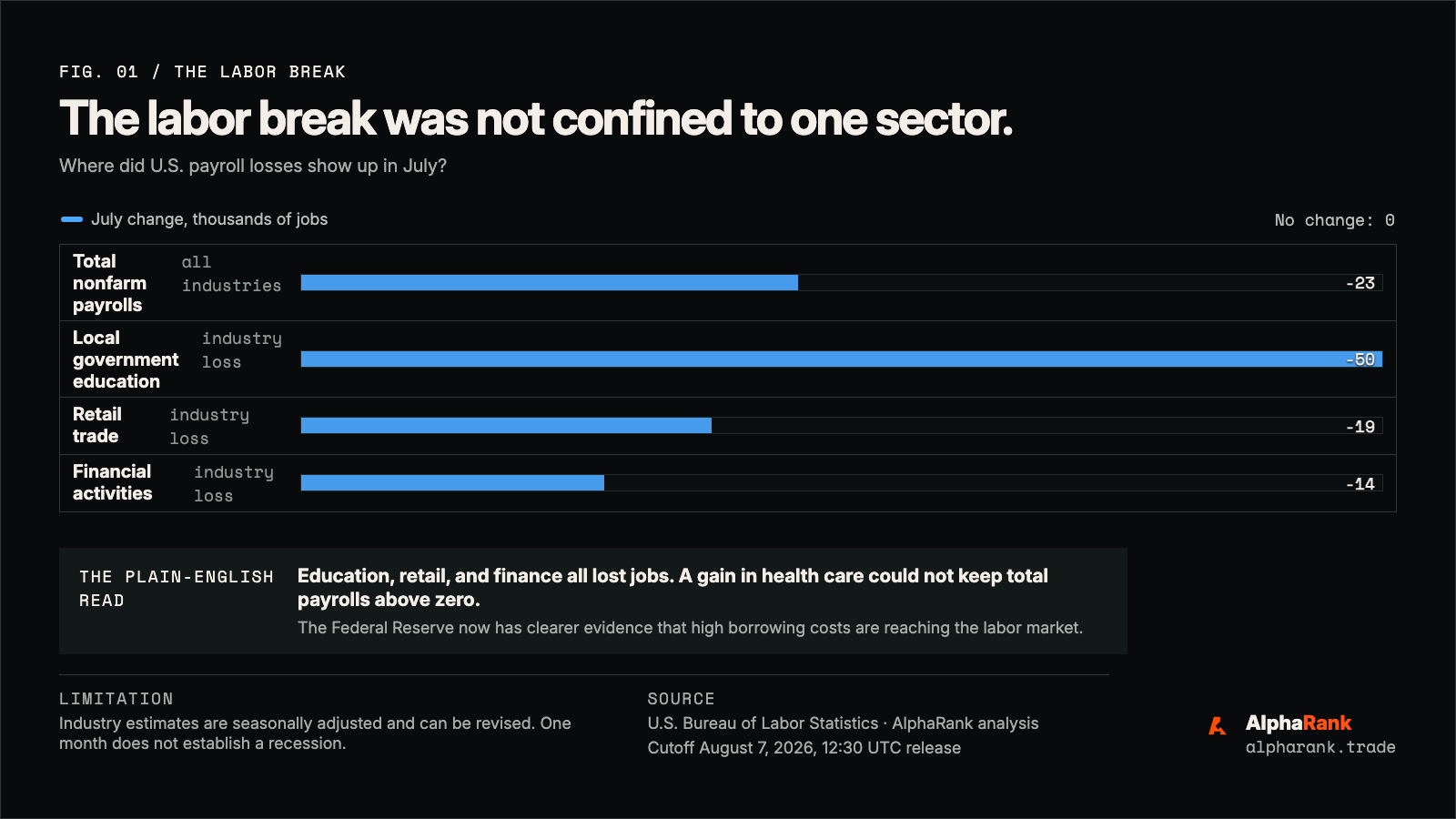
The unemployment rate counts people who have a job or are actively seeking one. Fewer people were looking for work, which kept the rate steadier even as hiring weakened.
Companies are leaving roles empty, delaying new stores, and reconsidering expansion before they resort to broad layoffs. High borrowing costs have reached the real economy. That gives the Fed a reason to stop pressing harder, but it also raises the risk that income and spending weaken before cheaper credit arrives.
Prices cooled enough for the Fed to stop pressing harder.
July's consumer price index rose 0.1% during the month and 3.4% from a year earlier. Core inflation removes volatile food and energy prices to reveal the underlying trend. It rose 0.2% during the month and slowed to 2.5% from a year earlier.
The shelter improvement was real, but uneven.
The broad shelter index rose 0.1% in July and 3.2% over the year. Hotel and motel prices fell 2.8%, helping the monthly number. The longer-lasting rent measures each rose 0.3%, so housing pressure slowed without disappearing.
The monthly drop did not erase the shock.
Energy fell 1.5% in July but remained 14.7% above a year earlier. Gasoline was still 24.6% higher. Household relief is real, but the comparison with last year remains painful.
Grocery pressure eased slowly.
Food prices rose 0.1% in July and 3.0% over the year. That is not a new inflation wave, but it still exceeds the Fed's 2% goal.
At its July meeting, the Fed held its policy rate at 3.50% to 3.75%. Three of twelve voters wanted an increase. The new jobs and inflation reports make another increase harder to justify.
A quick cut is not guaranteed. The Fed's preferred inflation measure is called the price index for personal consumption expenditures, or PCE. Its latest core reading was still 3.3%. One favorable consumer-price report gives officials time; it does not prove inflation is finished.
The Fed controls a very short-term rate. A pause removes the threat of another increase. Most families and companies borrow for years, so they still need longer-term rates to fall.
The Fed can pause while mortgages and corporate loans stay expensive.
The two-year Treasury yield, which moves closely with expectations for Fed policy, ended August 11 at 4.22%. The ten-year finished at 4.70%, and the thirty-year at 5.24%. All three were higher than on August 5, according to the Treasury's official daily rates.
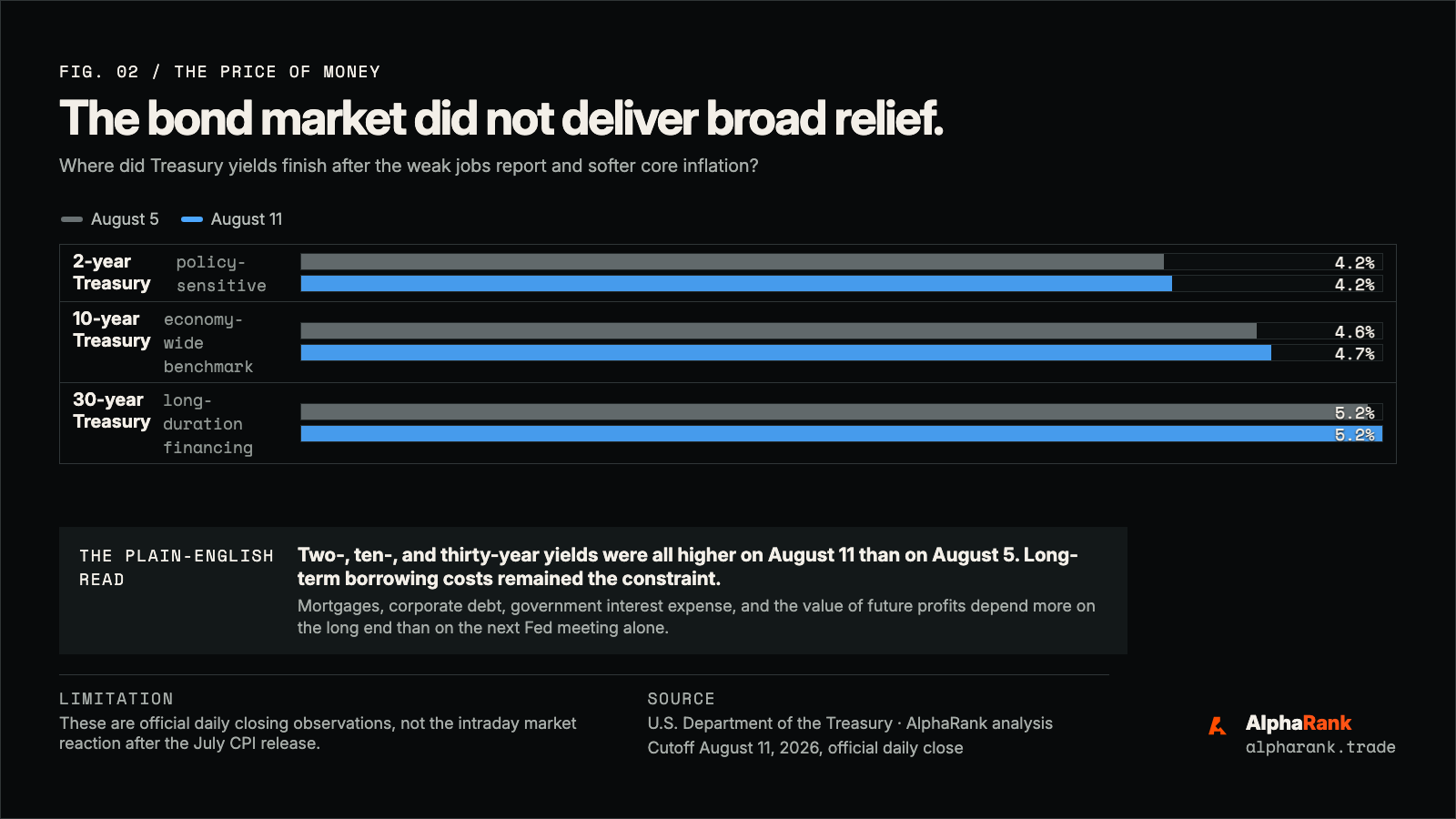
The ten-year real yield, which subtracts expected inflation from the nominal rate, was 2.43% on August 11. That is the cleanest measure of how expensive long-term money remains after inflation is removed.
A family feels that rate through a mortgage. A company feels it when a factory, acquisition, or data center no longer earns enough to justify the loan. Investors feel it when profits expected years from now become less valuable today. The Fed can stop raising its overnight rate and still leave all three under pressure.
The reason yields fall will matter. Lower inflation would reduce borrowing costs without damaging demand. A credit scare could also pull yields down, but only because investors fear something is breaking.
Treasury pulled about $38 billion into its checking account.
The Treasury General Account is the federal government's checking account at the Fed. It rose from $929.3 billion on August 5 to $966.9 billion on August 10. When Treasury rebuilds that account, cash moves out of banks and investors and into the government account until the government spends it again.
A $37.5 billion drain.
The cash rebuild absorbed money that could otherwise sit in markets or banks over five calendar days. That makes stocks, crypto, and other riskier markets less forgiving even when the banking system remains functional.
- Aug. 5
- $929.3B
- Aug. 10
- $966.9B
The system still had a buffer.
Reserve balances rose by $8.8 billion in the week through August 5 to $2.99 trillion. The latest weekly reading does not show a reserve shortage.
- Reserve level
- $2.99T
- Weekly change
- +$8.8B
No stress spike appeared.
The Secured Overnight Financing Rate, the main rate for overnight loans backed by Treasuries, was 3.64% on August 11. Investors parked only $1.25 billion overnight at the Fed through its reverse-repo facility, so that old cash cushion is nearly empty.
- SOFR
- 3.64%
- Reverse repo
- $1.25B
Treasury removed cash, but banks kept lending to one another normally. That distinction matters. This was pressure, not a funding accident. Stocks and crypto can absorb a slow drain when earnings, hiring, and credit are strong. They become less forgiving when the same drain meets weaker growth and expensive debt.
Oil, Japan, and China can still complicate the improvement.
The U.S. story does not operate alone. Shipping risk can revive inflation, higher Japanese rates can lift borrowing costs elsewhere, and weak Chinese demand can weigh on global growth.
Cheaper gasoline did not remove the supply risk.
The International Energy Agency calls the 2026 conflict the largest oil-supply disruption on record. By August 12, talks had bogged down over control of the Strait of Hormuz, while the Red Sea route remained risky. A fresh disruption would raise fuel and freight costs before higher rates could create more supply.
Higher local yields could travel.
Bank of Japan participant opinions released August 10 said inflation risks deserve more attention, and several participants argued for continued or faster rate increases. These were individual views, not a policy decision. If Japanese bonds pay more, the country's large insurers and pension funds have less reason to buy foreign debt, which can push borrowing costs higher elsewhere. This report found no proof that Japan sold U.S. Treasuries this week.
Consumers and factories tell different stories.
Consumer prices rose only 0.5% from a year earlier, while factory-gate prices rose 3.5%. Weak household demand is meeting higher production costs, which can squeeze company margins.
The latest U.S. petroleum report provided a short-term cushion: commercial crude inventories jumped after imports rose. Gasoline and diesel supplies still sat below their normal five-year ranges. Europe also remains exposed to imported energy while banks have tightened some business-lending rules. The global picture is not a synchronized move toward cheaper money.
Stocks liked lower inflation. Bonds, the dollar, and Bitcoin stayed cautious.
At the August 12, 15:15 UTC cutoff, growth-heavy stocks and gold led. Long Treasury bonds barely moved, the dollar did not weaken, and Bitcoin was lower over its own 24-hour window. Investors welcomed the inflation news without embracing a broad rush into risk.
Growth stocks led; credit stayed calm.
QQQ, a fund that tracks the growth-heavy Nasdaq-100, rose 0.83%. The broader SPY fund gained 0.21%, while HYG, a fund holding lower-rated corporate bonds, added 0.13%. Investors rewarded companies whose future profits benefit most from lower inflation, and corporate credit showed no sign of panic.
Cheaper money was not a market-wide conclusion.
TLT, a fund tracking long-term Treasury bonds, rose only 0.10%. UUP, a fund that rises with the U.S. dollar, gained 0.07%. If investors had embraced a broad easing wave, long bonds would normally rally more and the dollar would tend to weaken.
Protection beat broad risk-taking.
The GLD gold fund rose 1.32% while the USO oil fund fell 0.47%. Cheaper oil helps inflation, but stronger gold shows demand for protection remained. Bitcoin was $63,447 and down 0.47% over 24 hours at 15:13:40 UTC, so crypto did not confirm a worldwide rush into risk.
These exchange-traded funds are tradable baskets used here as market stand-ins; they are not the underlying index, bond yield, dollar, gold, or oil. Nasdaq's last-trade stamps were 11:14 a.m. ET. Bitcoin uses CoinGecko's rolling 24-hour window, so the returns are not perfectly synchronized.
Risk assets usually want stronger growth, cheaper money, or both. This week delivered neither cleanly. Growth weakened, while the borrowing costs and market cash that support stocks and crypto remained restrictive.
The network did not agree on what the slowdown means.
AlphaRank's private research review did not produce a clean consensus. It kept returning to two explanations for the same facts. Hiring weakened, underlying inflation cooled, and long-term borrowing stayed expensive. One reading sees a controlled slowdown that gives the Fed room to wait. The other sees the delayed cost of high rates beginning to reach jobs and income.
The economy is cooling without broad layoffs.
New unemployment claims remained below the comparable week a year earlier, while output per hour kept rising. If spending holds, July's payroll decline may prove to be a pause rather than the start of a recession.
High rates are reaching employment before borrowing gets cheaper.
Payrolls fell and prior months were revised lower, while the ten-year real yield remained high. Hiring and income could weaken before mortgages, company loans, and market financing provide relief.
Policy relief became more possible, but the reason matters. Lower inflation reduces the need for tighter policy, while weaker hiring raises recession risk. The clean outcome requires jobless claims and spending to hold while long-term rates fall. If layoffs rise first, markets may get cheaper money only because recession risk is climbing.
This can still become a soft landing.
A soft landing means inflation falls without a recession. It remains possible if hiring stabilizes before household spending breaks, oil stays contained, and long-term rates fall as investors become less worried about inflation.
Two releases keep that case alive. New applications for unemployment support were 199,000 in the week ending August 1, below the comparable week a year earlier. Output per hour rose at a 1.4% annual rate in the second quarter, while labor cost per unit of output rose 1.3%. Businesses were still producing more efficiently, and widespread layoffs had not appeared. That does not erase the payroll warning, but it argues against declaring a recession from one report.
Shelter and core inflation both slowed.
If jobless claims remain controlled and retail sales hold, July payrolls may mark a cooling step rather than a collapse.
Claims rise while long yields stay high.
That combination would mean households lose income before borrowing costs provide relief. A renewed oil shock would make the mix worse.
Watch jobs, inflation, borrowing costs, and spending.
Hiring must stabilize before layoffs spread.
Watch weekly applications for unemployment support and the next payroll report. A rising unemployment rate would matter more if people are still actively looking for work.
Price pressure must keep cooling beyond one report.
Producer prices arrive August 13. The Fed's preferred PCE inflation measure arrives August 26 beside household income and spending.
Long-term rates must fall for the right reason.
Treasury auctions test investor demand for government debt. Falling real yields would help borrowers; rising company borrowing costs would warn of stress.
Households and company earnings must hold.
July retail sales arrive August 14. Stable spending would show that weaker hiring has not yet become a broad loss of demand.
Stocks and Bitcoin can rally before all four tests pass. That would show investors are willing to take risk, not that the economy is healthy. Treat the improvement as durable only when hiring stabilizes and borrowing costs fall because inflation is easing. Rising layoffs, weaker spending, and companies paying increasingly more than the government to borrow would point toward recession instead.
Sources and methodologyPrimary releases, central-bank records, market data, and AlphaRank analysis that protects internal source identities
Every material public claim is supported by public evidence. AlphaRank's internal research process was used to find leads, contradictions, and omissions, never as a substitute for the sources below.
- BLS July employment reportBLS.GOV
- BLS July consumer pricesBLS.GOV
- BLS July real earningsBLS.GOV
- BEA June income, spending, and PCE pricesBEA.GOV
- BLS second-quarter productivityBLS.GOV
- Labor Department unemployment claimsDOL.GOV
- Federal Reserve July decisionFEDERALRESERVE.GOV
- Treasury nominal yield curveTREASURY.GOV
- Treasury real yield curveTREASURY.GOV
- Daily Treasury cash balanceFISCALDATA.TREASURY.GOV
- New York Fed SOFRNEWYORKFED.ORG
- Reserve balancesSTLOUISFED.ORG
- Overnight reverse repoSTLOUISFED.ORG
- BOJ participant opinionsBOJ.OR.JP
- ECB July bank lending surveyECB.EUROPA.EU
- China July consumer pricesSTATS.GOV.CN
- China July producer pricesSTATS.GOV.CN
- IEA chokepoint monitorIEA.ORG
- IMO Strait of Hormuz hubIMO.ORG
- AP Hormuz talks and Red Sea updateAPNEWS.COM
- EIA weekly petroleum summaryEIA.GOV
- Nasdaq intraday ETF quotesNASDAQ.COM
- U.S. high-yield corporate spreadSTLOUISFED.ORG
- Bitcoin price and 24-hour changeCOINGECKO.COM
- BLS producer-price scheduleBLS.GOV
- Census retail-sales scheduleCENSUS.GOV
- Federal Reserve August calendarFEDERALRESERVE.GOV
- Treasury auction scheduleTREASURY.GOV
- BEA release scheduleBEA.GOV
- BLS August release scheduleBLS.GOV
Window. Primary window August 5-12, 2026; older context appears only when it still changes the story.
Evidence cutoff. August 12, 2026 at 15:15 UTC. Market observations carry the instrument, source, and observation time in the private ledger.
Source records. Exact source records stay in the internal evidence ledger. Public output uses publishable sources or approved AlphaRank analysis that protects private source identities.
Evidence labels. Direct observations, public-body assessments, and AlphaRank interpretations are kept separate in the research packet.
AlphaRank TLDR is independent analysis for informational purposes only. It is not investment, legal, tax, or accounting advice.