Who Pays for AI’s $500 Billion Promise?
Six financing targets added up to the number that dominated AI news. The agreements map who may fund the next wave of data centers, who gets paid first, and who holds expensive hardware if demand disappoints.

- Coverage
- AI / Open Models / DeAI / AiFi
- Evidence cutoff
- August 17 · 18:51 UTC
Chapters
The AI buildout is starting to look like infrastructure finance.
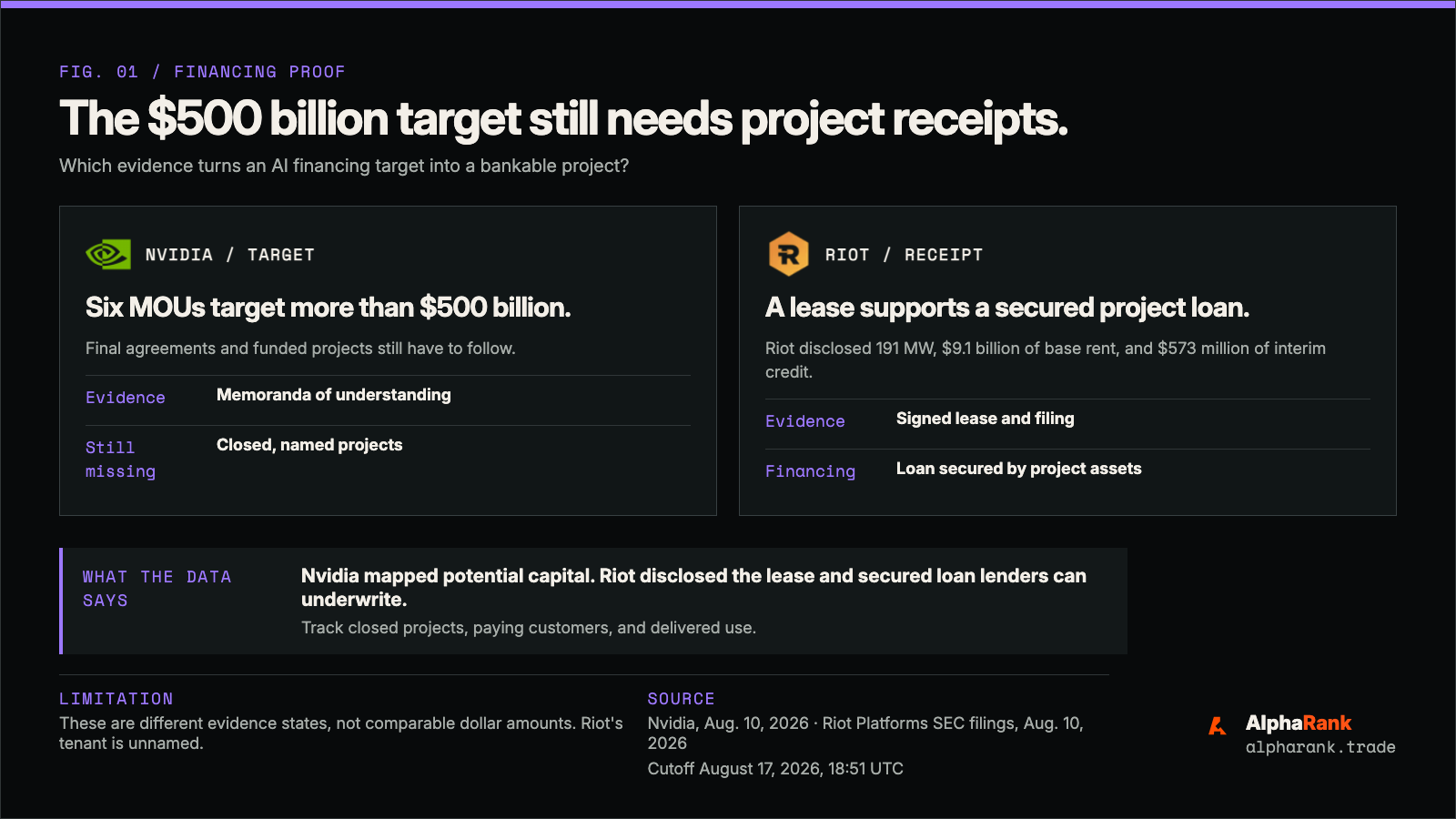
- Six MOUs make up Nvidia’s $500 billion target.Nvidia signed memoranda of understanding with six major financial firms. Their platforms aim to mobilize more than $500 billion of third-party capital. Final agreements and funded projects still have to follow.
- Long leases move risk away from AI labs.Labs can reserve capacity without owning every data center. Operators build and run the sites. Lenders underwrite the customer and the physical collateral. Nvidia may support part of a qualifying project’s residual value.
- Ohio shows the structure more clearly than the headline.OpenAI is the long-term customer, SB Energy is the builder and operator, and Nvidia supplies the compute and credit support. The first capacity is planned for 2028, so execution remains ahead.
- Riot supplied the week’s strongest executed receipt.Its 191-megawatt Texas lease runs for 20 years and carries $9.1 billion of base rent. A separate $573 million facility shows lenders funding an asset against the lease and collateral.
- Smaller models are the pressure test.Meta’s Muse Glimmer can run locally. Google, DeepSeek, Mistral, and Grok also moved price or efficiency. If useful work needs less centralized compute, long-lived GPU economics get harder to underwrite.
- Agentic finance has an open demand test.Brian Armstrong called crypto the currency of “AiFi”. Coinbase reports strong x402, Base, and USDC shares. Durable demand still requires named independent agents, repeat external revenue, concentration, and failure data.
- Decentralized AI still lacks the receipt that matters.Bittensor, Akash, Render, Virtuals, and the ASI ecosystem remain relevant to open coordination. This week produced no verified, material new external customer demand for their networks.
The week was a stack of contracts at different stages.
Read these in order. Each moves the story from an ambition to finance AI infrastructure toward a specific allocation of customer, construction, collateral, and technology risk.
The figure combines third-party platform targets. Funded projects still have to follow.
Open source ↗ A signed 20-year lease anchors 191 megawatts.The contract and interim loan are firmer evidence than an aggregate financing target.
Open filing ↗ A multi-year inference agreement adds a paying-workload signal.It supports demand, though the public announcement does not disclose economics.
Open source ↗ Muse Glimmer put an agentic model on local hardware.Local execution is a practical counterweight to ever-larger centralized inference.
Open source ↗ Claude added a text-watermarking control.Trust and provenance kept moving into product design as agents gained reach.
Open source ↗ Ohio connected a long lease to staged delivery.The project is concrete enough to map the roles and early enough to retain construction risk.
Open source ↗ Nvidia paired exclusive supply with credit support.The chip vendor moved closer to the financing structure while keeping project terms private.
Open source ↗The number marks a financing destination.
Nvidia’s announcement matters because the largest private-capital firms are building repeatable ways to finance AI compute. It becomes misleading when the target is reported as capital already raised.
A memorandum of understanding records an intended working relationship. It is lighter than a final financing agreement and far lighter than cash wired into a project. Nvidia signed separate MOUs with Apollo, BlackRock, Blackstone, Brookfield, Goldman Sachs, and KKR. Add their platform targets together and the total exceeds $500 billion.
The platforms may finance data centers, power, cooling, networking, and Nvidia systems. Each project still needs a customer, a site, permits, equipment, construction, and credit approval. Nvidia said support could be offered project by project and may cover up to 25 percent of residual value in qualifying structures. That ceiling is not a disclosed $125 billion commitment.
Wall Street is preparing to fund AI capacity as infrastructure. The financing follows bankable contracts. The aggregate target is a ceiling, with funded balances still undisclosed.
A repeatable platform can let a lab reserve compute without paying every construction bill upfront, while a specialist operator owns the physical asset. Pension, insurance, bank, and private-credit money can enter the buildout. Each new financier adds another claim on the customer’s future payment.
OpenAI gets capacity. The lease, loan, and hardware support decide who absorbs a miss.
Ohio makes the roles visible. OpenAI agreed to become the long-term customer for the Ports Pike campus. SB Energy plans to build, own, and operate the site. Nvidia will be the exclusive compute supplier, invested $1.5 billion in SB Energy, and agreed to support early land, power, and shell obligations. Public statements describe roughly eight gigawatts of technology capacity, with an initial 800 megawatts planned for 2028 and the wider build stretching through 2032.
Those facts show commitment and delay at the same time. OpenAI pays as capacity arrives. SB Energy must deliver a functioning campus. Lenders will care about OpenAI’s ability to pay and the value of the collateral. Nvidia gains hardware demand and accepts some ecosystem or residual exposure. Utilities and communities face grid, water, permitting, and political pressure. Equity owners stand behind everyone else.
The public announcements do not disclose the rent, the financing stack, the amount or triggers of Nvidia’s support, or the remedies if schedules slip. Those omissions are normal for a commercial deal. They are also the terms an investor would need before treating the capacity as fully financed.
Riot’s Texas filing is more useful as a finished receipt. The company signed a 20-year lease for 191 megawatts and disclosed $9.1 billion of base rent. It also arranged a $573 million interim credit facility led by Morgan Stanley. The loan is secured by project assets and described as generally non-recourse to Riot, so lenders look first to the project and its contracts rather than the whole parent company.
The tenant’s name is not in the filing. Reports have identified Anthropic, but the primary document does not confirm that identity. The economics stand without it: a long customer obligation makes an asset easier to finance, and a financed asset lets the customer avoid owning the entire site.
Vendor support draws in capital while blurring where demand ends and financing begins.
The skeptical reading starts with a chip vendor helping to finance the infrastructure that buys its chips. A lab signs a long contract, and outside lenders rely on both names. Revenue can arrive before final users prove they will pay enough for the resulting AI services.
Manufacturers have supported customers, dealers, aircraft buyers, and energy projects for decades. Here, the credit questions are concentration and loss absorption. Does the project have an independent paying customer? Is the lease enforceable? How much equity stands below the debt? What happens when the hardware is older? How large is the vendor’s support compared with the project?
The strongest countercase is rational specialization. Labs should not have to become utilities and real-estate developers. Operators can build data centers more efficiently. Credit investors can price contract and collateral risk. Nvidia can support a limited slice because it understands the equipment and benefits from a larger installed base. If usage, renewals, and cash payments arrive, the financing is a bridge to productive infrastructure.
The bear case wins when customers delay capacity, renegotiate leases, or fail to turn compute into revenue; when a small set of labs supports too much collateral; or when resale values fall faster than lenders assumed. The bull case wins when closed projects attract independent capital without widening vendor guarantees and when completed capacity stays busy.
Every efficiency gain competes with a long-lived compute assumption.
Meta’s Muse Glimmer has 30 billion parameters and is designed to run on local hardware. Open weights let a company operate the learned parameters itself, though they do not reveal every part of the training process. Local execution can keep sensitive data closer, lower latency, and reduce dependence on a centralized provider.
Price pressure arrived from several directions. Google introduced Gemini 3.7 Flash. DeepSeek changed its model lineup and pricing. Mistral paired regional inference with open models and new compute. Grok 4.6 also entered with explicit usage pricing. The details differ, but providers are still competing on useful work per dollar.
Efficiency can increase total compute. Cheaper inference can create more uses in the way cheaper bandwidth created more internet traffic. The underwriting problem is narrower: a lender financing today’s hardware needs to know whether a project can keep earning after models get smaller, chips improve, and prices fall.
That is why utilization matters more than announced gigawatts. A large reservation can signal demand. Repeated, paid workloads tell us whether the economics survived contact with customers.
Products moved faster than the financing story alone suggests.
- Inference moved toward lower latency.OpenAI previewed an ultrafast service with Cerebras. Speed can create new product behavior, but the announcement did not disclose enough economics to compare margins.
- Model provenance became a product feature.Anthropic introduced text watermarking for Claude. The test is whether platforms and users can rely on it without treating a probabilistic signal as proof.
- Agents reached developer workflows.xAI introduced Grok Bot. The release matters less as another chatbot and more as evidence that model companies want a place inside the software-production loop.
- Open-source inference won an enterprise distribution channel.IBM and Together AI announced a multi-year agreement on IBM Cloud using Nvidia infrastructure. The customer economics were not public, so this counts as demand evidence, not margin proof.
- Crypto gave agent payments a new label.Brian Armstrong called the category “AiFi,” or agentic finance. The phrase arrived this week, while Coinbase’s payment stack predates it. x402 lets software pay for an online resource inside the same request.
The argument is over whether finance is confirming demand or compensating for its uncertainty.
One camp sees a normal maturation. AI is becoming essential infrastructure, capital is moving to the owners best equipped to hold long-duration assets, and limited vendor support helps a young market reach scale. Ohio and Riot look like early templates for the buildout.
The other camp sees off-balance-sheet debt and circular demand. Labs reserve capacity far beyond current cash generation, operators borrow against long contracts, and Nvidia supports the hardware market that drives its own revenue. In that view, the financing chain can postpone the moment when final-user economics are tested.
AlphaRank’s current read starts with the contracts. They prove a change in financing structure while the $500 billion demand claim remains unproven. Executed leases, closed debt, delivered capacity, utilization, renewal, and shrinking vendor support will decide which interpretation survives.
The missing public proof is a clean, non-overlapping tally of closed projects tied to unaffiliated paying customers. Announced gigawatts cannot be added across different units, dates, legal commitments, and project scopes.
AiFi has payment rails. Its independent customer receipt is still missing.
Coinbase is calling the crypto payment layer for software agents agentic finance, or AiFi. The mechanism is concrete. x402 turns an online resource into something a machine can pay for inside the same request. Coinbase’s agent wallet supports automatic USDC payments with spending limits that the agent cannot change.
Coinbase reported that more than 97 percent of onchain agentic transactions used x402 in the second quarter, more than 90 percent of agentic stablecoin volume ran on Base, and more than 99 percent of agentic commerce used USDC. Those figures show distribution inside Coinbase’s defined market. They do not disclose what qualifies as an agentic transaction, unique agents or merchants, repeat external revenue, payer concentration, incentives, refunds, or failure rates.
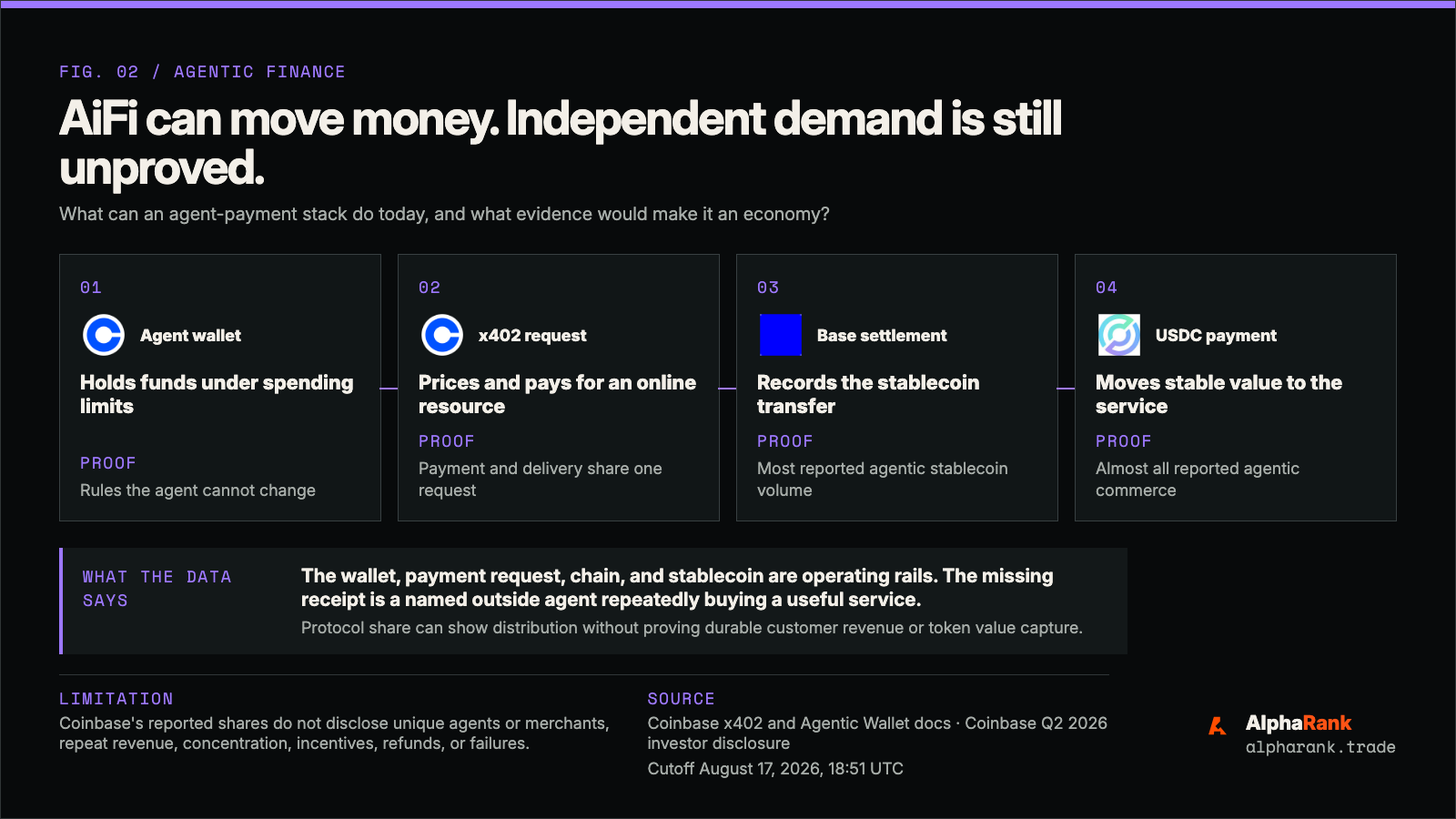
AiFi is payment infrastructure with an open demand test. Proof requires named independent agents making repeat, useful payments to outside services, followed by disclosed revenue, controls, and value capture.
Open networks could also coordinate compute, models, data, verification, and agents across independent participants. Smaller local models strengthen that possibility because useful work can happen outside a single cloud.
This week’s evidence did not show material new external customers paying Bittensor, Akash, Render, Virtuals, or the ASI ecosystem for production AI work. Token activity, partnership language, and internal incentives do not clear that bar. The gap does not prove decentralized AI will fail. It keeps the investor burden where it belongs: named customers, repeat usage, revenue, margins, and a clear route from network activity to the token.
Follow contracts, utilization, and loss protection. Ignore the largest noun in the press release.
- 01Closed capital
How much money reached projects under final agreements, and how much remains an MOU target?
- 02Independent customers
Are several unaffiliated customers paying, or does one lab support most of the collateral?
- 03Delivered use
Is capacity operating and paid for, or still measured as a future gigawatt?
- 04Residual support
How much loss remains with the operator, lenders, equity, and Nvidia if hardware values fall?
- 05Efficiency pressure
Can smaller local models or lower inference prices perform the same work before the debt matures?
By August 17, 2027, the financing case should show at least $25 billion of non-overlapping closed projects across two platforms, three unaffiliated paying customers, and vendor support no greater than 25 percent of project value. Earlier cancellation, deferral, or restructuring of more than a quarter of announced capacity would push the evidence the other way.
Customers pay through long contracts; operators and lenders fund the build; Nvidia sells the equipment and may absorb a limited slice of residual risk; equity takes what remains. The $500 billion promise becomes real when that chain produces delivered, paid, useful compute.
Sources & methodology15 public evidence surfaces · 1 source-blind synthesis · cutoff August 17, 18:51 UTC
Reader-facing claims link to the evidence they rely on. AlphaRank’s private library was used to find mechanisms, disagreements, and missing questions. Public facts were then verified independently. Private identities, excerpts, timestamps, and evidence IDs remain in the internal audit record.
- Six AI infrastructure financing platformsNVIDIA
- AI factory financing explanationNVIDIA
- Ports Pike customer and delivery structureOPENAI
- Ports Pike supply and credit supportNVIDIA
- Riot data-center lease announcementSEC
- Riot quarterly filing and credit facilitySEC
- Muse Glimmer local agentic modelMETA
- Claude text watermarkANTHROPIC
- Gemini 3.7 FlashGOOGLE
- August model and pricing updateDEEPSEEK
- Regional inference and open modelsMISTRAL
- Multi-year open inference agreementIBM
- AiFi narrative catalystBRIAN ARMSTRONG
- x402 payment mechanism and cumulative countCOINBASE
- Q2 agentic transaction sharesCOINBASE IR
Window. August 10 through August 17, 2026. Later claims and revisions are excluded.
Contract status. MOUs, leases, loans, investments, and operating capacity are treated as different evidence.
Capacity. Gigawatt announcements are not added across incompatible units, dates, counterparties, or legal commitments.
Private research. Source identities and corpus material remain in the internal evidence ledger.