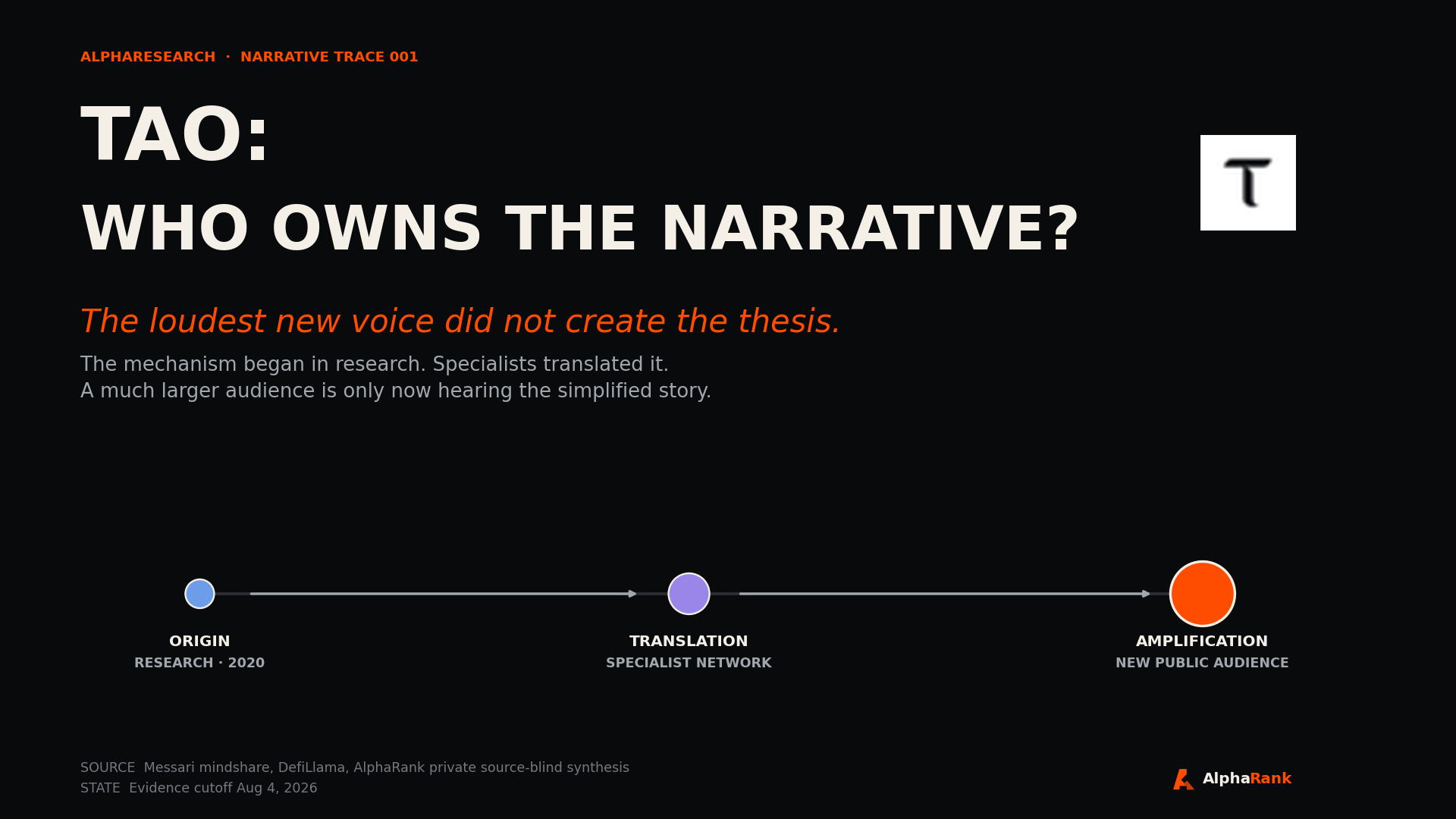
TAO: Who Owns the Narrative?
A viral claim says one famous investor is almost single-handedly keeping TAO in the conversation. Our evidence says no. Bittensor's story began with researchers, passed through builders and specialists, and is only now reaching generalist investors. But the louder conversation still depends on surprisingly few voices.

- Coverage
- Bittensor / TAO / Social Narrative
- Evidence cutoff
- August 4 · 14:21 UTC
Chapters
Jason is not the whole story. The real story is still too concentrated.
- Jason did not create the TAO thesis.He is a late-stage amplifier: someone who carries an existing idea to a much larger audience. Bittensor's core idea appeared years earlier in its technical research and network design.
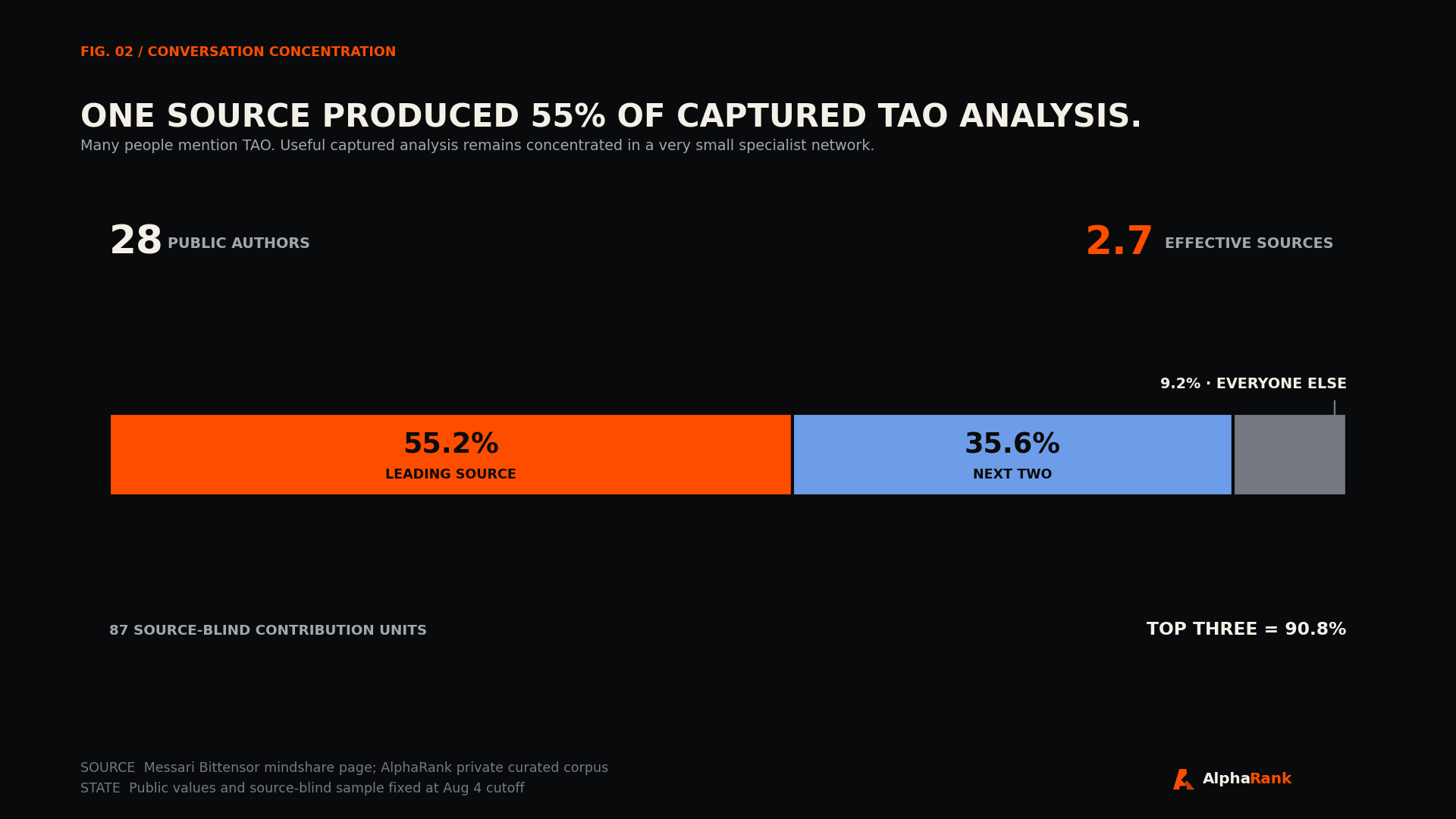
- The conversation is larger than one person, but it is not broad.Messari counted 28 authors discussing Bittensor at the cutoff. That proves there are multiple voices. It does not show that TAO dominates the wider crypto conversation.
- Most of the useful discussion still comes from a few places.AlphaRank reviewed 87 relevant posts and long-form episodes in its curated sample. One source produced more than half. The top three produced about nine-tenths. In practical terms, the sample behaved like a conversation with fewer than three equally active voices.
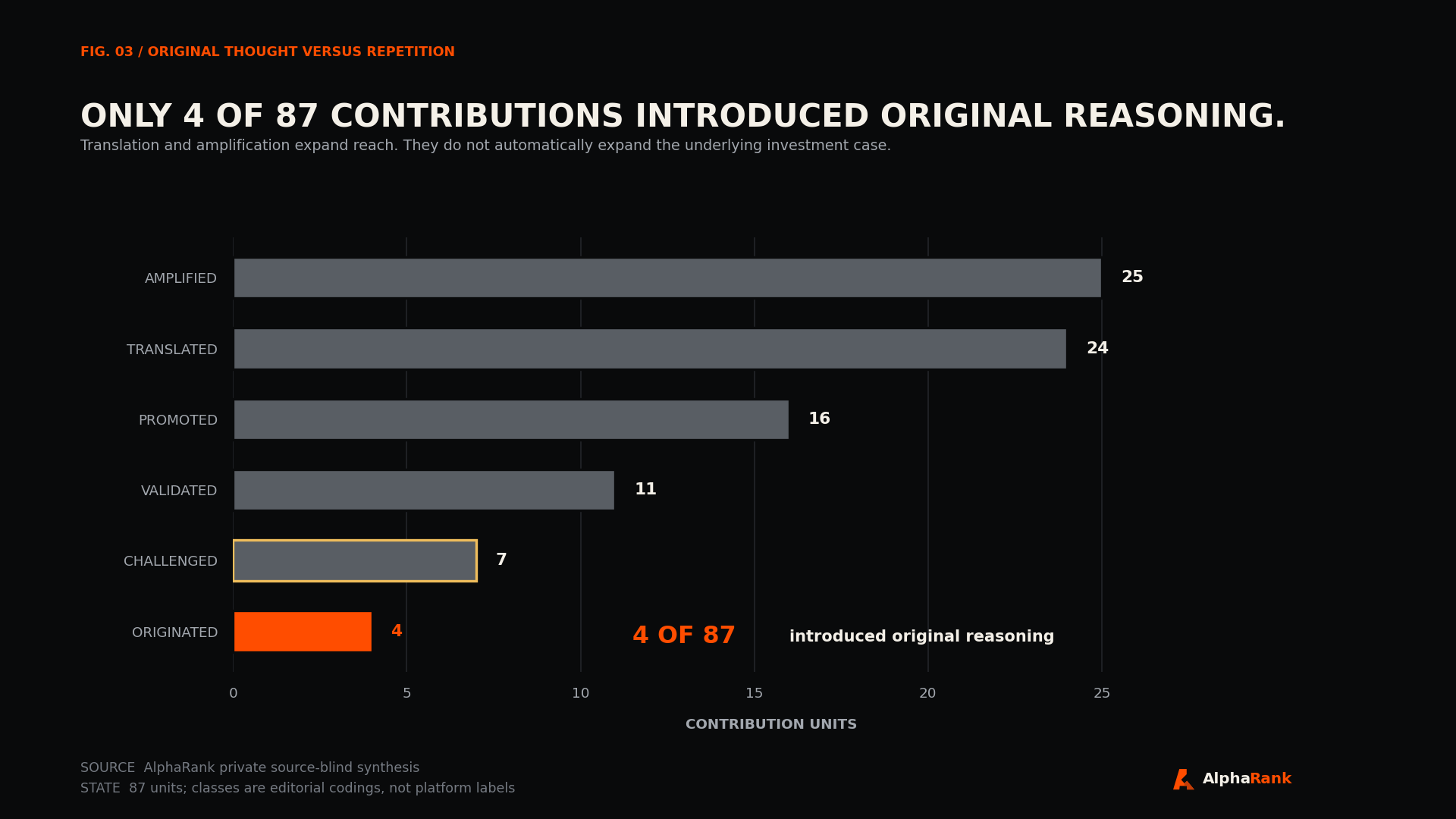
- Most attention spreads the idea instead of improving it.Only four captured contributions introduced original reasoning. Sixty-five translated, amplified, or promoted an existing thesis. That helps distribution, but repetition cannot replace independent proof.
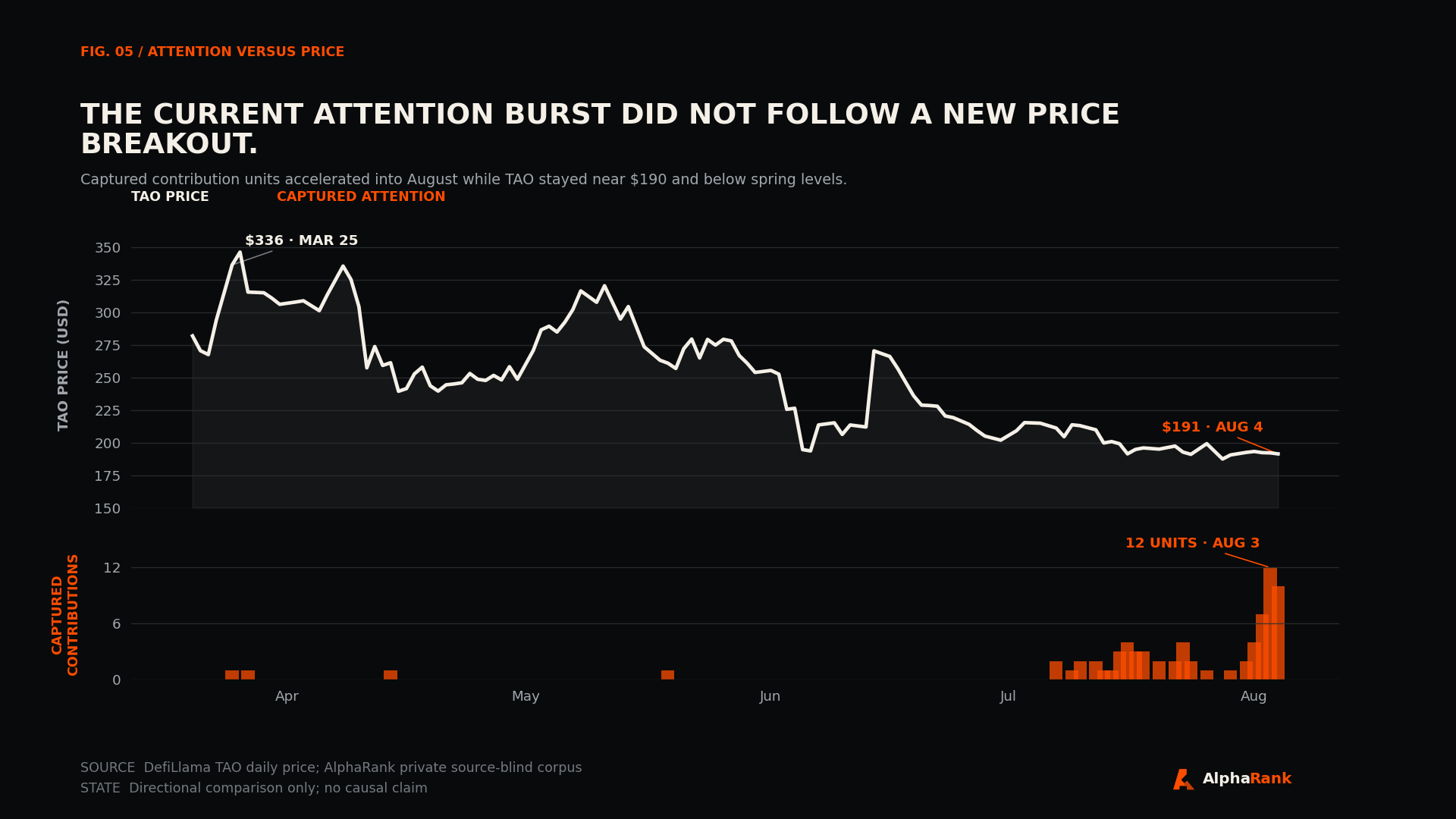
- The latest attention burst arrived without a fresh price breakout.Discussion accelerated into August while TAO remained near $190 to $200, about 43% below its late-March level. This time, attention is trying to lead or repair the trade rather than celebrate a new high.
- The story has become easier to repeat and harder to prove.The language moved from a market for machine intelligence to "Bitcoin for AI" and then a reserve asset for machine intelligence. The final version only works if real customers repeatedly pay for useful products and that demand reaches TAO.
- The next buyer needs a new reason to care.Crypto-native AI investors already know the story. The next wave must reach researchers, businesses, institutions, builders, or end users through products that solve real problems.
A mention count is an applause meter. A Narrative Trace is the idea's family tree.
Ten people repeating the same slogan are not ten independent discoveries. We need to know who introduced the idea, who tested it, who challenged it, and who simply helped it travel.
That is what AlphaRank calls a Narrative Trace. Each contribution is placed into a simple role: create the idea, extend it, test it, challenge it, translate it for a new audience, amplify it, or promote it. We then follow the idea from research to builders, media, price, and finally real economic use.
Why does this matter? Markets can mistake a louder story for a stronger case. A trace shows whether new evidence is accumulating with attention or whether the same claim is only being repeated more widely.
AlphaRank's private library combines selected X posts and long-form transcripts. It preserves the context needed to follow an idea across formats, but it is not every post or show on the internet. We therefore use it to discover patterns, keep the public analysis source-blind, and verify public facts against sources readers can inspect.
More people discuss TAO than a simple search suggests. Far fewer do most of the explanatory work.
The honest answer sits between two extremes. It is not "only Jason." It is also not a broad movement with many independent centers of thought.
Messari's Bittensor page counted 28 authors and ranked the project 51st by mindshare at the cutoff. Mindshare means its share of measured crypto attention. That shows visible activity, but not category leadership.
AlphaRank asked a different question: who did the useful work inside our curated sample? After removing four unrelated references to the name Tao, we found 87 relevant posts and episodes. One source produced 55.2%. The top three produced 90.8%.
This does not mean the entire internet has only three TAO voices. It means the captured conversation relies on a thin layer of people who explain and distribute the idea. If one or two of them stop, the visible conversation could shrink much faster than the follower counts imply.
Creating an idea, explaining it, spreading it, and selling it are different jobs.
Bittensor's story began with protocol research. Its largest audience now encounters a much simpler investment pitch.
The original Bittensor paper and network whitepaper introduced the core idea: let computers compete to produce useful intelligence, then reward the best output. The founders and researchers originated that mechanism. Builders test it by turning the idea into working subnets, which are specialized markets inside Bittensor.
Other roles come later. The OpenTensor account distributes official information. Specialist researchers translate the mechanics into investment language. Funds make the token easier to access. Large investors and podcasters amplify the story to new audiences. Critics add value when they reveal governance, incentive, revenue, or concentration risks that a bullish pitch leaves out.
Jason matters because his audience is different. His public TAO posts turn Bittensor into three simple ideas: AI sovereignty, a productive alternative to passive digital scarcity, and a small position as a way to learn. That language can recruit mainstream technology and venture investors. It still does not make him the origin of the thesis.
Public voices worth tracking
The originator lane begins with Jacob Steeves, Ala Shaabana, and the published Bittensor research team. The long-running translation layer includes Keith Singery and Bittensor Guru, Travis Millott's TAO Templar channel, MogMachine and TaoStats, Mark Jeffrey and the Hash Rate research network, and Brody Adreon. These sources make the protocol legible through interviews, data, subnet analysis, and market interpretation.
The capital and distribution layer includes Barry Silbert, James Altucher, Joseph Jacks, Sami Kassab, and The TAO Pod, dedicated product issuers, and now Jason's much larger technology-investor audience. The critical lane is equally important. Sam Dare and Covenant AI's April exit forced governance and decentralization back into the thesis.
This is a public role map, not a named ranking from AlphaRank's private corpus. The private source identities remain hidden by design. The named examples above are independently publishable nodes that help explain how the idea moves.
The story is being distributed faster than it is being independently advanced.
Only four of the 87 cleaned items introduced original reasoning. Sixty-five explained, amplified, or promoted ideas that already existed.
That is not automatically bad. A technical project needs translators before ordinary investors can understand it. A market needs distribution before buyers and sellers can find one another. The risk begins when a repeated claim starts to feel proven only because it is familiar.
The seven challenges therefore matter more than their small count suggests. They ask whether governance is clear, demand survives without token rewards, outside customers pay real money, subnet quality holds up, and value from a useful AI product actually reaches TAO holders. Those are the tests the bullish case must survive.
The investor slogan arrived years after the mechanism.
The story did not jump from a research paper to a popular investment slogan. It passed through several groups, and each group changed the language.
The original research proposed a market where computers compete to produce useful intelligence. Builders made that abstract idea visible through specialized markets called subnets. Each subnet focuses on a task, such as generating predictions, searching data, or evaluating AI output.
The next change affected how rewards move. Instead of treating every subnet the same, Bittensor gave each one its own market price and used that price to help direct rewards. This system is called Dynamic TAO. In plain English, investors now help signal which subnets deserve more of the network's budget.
Specialists then translated the mechanism into an investment story: a market for intelligence, then "Bitcoin for AI," and finally a possible reserve asset for machine intelligence. Each phrase reaches a wider audience. But the final claim is much harder to prove. A reserve asset needs an economy that repeatedly uses it. Scarcity and token rewards alone are not enough.
Every new framing made TAO easier to explain and harder to prove.
A machine-intelligence market describes how the system works. "Bitcoin for AI" is an analogy. A reserve asset for machine intelligence is a future economic outcome. Those claims require different evidence.
Start with the simplest test: can independent computers produce useful output and judge one another fairly? The subnet test goes further: can many specialized markets work under one network? Dynamic TAO adds another question: can market prices direct rewards better than a small group of validators deciding where they go?
The reserve-asset claim is the hardest. It asks whether an outside economy will repeatedly need TAO. Think of the difference between a busy arcade and a national currency. An arcade can have popular games and active internal tokens. A reserve asset must be useful far beyond the arcade itself.
This is why one kind of success cannot prove every version of the story. A strong benchmark can show that a subnet works without showing that customers will pay. A rising subnet price can redirect rewards without proving genuine demand. An exchange-traded product can make TAO easier to buy without improving the network underneath it.

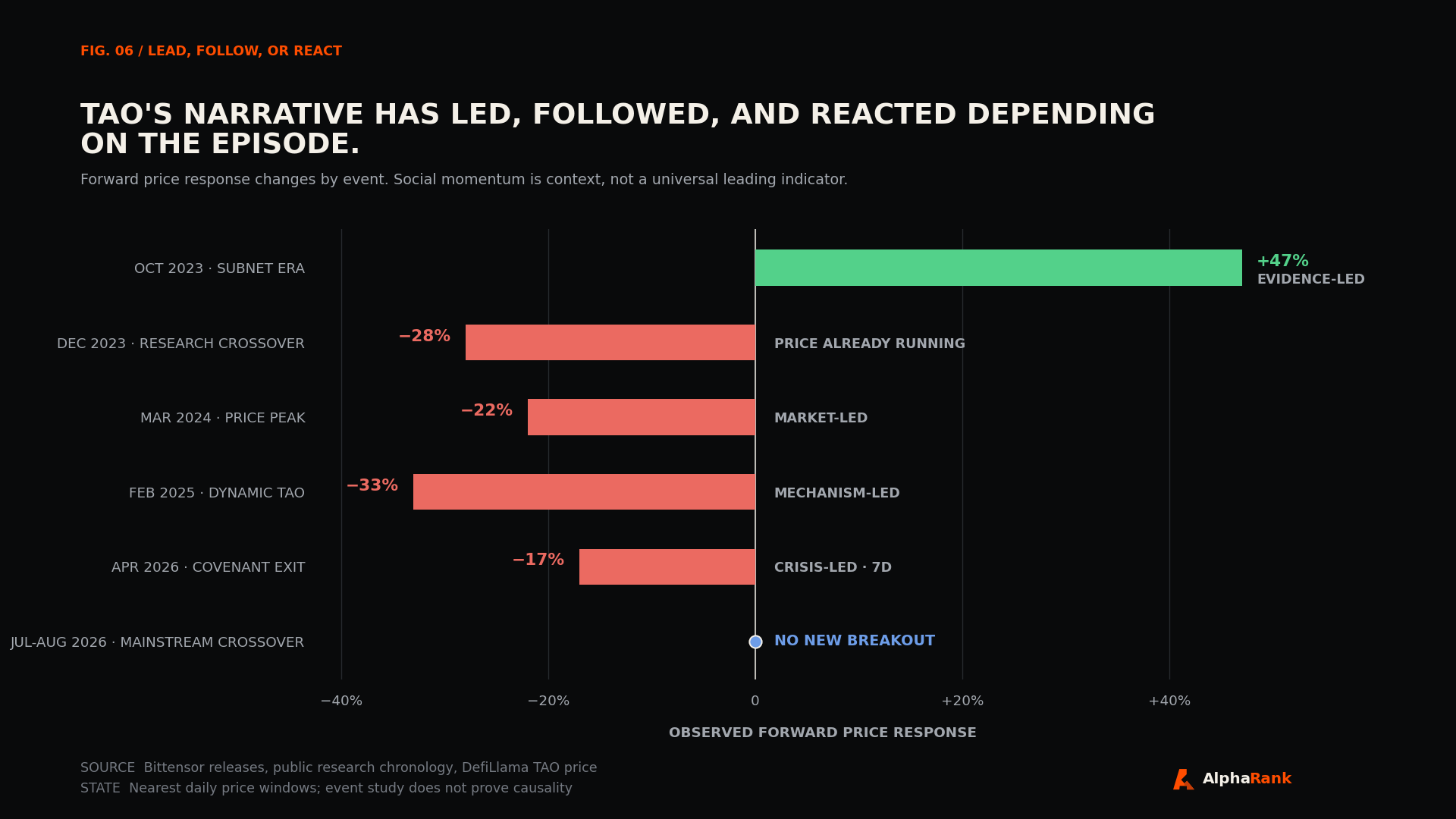
Sometimes attention leads price. Sometimes it arrives after the move and explains it.
Analysts call this a lead-lag question: did the story move first, or did the market move first? TAO has no single answer.
In late 2023, a real change to the network arrived while price was already rising quickly. By the December research crossover, TAO had gained about 120% in 30 days. Evidence and price appeared to reinforce one another, so it is too simple to say the conversation caused the rally.
The March 2024 peak was different. Price led the excitement. Dynamic TAO launched in February 2025, but price fell during the following month. A meaningful product change did not guarantee an immediate market reward.
The April 2026 Covenant exit created a third pattern. A governance dispute appeared first, then price absorbed the damage. The current episode is different again: captured attention rose into August while TAO stayed near $190 to $200, far below its March level.
Why does this matter? A trader cannot treat every increase in attention as an early signal. Sometimes it is discovery. Sometimes it is celebration. Sometimes it is the market trying to make sense of a loss.
Jason matters because he changes the audience, not because he invented the idea.
An amplifier can matter greatly even when someone else created the idea. Distribution can change who is able to understand and buy an asset.
Jason's public framing turns a complex network into three accessible propositions: AI sovereignty, a productive alternative to passive digital scarcity, and a small position as a way to learn. That language reaches investors who will never begin by studying how Bittensor scores AI output or how subnet markets direct rewards.
The bullish interpretation is simple: TAO is reaching a broader technology-investor audience while price is weak. That is the kind of crossover that can create new demand before a market move.
The bearish interpretation is also simple: a complicated protocol is being compressed into one charismatic story before outside customer demand is easy to measure. If the messenger becomes more convincing faster than the business becomes provable, attention can outrun reality.
The distinction matters for traders. If the next move depends on one amplifier, attention can disappear quickly. If Jason is only the first visible node in a broader crossover, the next evidence should be new independent voices, new wrappers, new research, and new buyers who arrive through different channels.
The next buyer must arrive for a different reason than the last one.
Crypto-native AI investors already know the pitch. Repeating it to the same people creates less value each time.
Dedicated products such as the Grayscale Bittensor Trust and 21Shares Bittensor exchange-traded product make TAO easier to buy without managing a crypto wallet. That removes friction. It does not answer why a generalist investor should choose TAO in the first place.
Each new audience needs different proof. AI researchers need credible technical results. Businesses need reliability, privacy, and a measurable advantage in cost or quality. Institutions need clear governance, deep liquidity, safe custody, and a valuation they can defend. Global builders need documentation and tools that work outside the existing English-language crypto circle.
End users may never need to know Bittensor exists. They only need a product worth paying for. The important part is that some of their payment eventually reaches the Bittensor economy.

A popular story only becomes durable when somebody outside the system pays for the product.
The chain is simple: build something, make it useful, win a customer, earn repeat revenue, and connect that demand back to TAO.
Bittensor is strongest at the beginning of that chain. The network exists, and many subnets produce measurable output. Evidence of outside deals and revenue is emerging, including curated reporting from SubnetRadar.
The remaining questions are business questions. How large are the deals? Do customers return? Are revenues profitable? Does one customer dominate? Most importantly, does success create lasting demand for TAO, or only demand for one subnet's product?
Bittensor has also changed how it distributes rewards. Version 431 made a subnet's market price a direct input into how much TAO it receives. The published version 440 design would make that filter more selective. In plain English, the network is getting better at moving its budget toward stronger markets. That can improve internal competition. It cannot create outside customers by itself.

The next phase needs independent proof, not another slogan.
Watch six simple questions: are more independent people contributing, are customers paying, and does the story remain specific when price is weak?
Unique authors rise without one source producing most of the useful captured discussion.
New technical, economic, and critical work grows faster than amplification and promotion.
More subnets disclose repeat customers, contract duration, margins, and revenue that does not come from network rewards.
Research, wrappers, and users appear across channels that do not share the same crypto-native audience.
Attention and builder activity persist through weak price rather than disappearing when the trade cools.
Public explanations become more specific about customers, revenue, governance, and how value reaches TAO instead of becoming more promotional.
Sources & methodologyPublic protocol and market evidence · source-blind internal synthesis · cutoff August 4, 14:21 UTC
Reader-facing claims link directly to publishable evidence. AlphaRank's private transcript and X library was used to find contributors, disagreements, narrative changes, and missing questions. Public claims were checked independently. Private identities, raw text, and exact internal provenance remain outside this report.
- Original Bittensor research paperPRIMARY
- Bittensor whitepaperPRIMARY
- Dynamic TAO whitepaperPRIMARY
- Emissions and dTAO documentationPRIMARY
- v431 release and price-based allocationPRIMARY
- v440 emission-gate designPRIMARY
- Bittensor mindshare dashboardMESSARI
- TAO daily price historyDEFILLAMA
- Grayscale Bittensor TrustPRIMARY
- 21Shares Bittensor ETPPRIMARY
- Subnet external revenue and dealsECOSYSTEM DATA
- Covenant AI exit and governance disputeINDEPENDENT
- AlphaRank source-blind narrative synthesisINTERNAL
Unit. One X post or one long-form episode after duplicate search hits were collapsed.
Cleaning. Four unrelated namesake results were removed before concentration statistics.
Coding. Contribution classes are AlphaRank editorial judgments, not platform labels.
Coverage. The private library is curated and cannot be interpreted as a census of all social or media activity.
Lead-lag. Event windows use the nearest provider observation and do not establish causality.
Privacy. Internal evidence IDs, source mappings, timestamps, hashes, and exact context remain in the private audit ledger.