NEAR: Can a Transformer Pioneer Build an Economy for AI Agents?
Illia Polosukhin helped build the Transformer architecture behind modern generative AI. His blockchain now gives AI agents accounts, spending limits, and ways to pay across many chains. The products are real, but their growth may not create lasting demand for the NEAR token.

- Coverage
- NEAR Protocol / NEAR
- Evidence cutoff
- August 11 · 13:01 UTC
Chapters
NEAR has useful agent infrastructure. The token still needs a reason to benefit.
- NEAR has evolved far beyond its original Layer 1 pitch.Its current strategy combines a sharded chain, human-readable accounts, multichain signatures, outcome-based routing, private AI, and agent tooling.
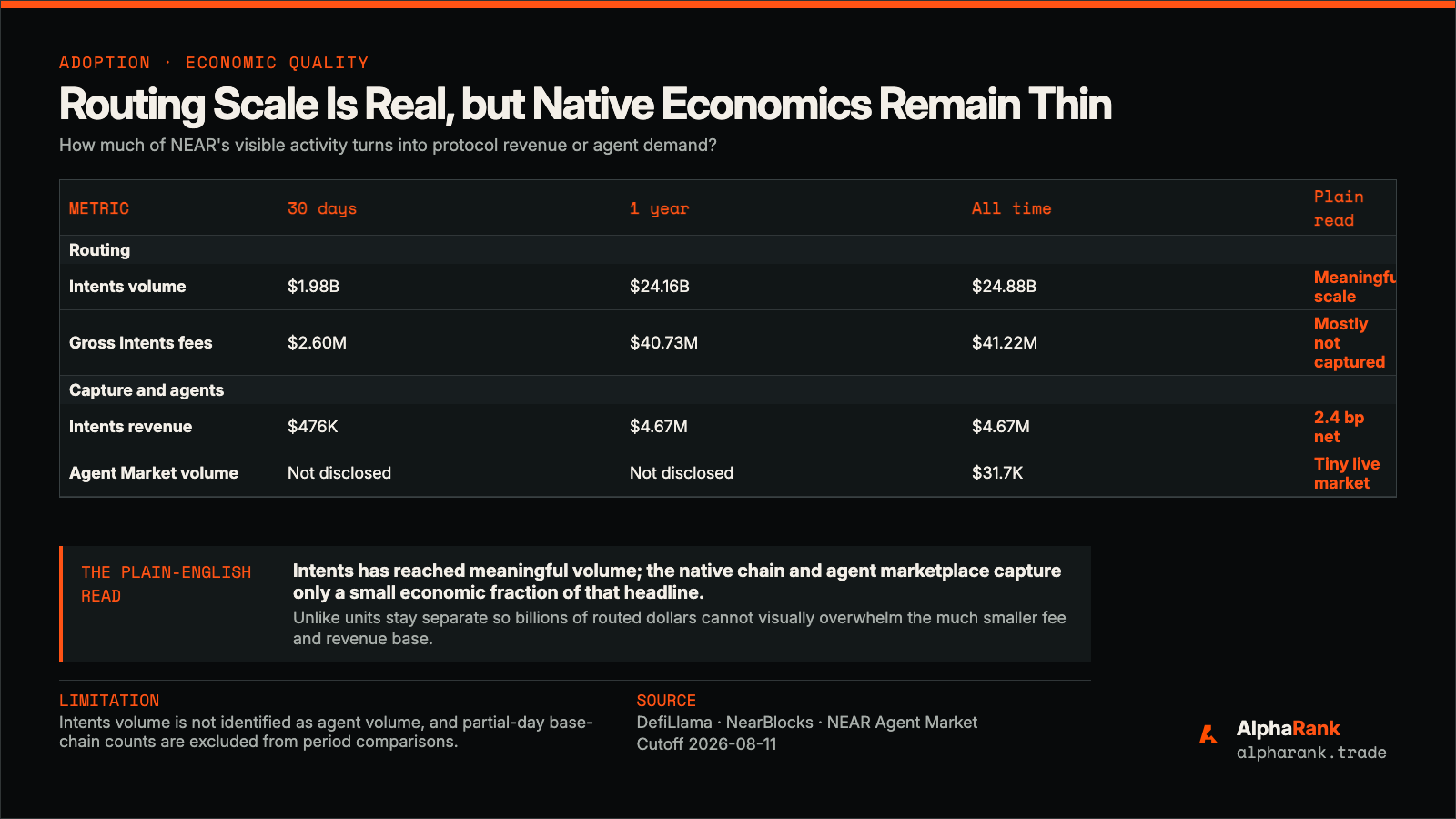
- NEAR Intents has real scale, but the protocol keeps little.Independent data measured $24.88 billion of all-time routed volume and $1.98 billion over the last 30 days. Intents produced $2.60 million of gross fees over 30 days but only $476,100 of captured revenue.
- The native agent economy is still tiny.The live Agent Market showed about $31,700 of total volume, despite 3,938 registered agents and 9,167 jobs. Registration counts overstate economic activity.
- Stablecoins solve the agent's problem better than a volatile gas asset.NEAR's own Agent Market added private USDC payments, while Coinbase's x402 standard is built around stablecoin settlement. Useful infrastructure can grow without making NEAR the unit agents prefer to hold.
- Staking for AI is the clearest new path to direct token use.NEAR now lets users stake the token for AI compute credits. The mechanism is live, but the project has not disclosed how much NEAR is locked or how many people use the credits.
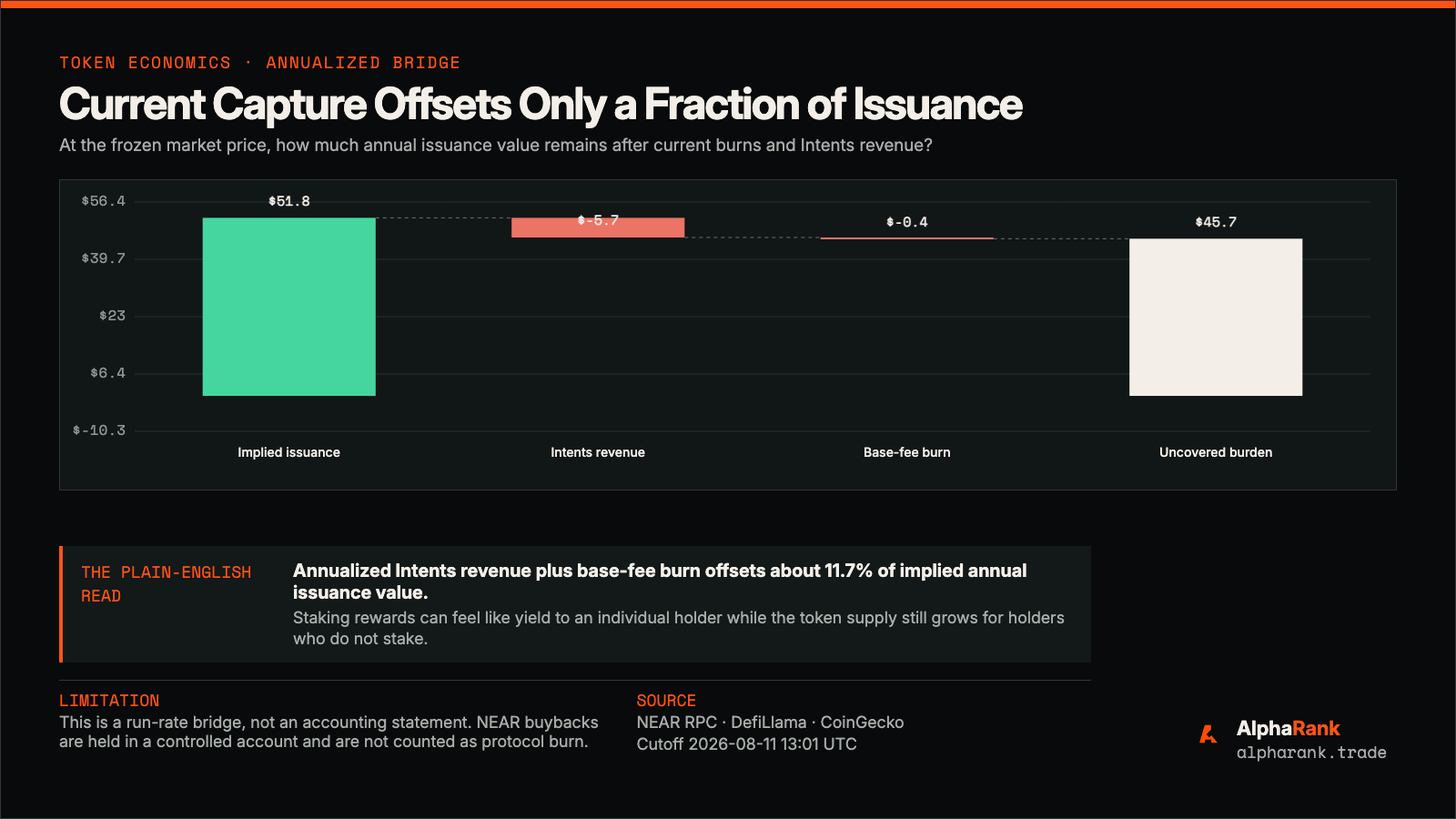
- Current value return is small relative to issuance.Annualized trailing Intents revenue and base-fee burn offset about 11.7% of implied annual issuance value at the cutoff price.
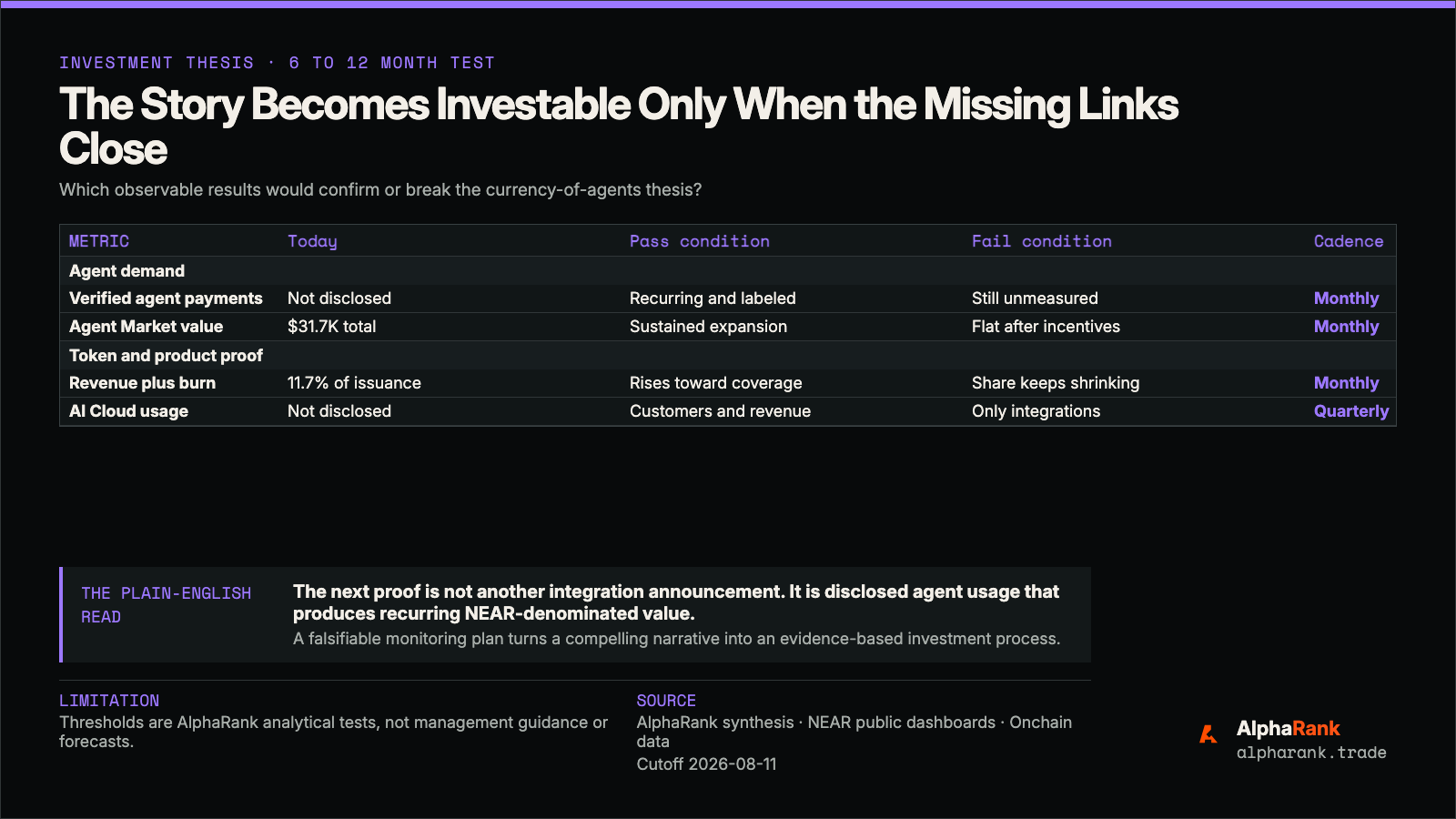
- The thesis is falsifiable.NEAR must disclose recurring agent payments, paid AI usage, stronger native value capture, and a reason agents need NEAR rather than merely route through it.
Illia Polosukhin helped build the Transformer. Now he wants AI agents to control money.
In 2017, Polosukhin helped create the architecture that powers modern generative AI. Nine years later, the company he founded is trying to give AI agents accounts, spending limits, and ways to pay for work.
The founder story is unusually relevant, but the credit must be precise. The original “Attention Is All You Need” paper lists eight equal contributors in randomized order. Its contribution note says Ashish Vaswani and Polosukhin designed and implemented the first Transformer models and played a major role across the project. Credit belongs to all eight authors.
The Transformer made software better at reading instructions, planning steps, and choosing tools. Those abilities are turning AI from a system that answers questions into software that can act on a user's behalf.
Polosukhin's answer is “user-owned AI.” NEAR is trying to give users control over the models, data, accounts, and payment rails that their software uses. His return to AI links the system he helped create with the economic problem NEAR now wants to solve.
His background gives NEAR credibility. Paying customers, fees, and token demand will decide the investment. That leaves one question:
Can NEAR become useful infrastructure for autonomous AI agents and create durable demand for the NEAR token?
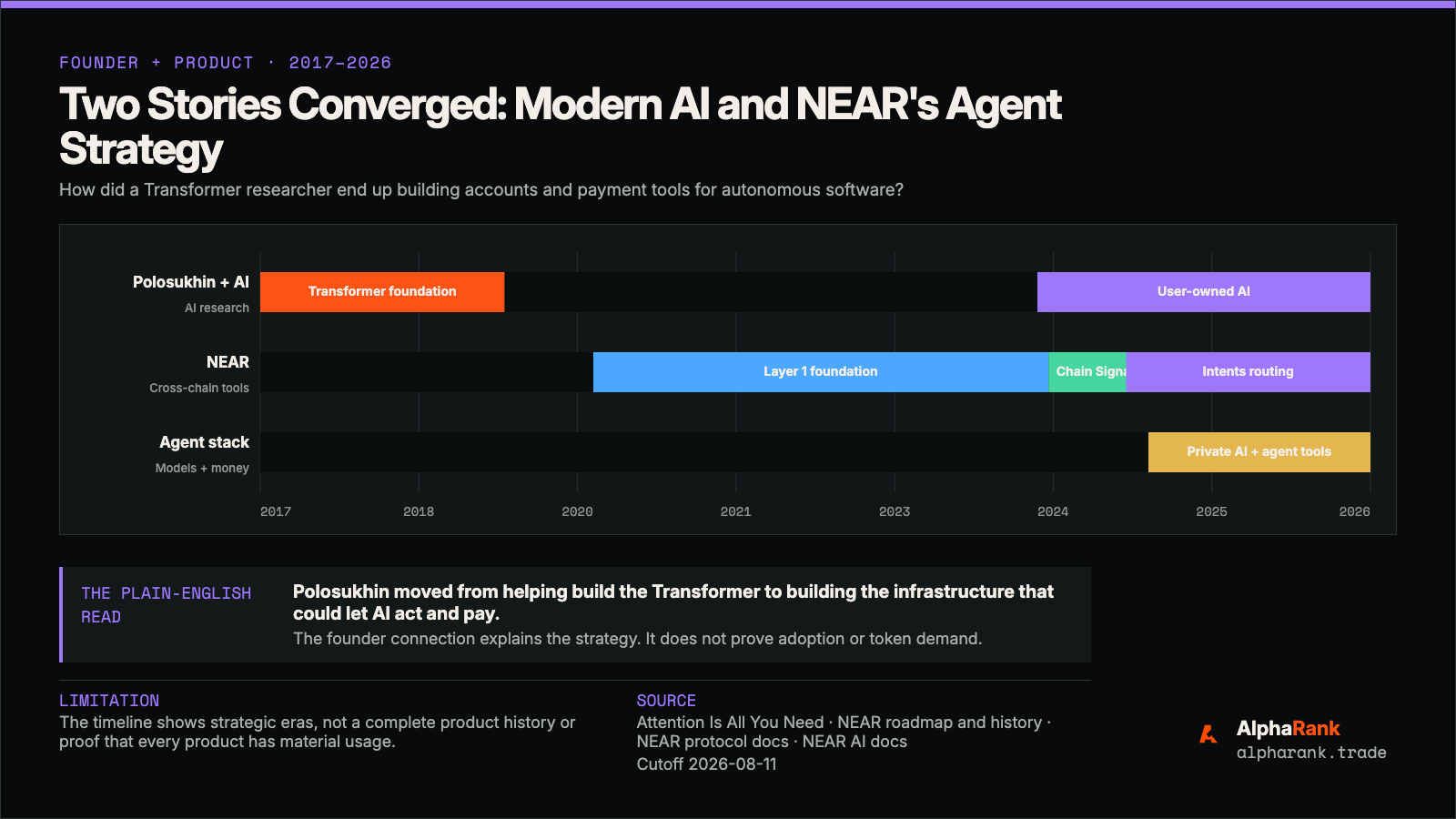
NEAR lets one account act across many blockchains.
NEAR began as a faster Layer 1 blockchain. Its current product is broader: one place to set permissions and carry out actions across many chains.
Its foundation is Nightshade, a design that splits transaction processing into parallel groups called shards. To a user or application, those groups still look like one chain. The practical benefit is simple: NEAR can add capacity without forcing each application into a separate mini-chain.
The chain is also built around accounts rather than anonymous hexadecimal addresses. A NEAR account can have a readable name, store a contract, and hold several keys with different permissions. A function-call key can be restricted to one contract, chosen methods, and a gas allowance. It cannot directly transfer NEAR. That makes the account model useful for software agents because authority can be narrowed instead of handing a bot the equivalent of a master wallet key.
The next layer is “chain abstraction,” which means hiding the mechanical work of using several blockchains. With Chain Signatures, a NEAR account can approve transactions on Bitcoin, Ethereum, Solana, and other networks. The asset can stay on another chain while NEAR coordinates who is allowed to move it.
NEAR Intents adds a market. A user says what result they want, such as swapping Bitcoin for USDC. Competing market makers, called solvers, offer routes and prices. The user accepts one offer, and a smart contract on NEAR checks that the result was delivered. The user chooses the outcome without building the route.
This is why NEAR's strategy changed. Selling generic blockspace means competing with Ethereum, Solana, and dozens of cheaper chains. Selling the simplest path to any asset, any chain, and eventually any autonomous action is a more differentiated business.
AI agents need spending limits, market access, and proof that a job was completed.
Autonomous software needs a model, an identity, limited permission, access to money, a way to find counterparties, and proof that the requested work happened.
Imagine asking an agent to move spare cash into the best available dollar yield. The model can compare rates. It still needs permission to use an account, limits on how much it may spend, market access across several chains, protection from malicious routes, and a receipt that the result matches the instruction.
A blockchain helps because it provides accounts that software can control, rules that can be inspected, and settlement that does not depend on one company's internal database. But an agent does not need a blockchain for every thought. It needs one when value, ownership, or verification crosses organizational boundaries.
NEAR's advantage is composability across that entire loop. Scoped account keys constrain authority. Trusted execution environments can keep code and prompts private. Chain Signatures reach external networks. Intents finds liquidity. The NEAR verifier records the accepted result.
The same design creates the investment problem. If NEAR successfully hides every chain, it can also hide NEAR. The user may receive Bitcoin, pay a solver in USDC, and never knowingly hold the native asset.
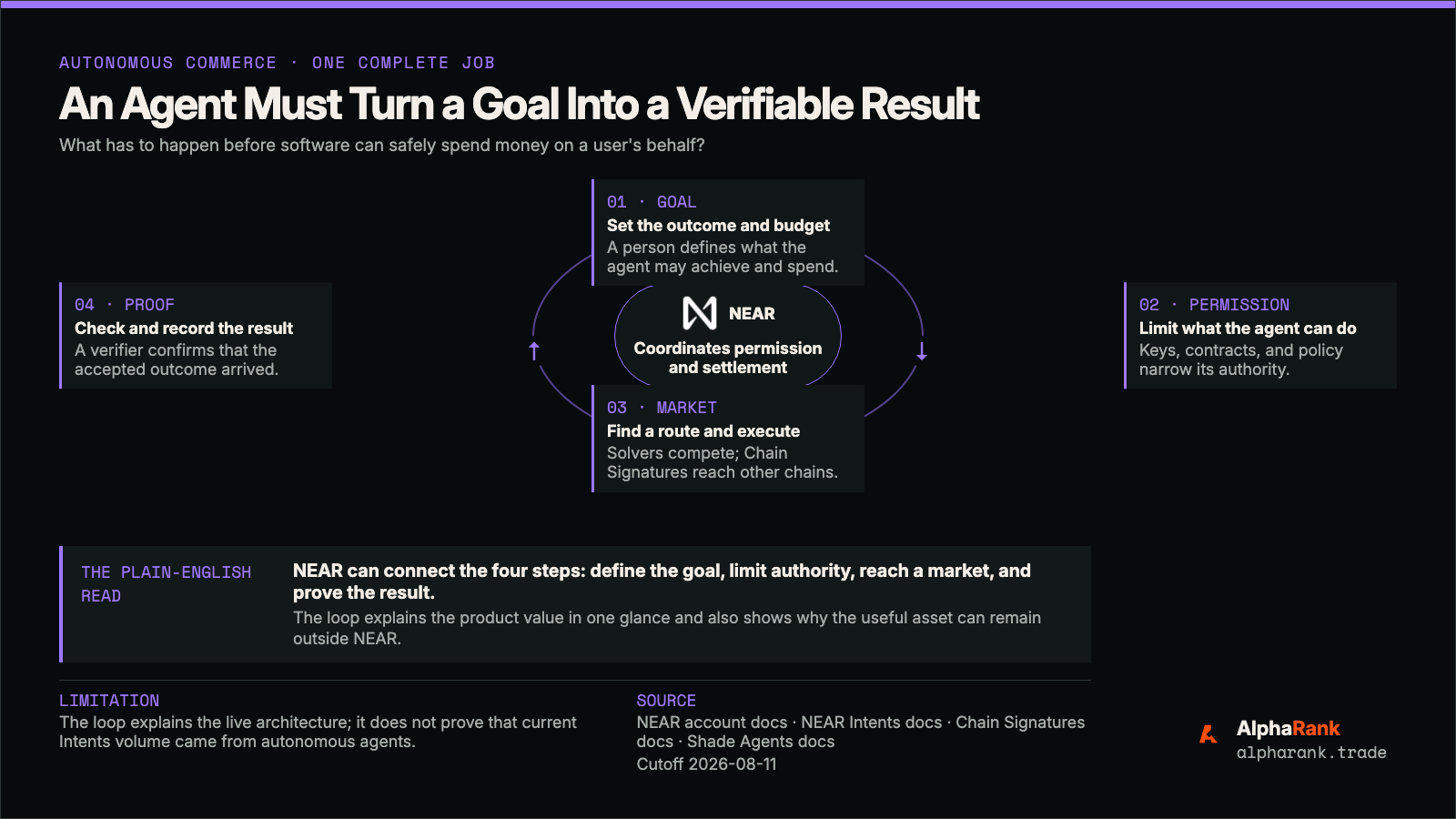
NEAR has built the pieces. Most of its AI products are still early.
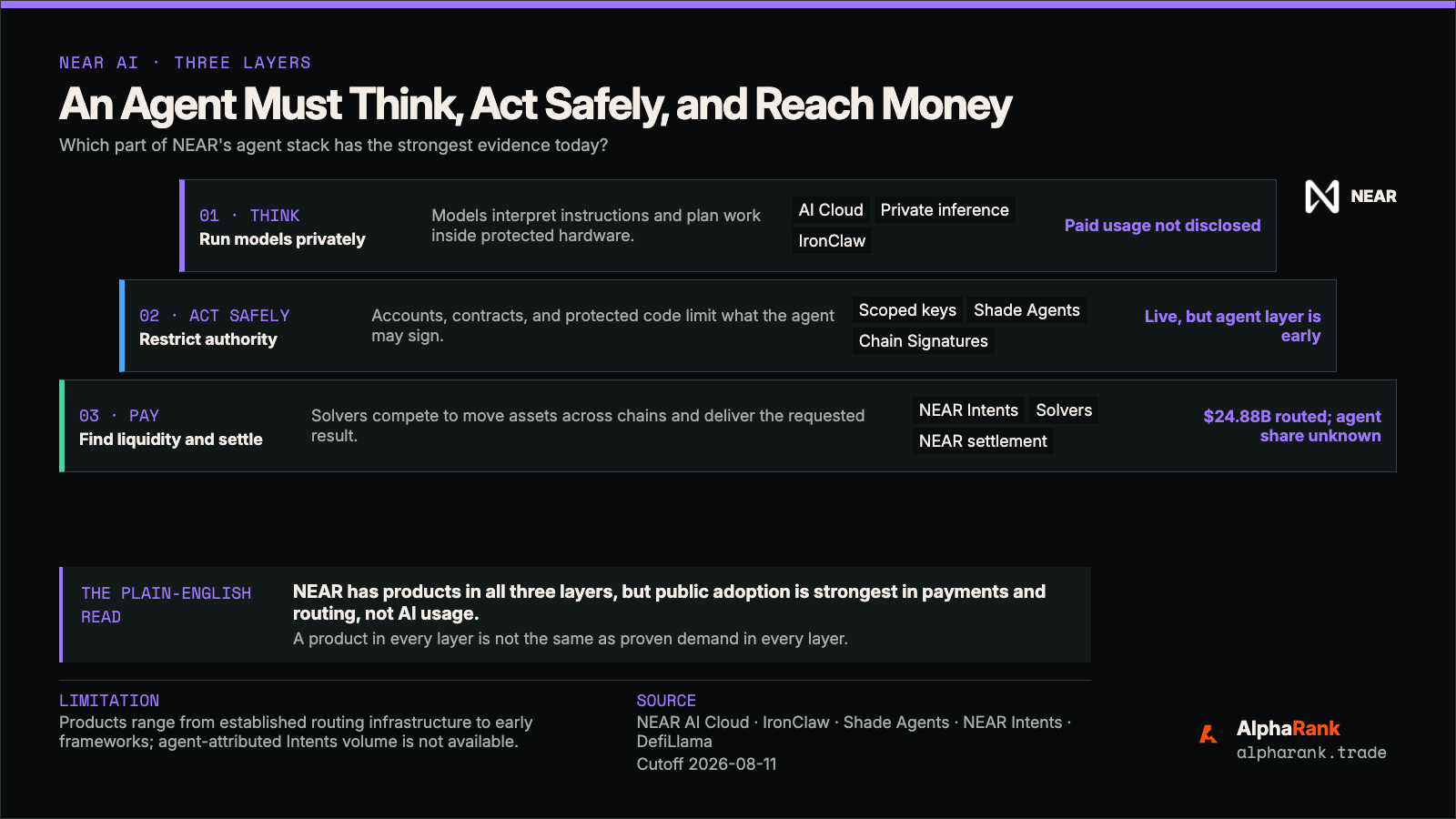
NEAR is building three things an autonomous agent needs: intelligence, permission to act, and a way to pay.
NEAR AI Cloud offers an OpenAI-compatible model endpoint. The live catalog displayed 47 models, including 16 confidential options. Private inference can run inside Intel or NVIDIA trusted execution environments, or TEEs. A TEE is a protected area of a processor designed to keep the code and data hidden even from the machine operator. Attestations let the customer check which environment ran the request.
The model layer has credible integrations. Brave tested browser AI backed by NEAR AI and NVIDIA TEEs. Venice names NEAR AI Cloud as a privacy infrastructure partner. Corbits integrated private inference and an IronClaw runtime. These confirmations prove real engineering distribution. None discloses paid usage or revenue attributable to NEAR.
IronClaw is an open-source agent runtime written in Rust. It had roughly 12,400 GitHub stars and 1,400 forks at the cutoff. It includes permission and security controls, but supports many model providers. That is good product design and weak forced token demand. Developers can like IronClaw without buying NEAR or using NEAR AI.
Shade Agents connect TEE code to an onchain agent contract and Chain Signatures. This is the closest thing to the complete autonomy thesis: private code can request signatures and act across chains under rules. The official documentation also warns that the framework has not undergone a formal audit. Financial autonomy magnifies the cost of a software mistake.
The Agent Market is the live commercial experiment. Agents bid for jobs and settle work through escrow. Its existence matters because most “agent economy” pitches never reach a working market. Its economics are still minuscule: about $31,700 of total volume, 34 active agents over seven days, and only three online services out of 859 registered.
The honest map therefore has two maturity levels. Intents and cross-chain execution have meaningful usage. Private inference, agent runtimes, and the marketplace are live but have little public evidence of paid demand.
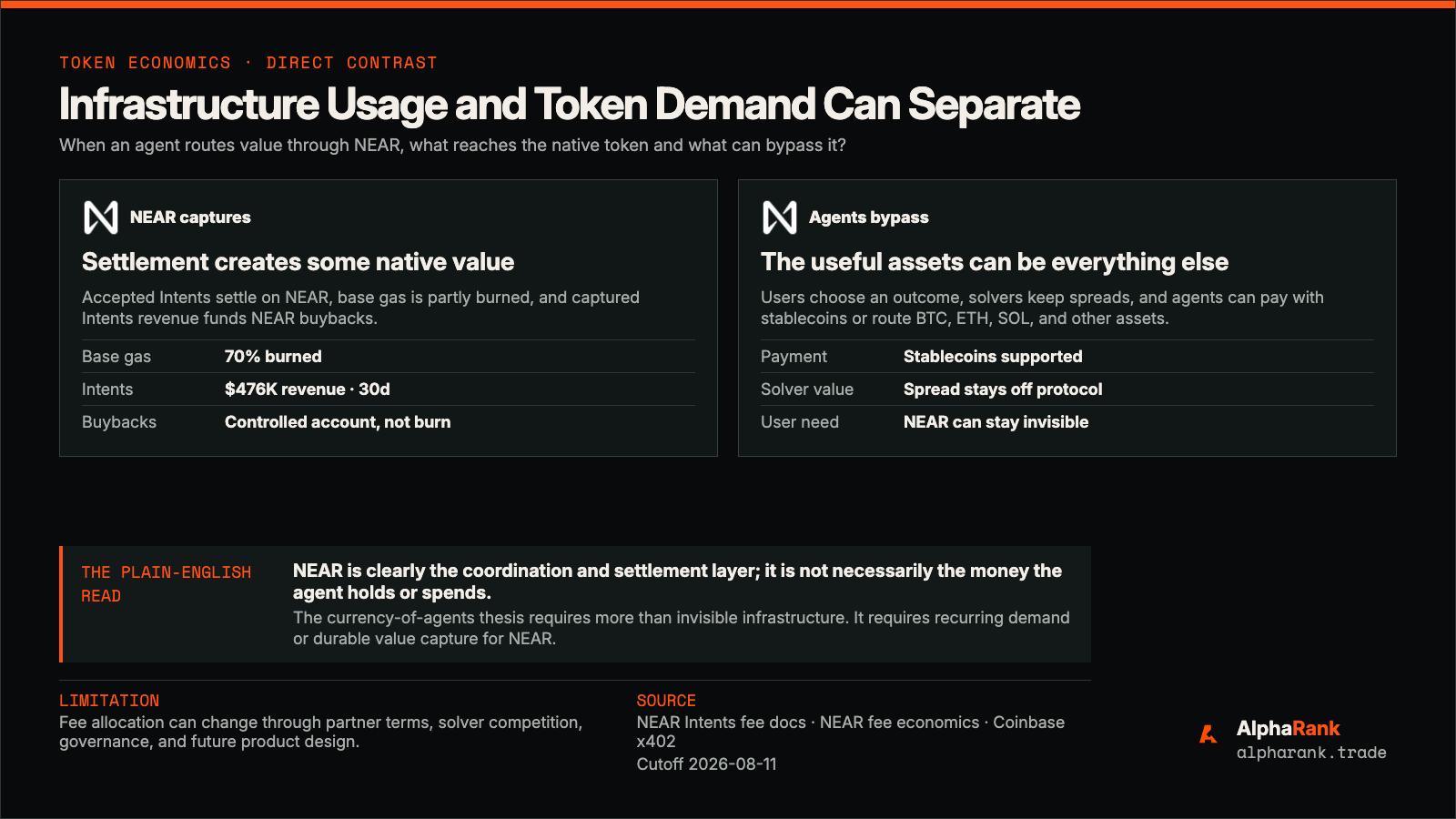
Agents can use NEAR without holding NEAR as their money.
The phrase “currency of agents” mixes four different jobs: what an agent saves, what it spends, what pays transaction fees, and what coordinates the action.
An agent might hold USDC because its purchasing power is stable. It might receive Bitcoin because that is what the customer wants. It might use a solver who pays execution gas on Solana. The accepted fulfillment can still settle through NEAR Intents. NEAR supplies coordination and gas in that transaction; the agent's money can remain USDC or Bitcoin.
The product design confirms this flexibility. The Agent Market initially emphasized NEAR payments. In May 2026, NEAR added private USDC settlement and routing from supported assets. Coinbase's x402 agent-payment standard, which names NEAR as a collaborator, is built around stablecoins, especially USDC.
Stablecoins are good product design for autonomous budgets. A business can authorize an agent to spend $100 without worrying that the budget changes by 15% before lunch. That product choice weakens the token story: the easier it becomes to pay in a stable unit, the weaker the reason to hold the volatile native unit.
There are still paths to NEAR demand. Intents settlement uses a small amount of NEAR for transaction fees. Captured Intents revenue buys NEAR on the open market. In July 2026, NEAR also launched a program that turns staked NEAR into credits for AI inference and always-on agents. The token remains locked and returns to the user's wallet after unstaking.
The new staking program is the clearest direct link between AI usage and token demand. It is also too new to prove the thesis. NEAR has not disclosed how much is staked for AI, how many credits are redeemed, or how many users return. Gas, buybacks, and AI staking are different mechanisms, and each must be measured separately.
NEAR Intents routes billions, but the protocol keeps a small share.
NEAR's strongest proof is nearly $25 billion of all-time Intents volume. Its strongest warning is how little of that value becomes native revenue.
DefiLlama measured $24.88 billion of all-time routed volume, of which $24.16 billion arrived during the last year. The last 30 days contributed $1.98 billion. The volume is independently visible and consistent with NEAR's own product dashboard.
Distribution is real as well. Brave Wallet integrated Intents for Bitcoin, Solana, Zcash, Cardano, and EVM assets. Ledger Wallet added it through SwapKit. These integrations expand potential reach, but public user counts are unavailable.
The fee bridge is less impressive. Thirty-day gross fees were $2.60 million. Captured protocol revenue was $476,100, or about 18.3% of gross fees. The net capture rate against routed volume was roughly 2.4 basis points, meaning 24 cents for every $10,000 routed.
The gap exists because Intents is a market with several participants. The public base protocol fee is only 0.0001%. The near-intents.org interface charges 0.2%. Partner applications can add fees and usually split them with the protocol. Solvers keep the spread between the assets they acquire and the quote they deliver. The remaining 81.7% of gross fees can pay for distribution, inventory risk, execution, and competition outside the protocol's captured-revenue line.
The base chain adds little direct revenue. DefiLlama measured only $42,841 of gas fees over 30 days and $1.57 million over one year. Low cost is excellent for users. It means transaction count is a poor shortcut for tokenholder economics.
The stablecoin base is healthier than the native fee base. NEAR held about $128.7 million of circulating stablecoins, up 13.9% over 30 days. That is useful liquidity for applications and another reminder that economic activity can choose a dollar unit.
Today's fees and buybacks do not offset token issuance.
At the cutoff, NEAR was a $2.07 billion network priced like a credible mid-cap infrastructure bet, not like a proven agent economy.
CoinGecko showed NEAR at $1.59, with a $2.07 billion circulating market capitalization, the same approximate fully diluted value, 1.3033 billion circulating and total tokens, and about $125 million of 24-hour trading volume. CoinGecko lists no maximum supply. There was no material tracker-defined unlock gap between circulating and total supply.
The price remained 92.2% below its $20.44 peak from January 2022. Historical trackers place peak market value at roughly $12.5 billion, making the current market capitalization about 83% lower. The historical market-cap comparison is approximate because circulating-supply definitions changed through the cycle.
NEAR is traded on large centralized venues, including Coinbase, Binance, Kraken, and OKX, and through onchain markets. Common pairs include NEAR with the dollar or dollar stablecoins. Availability varies by jurisdiction. This is a market-access description, not an endorsement of any venue.
The protocol targets annual issuance of 2.5% of total supply. At the cutoff, 617.2 million NEAR was staked, or 47.36% of supply, across 421 current validators. Dividing target issuance by staked supply implies a gross reward near 5.28% before validator commission. After accounting for the holder's share of supply expansion, the dilution-adjusted yield was closer to 2.71%.
One subtlety matters. Validator issuance is paid at the target rate regardless of fees burned. More usage does not automatically reduce rewards. Fee burn offsets total supply growth at the margin while validators continue receiving issuance.
Using the $1.59 market price, target issuance implied about $51.8 million of new NEAR value per year. Annualizing the last 30 days of Intents revenue produced $5.71 million. Annualized base-fee burn contributed about $360,000. Together, those offsets covered 11.7% of implied issuance value.
DefiLlama classifies captured Intents revenue as holder revenue because it buys NEAR on the open market. The official dashboard says the purchases permanently remove NEAR from circulation. The onchain account told a more precise story. It held about 723,234 NEAR in a multisignature contract with four function-call keys and no full-access keys. That custody can reduce liquid supply, but total supply remains unchanged.
The valuation therefore cannot be reduced to a normal price-to-earnings ratio. Market capitalization was roughly 341 times annualized Intents capture plus base-fee burn. Token holders do not own corporate cash flow. The multiple is useful only as a measure of how much future usage and value return the market already requires.
NEAR offers an integrated stack. Larger rivals can win each layer separately.
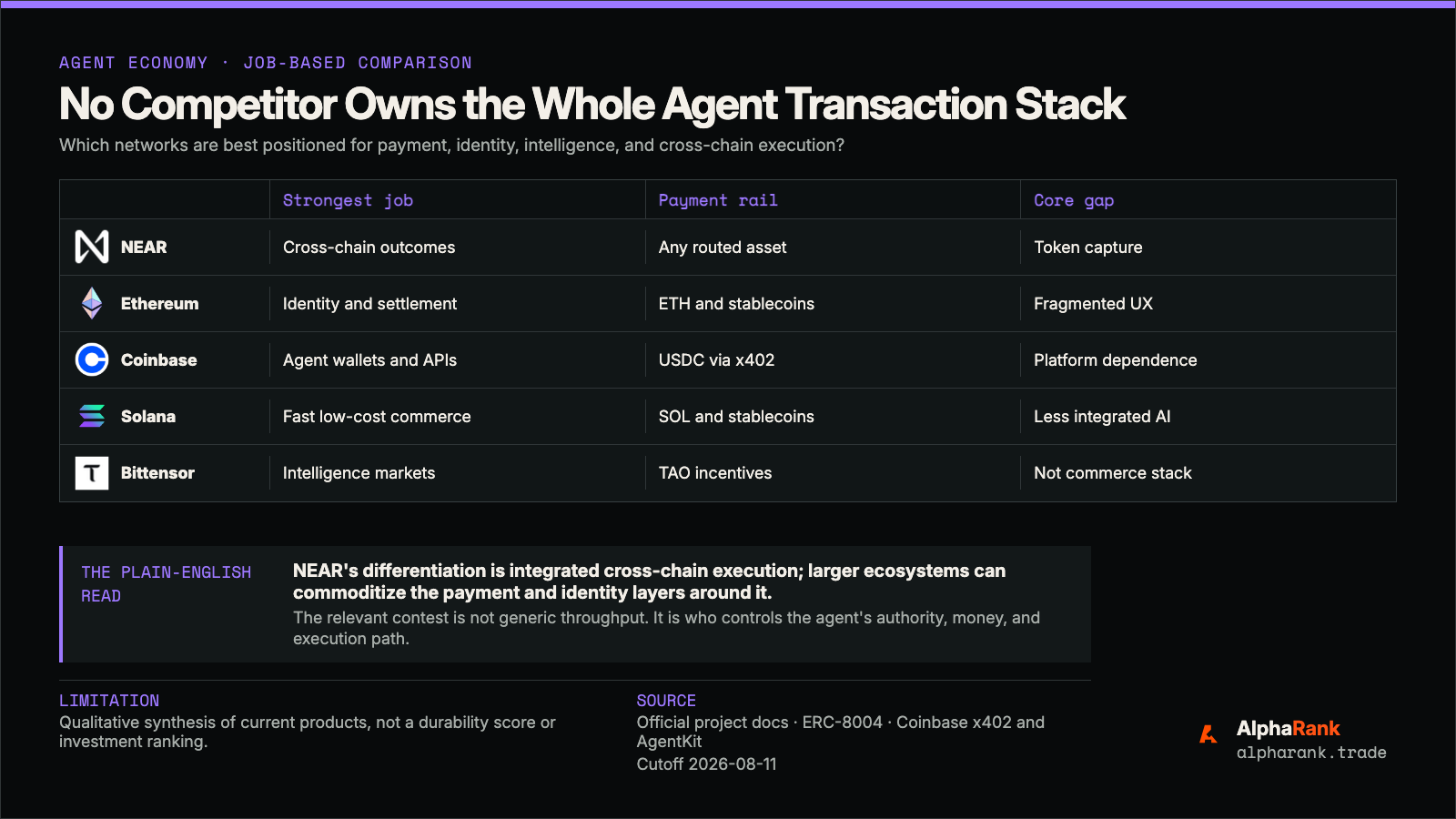
The winner will control the agent's account, permissions, payment method, or route to the market. No single competitor needs to own all four.
Ethereum and its Layer 2 ecosystem have the deepest settlement, stablecoin, and developer base. The draft ERC-8004 standard defines portable registries for agent identity, reputation, and validation. Base can pair that settlement with Coinbase's consumer distribution.
Coinbase is the clearest payment threat. AgentKit gives software wallets and onchain actions. Agentic Wallet adds managed authority. x402 turns an HTTP request into a stablecoin payment. None requires NEAR, although x402 collaboration gives NEAR a distribution opportunity.
Solana offers cheap, fast commerce and a large base of consumer crypto activity. Stripe approaches the same problem from merchants rather than chains. Its Agentic Commerce Protocol uses shared payment tokens tied to existing payment methods, backed by familiar fraud and acceptance infrastructure.
Bittensor is a market for machine intelligence, not a general payment and execution layer. Fetch.ai and the ASI ecosystem center agent coordination and services. Virtuals focuses on launching, distributing, and monetizing consumer-facing agents. They compete for the narrative and developer attention without reproducing NEAR's exact stack.
The valuation comparison shows the strategic gap. NEAR's $2.07 billion market value was close to Bittensor's roughly $1.94 billion and well above Virtuals near $363 million or Fetch.ai near $307 million. Ethereum and Solana were orders of magnitude larger. NEAR is valued above most pure agent narratives but far below the dominant settlement ecosystems.
The strategy depends on the integrated stack retaining value. Portable identity standards, chain-agnostic stablecoin payments, and competing wallet routers could reduce NEAR to a replaceable backend.
NEAR can succeed as infrastructure while the token disappoints.
Bull case: autonomous software becomes a major economic actor. Agents need constrained accounts, private inference, multichain signatures, competitive liquidity, and verifiable settlement. NEAR is one of the few networks assembling all of those layers under a single developer experience.
Intents already has distribution and nearly $25 billion of routed volume. If wallets, exchanges, and AI applications treat it as the default path to cross-chain outcomes, NEAR can become the coordination layer users never see. Higher app fees, more protocol capture, recurring buybacks, and new stake or collateral requirements could then turn infrastructure usage into native demand.
In the strongest version, the founder advantage matters. NEAR AI attracts credible model and privacy partners. IronClaw becomes a standard agent runtime. Shade Agents prove safe enough for financial autonomy. The Agent Market finds real buyers. Each layer feeds the others: more agents create more transactions, more routing attracts more solvers, and better liquidity improves the product.
Bear case: the AI story remains ahead of usage. NEAR AI products accumulate integrations and GitHub stars but not paid customers. Shade Agents stay an unaudited framework. The Agent Market remains a small incentivized experiment. Headline transaction counts stay cheap and economically thin.
The more dangerous bear case is product success without token success. Intents can route billions while users hold stablecoins, solvers keep spreads, and partner applications capture the customer relationship. Chain abstraction can turn NEAR into a replaceable settlement backend. The token receives a little gas demand and some buyback support while issuance continues.
Competition does not need to copy the whole stack. Coinbase can own wallets and stablecoin payments. Ethereum can own identity and final settlement. Solana can own cheap commerce. Stripe can own merchants. An application may combine those pieces and treat NEAR as one router among several.
The integrated stack spans NEAR consensus, offchain solvers, an MPC signing service, bridges, relayers, protected-compute operators, administrators, and commercial applications. Each link adds useful capability and a separate security or governance risk.
Governance adds a quieter risk. House of Stake and veNEAR create a formal path for participation, but its own 2026 analysis said voting power was not yet capture-resistant. A foundation-led ecosystem can move quickly. Investors still need to know whether economic decisions, buybacks, and protocol priorities become more accountable as the system matures.
Six monthly numbers will show whether the agent thesis is working.
The next six to twelve months should be judged by recurring value, not another broad partnership list.
Separate agent-initiated Intents, Chain Signature calls, and payments from ordinary wallet flow without exposing user data.
Report NEAR AI Cloud customers, confidential-model token volume, retention, and revenue.
Track settled dollar or NEAR volume, repeat buyers, successful jobs, disputes, and activity after incentives.
Grow Intents revenue and base-fee burn faster than issuance. Explain partner, solver, and protocol economics consistently.
Show why agents or service providers hold, stake, collateralize, or spend NEAR while stablecoins handle payments.
Complete formal audits, publish incident and attestation records, and demonstrate safe constrained spending at production scale.
If these measures improve together, NEAR can plausibly become the operating and settlement layer for autonomous commerce. If routed volume grows while agent usage, capture, and native demand stay flat, the infrastructure thesis may be working and the token thesis may still be wrong.
Sources & methodologyProtocol, code, onchain, product, market, and counterparty evidence · cutoff August 11, 13:01 UTC
AlphaRank's research process shaped the questions about agent demand, solver economics, and token value capture. Every public factual claim was then checked against original papers, protocol state, product documentation, counterparty confirmations, and independent data providers. AI challenge tools generated leads only and are not evidence.
- Attention Is All You NeedORIGINAL PAPER
- Nightshade sharding designPROTOCOL
- NEAR account modelPROTOCOL
- Scoped access keysPROTOCOL
- Chain SignaturesPROTOCOL
- NEAR Intents mechanismPROTOCOL
- Intents feesPRODUCT TERMS
- Solver economicsFIRST PARTY
- Intents volume, fees, and revenueDEFILLAMA
- NEAR base-chain feesDEFILLAMA
- NEAR stablecoin supplyDEFILLAMA
- Transactions, accounts, validators, and buyback accountONCHAIN
- Mainnet protocol stateRPC
- Validator issuance economicsPROTOCOL
- Gas burn and contract rebatePROTOCOL
- NEAR revenue and buyback dashboardFIRST PARTY
- NEAR market and supply snapshotCOINGECKO
- Private inference designNEAR AI
- NEAR AI Cloud catalogLIVE PRODUCT
- Staking for NEAR AI launchFIRST PARTY
- Shade Agents and audit warningDEVELOPER DOCS
- IronClaw runtimeCODE
- Agent Market dashboardLIVE PRODUCT
- Brave Wallet Intents integrationCOUNTERPARTY
- Ledger Wallet Intents integrationCOUNTERPARTY
- Coinbase x402 launchCOUNTERPARTY
- ERC-8004 agent registriesSTANDARD
- Stripe agentic commerceCOUNTERPARTY
- NEAR roadmapROADMAP
- AlphaRank evidence synthesisMETHOD
Identity. The canonical asset is native NEAR on NEAR mainnet, not a wrapped token contract.
Market data. Price, capitalization, supply, volume, and comparable valuations were frozen at the stated cutoff. Live values can differ materially.
Protocol state. Shards, validators, stake, treasury, and key permissions came from public mainnet RPC or block-explorer endpoints.
Economics. Gross fees, captured revenue, burn, buybacks, and issuance remain separate. Run-rate values are not accounting profit.
Agent evidence. Registered accounts, agents, and jobs are not assumed to be unique people, autonomous actors, or economically meaningful activity.
Private research. Source identities, exact transcript and post text, timestamps, hashes, and retrieval context remain in the private evidence ledger.