LIT: Lighter, Hyperliquid, and the Regulated Exchange Bet
Lighter has real users, Robinhood behind it, and about $22 million a year in protocol revenue. The bet is whether free trading can become a durable business before Hyperliquid pulls farther ahead.

- Coverage
- LIT / HYPE · Ethereum / Lighter / Hyperliquid
- Evidence cutoff
- August 18 · 16:05 UTC
Chapters
Lighter is real. The difficult part is turning free activity into a business.
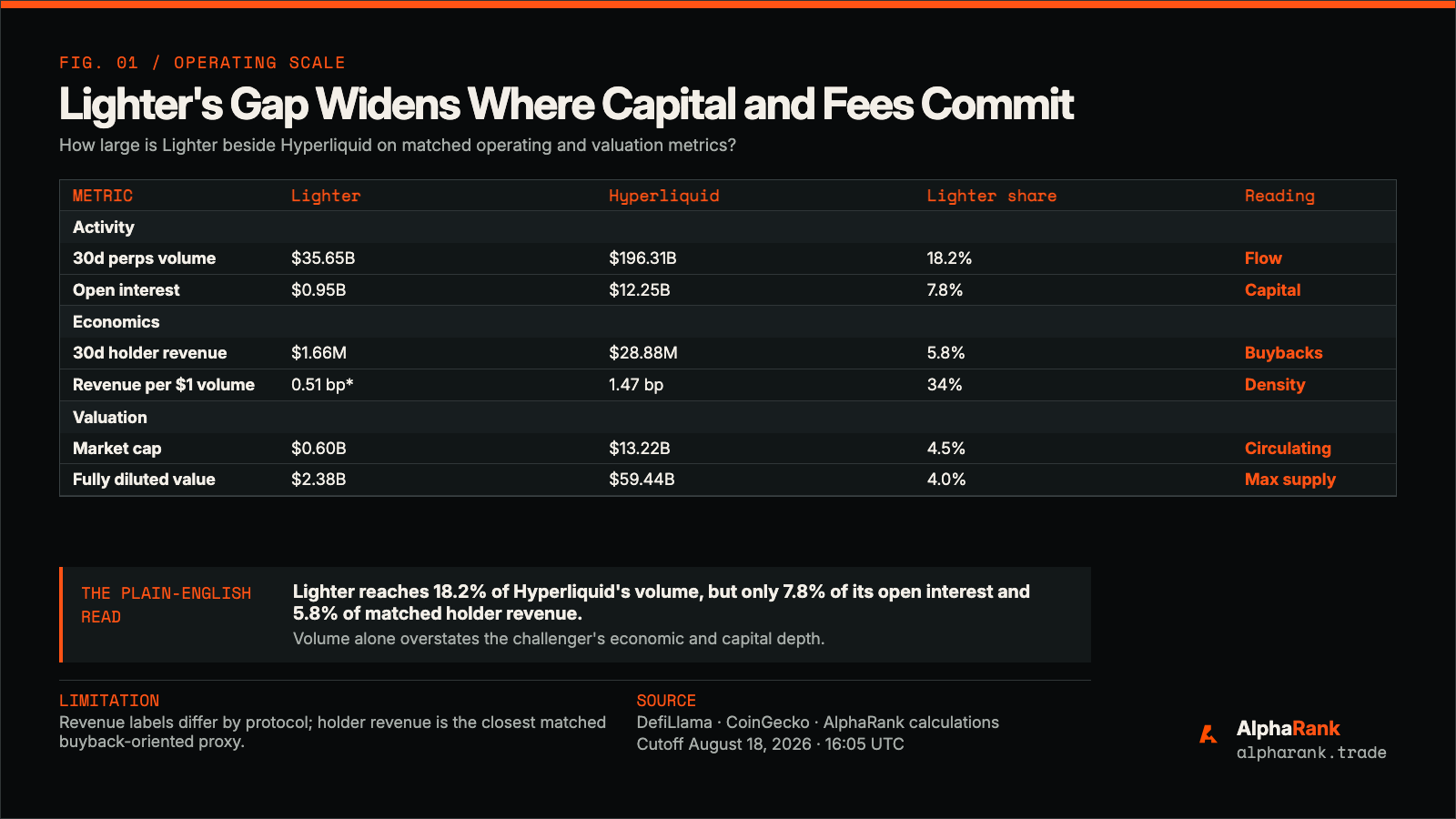
At first glance, Lighter looks like a bargain Hyperliquid. It handled 18% as much trading volume, while LIT traded at 4% of HYPE's fully diluted value. The harder business measures tell a less dramatic story.
- Lighter is a fast crypto futures exchange that posts proofs to Ethereum.This gives users more visibility than a normal exchange database, but Lighter still controls important parts of the live system.
- The best current revenue estimate is about $22M a year.Recent windows point to roughly $19M to $28M. This is protocol revenue, not audited company sales or profit.
- Hyperliquid remains much larger where it counts most.Lighter has 18.2% of its trading volume, but only 7.8% as much money sitting in open positions and 5.8% of its matched token-buyback revenue.
- Robinhood can bring users, but it does not own Lighter.The investment, listing, Wallet product, and 11M LIT reward are real. The CFTC connection is an advisory seat, not a license.
- LIT gets buybacks and useful staking benefits, not company ownership.The investment case works only if fee-funded demand grows faster than token unlocks and incentives.
A fast crypto exchange with Ethereum receipts.
Lighter runs the trading engine itself, then gives Ethereum the data and proof needed to check the result.
A perpetual future is a leveraged bet on the price of an asset that does not expire. The exchange must match buyers and sellers quickly, keep prices accurate, and close losing positions before they create losses for everyone else.
A normal crypto exchange does all of this inside a private database. Lighter takes a middle path. It runs the fast trading engine away from Ethereum, then sends Ethereum the data and a mathematical proof that the approved rules produced the final account balances.
That design is called a zero-knowledge rollup. The label matters less than the promise: traders get exchange-like speed, while Ethereum can check the outcome without replaying every trade.
Ethereum does not run Lighter. Lighter decides the live order of transactions and still controls important software, price feeds, and emergency upgrades. Users have tools designed to force a request or withdraw if the operator stops, but the system is not fully independent.
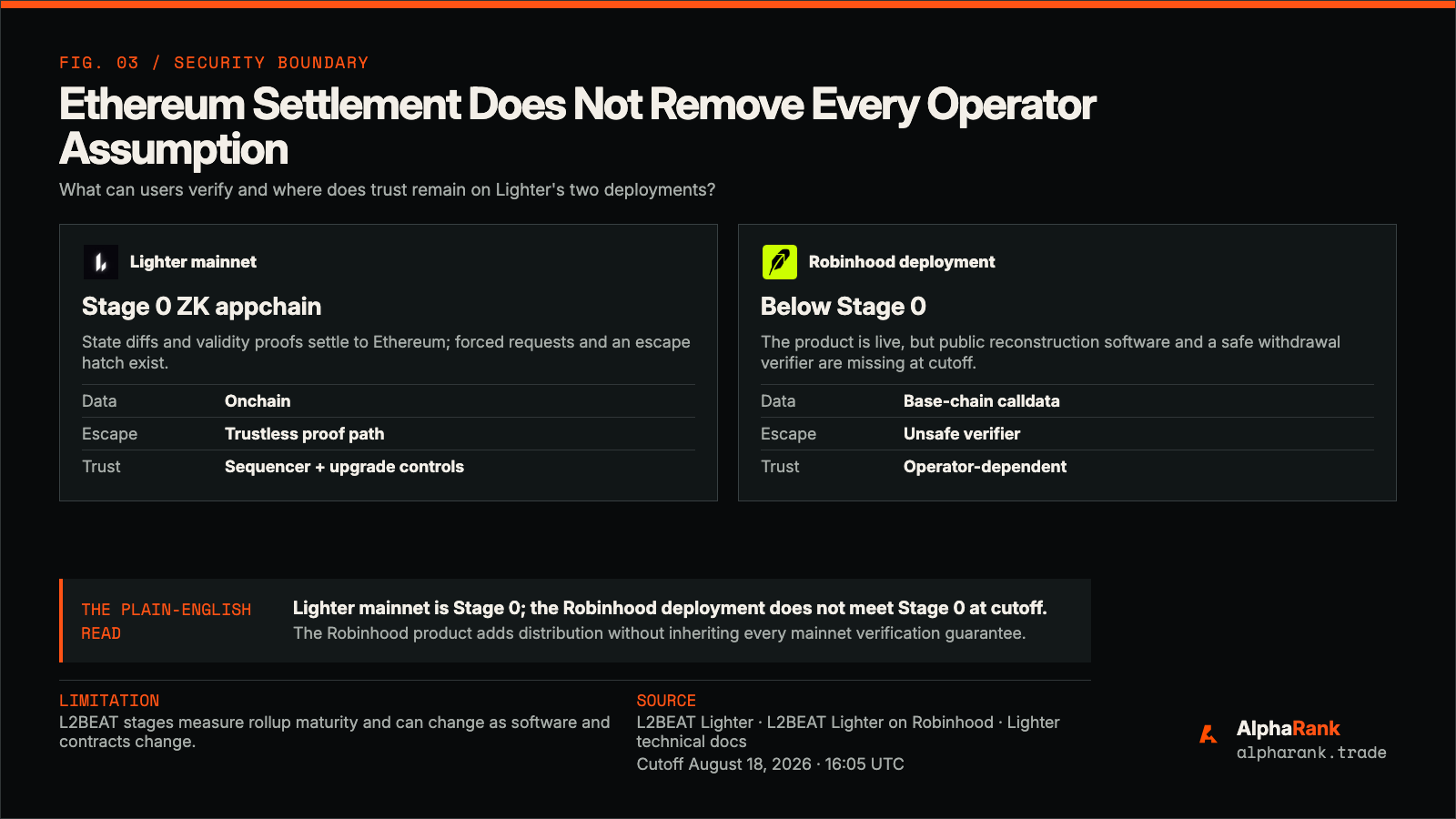
L2BEAT classifies Lighter's main exchange as Stage 0, its earliest maturity category. The required withdrawal data is onchain and proofs protect the account state. Centralized control remains.
The separate version used by Robinhood has weaker safeguards. L2BEAT says public software cannot rebuild its state from the base-chain data and that its escape tool is unsafe. The product can be live while still asking users to trust more of the operator.
Lighter makes about $22 million a year.
That is the best estimate for revenue kept by the protocol. The company behind Lighter does not publish audited sales or profit.
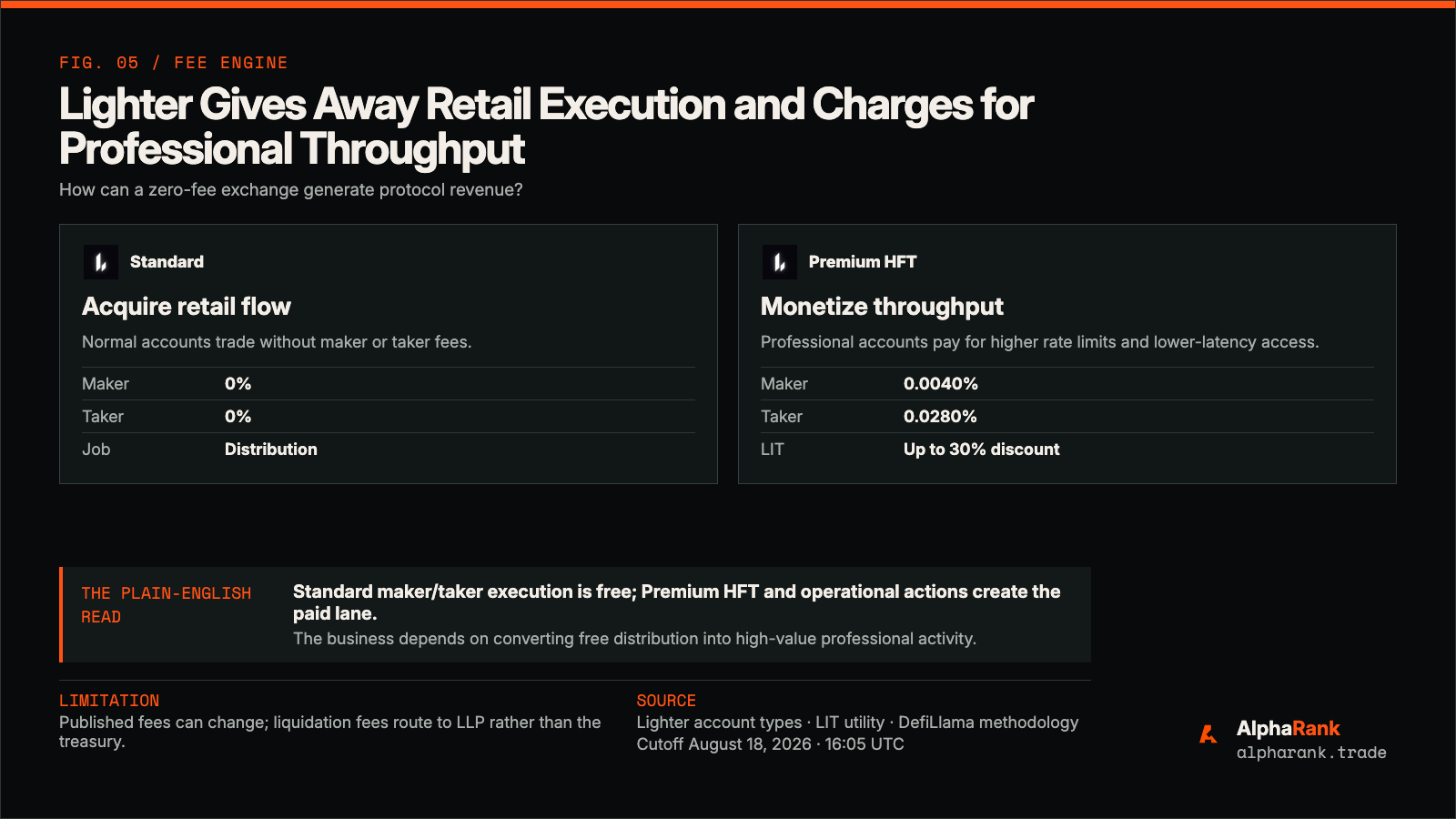
The phrase “zero fee” hides the business model. Standard users pay nothing when they place or take an order. Professional high-frequency traders pay for higher limits and faster access. Transfers and withdrawals can also create fees, while liquidation fees go to a separate liquidity pool.
Over the 30 days ending August 17, Lighter kept $1.805M as protocol revenue. Dividing by 30 and multiplying by 365 gives a yearly pace of $21.96M.
The latest seven days point to $19.32M a year. The latest 90 days point to $27.55M. Together, they support a current range of about $19M to $28M, with $22M as the clean headline.
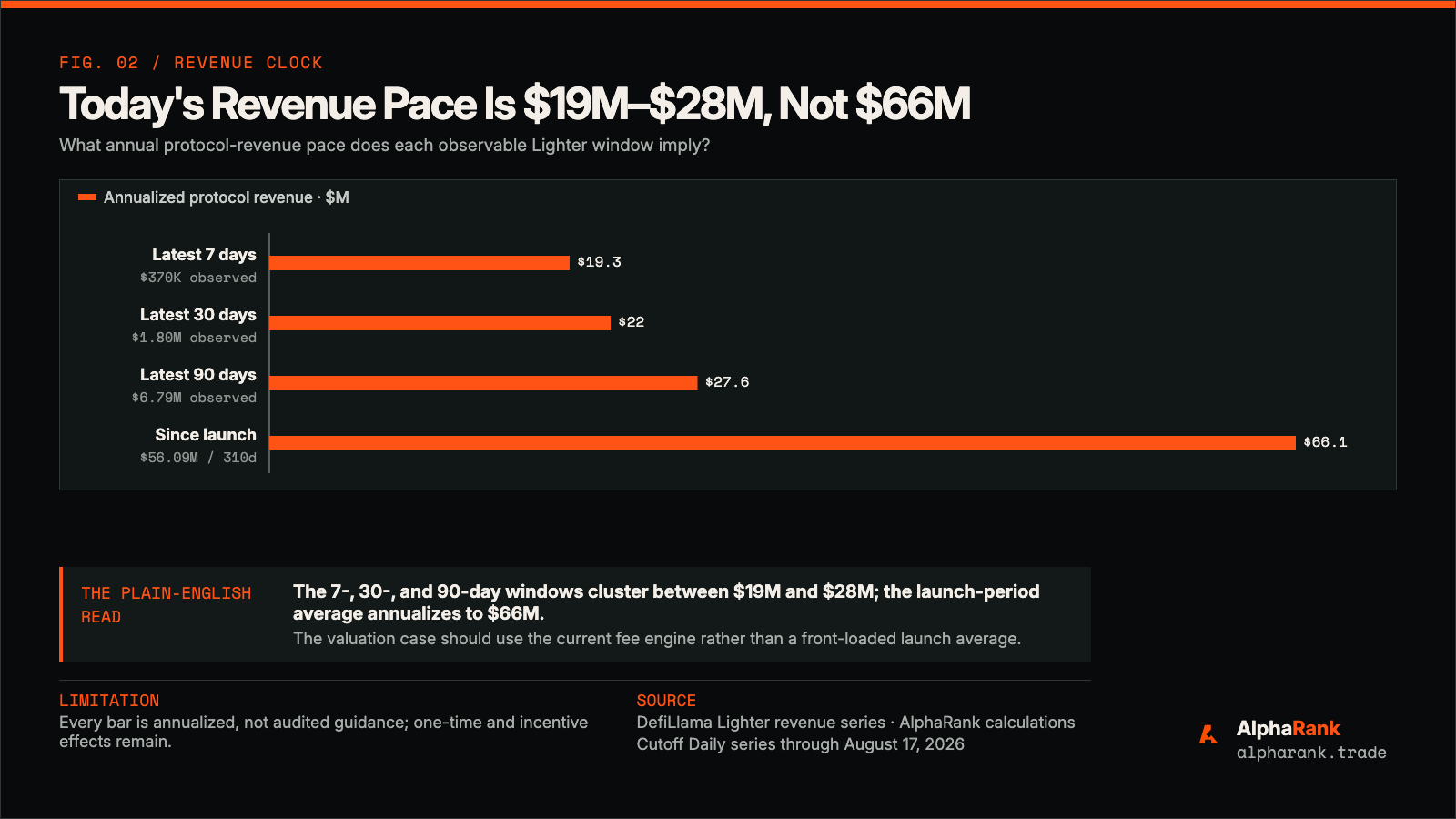
Lighter has collected $56.09M since the public series began in October 2025. Turning that whole launch period into a yearly rate produces about $66M, but that answer is misleading. Early trading and points make the past average look like today's business when it is not.
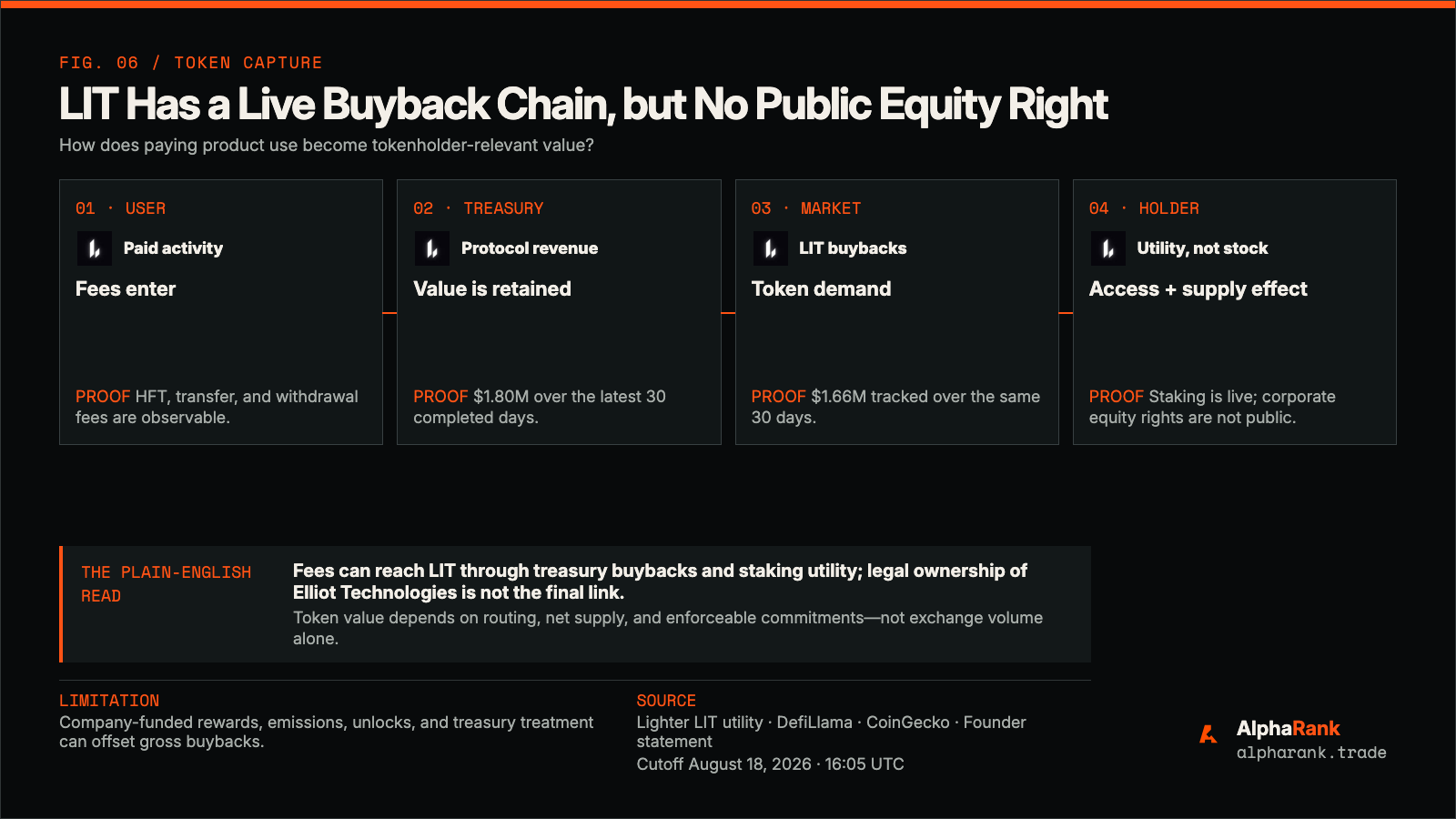
The latest 30 days also included $2.219M of total user fees and $1.662M of LIT buybacks. At that pace, buybacks would total about $20M a year.
These numbers describe the protocol, not Elliot Technologies. Public data does not show the company's payroll, incentives, infrastructure costs, legal bills, or profit. The exchange has a real fee business. We cannot tell whether the company is profitable.
The same market, two very different businesses.
Lighter and Hyperliquid both make an onchain order book feel like a fast exchange. Hyperliquid built its own blockchain. Its trading engine, applications, and HYPE token all live inside one growing financial network.
Lighter stays focused on the exchange and uses Ethereum as the place where its data and proofs settle. That is familiar to traders and institutions already comfortable with Ethereum. It also means users depend on Ethereum plus Lighter's own software and operator.
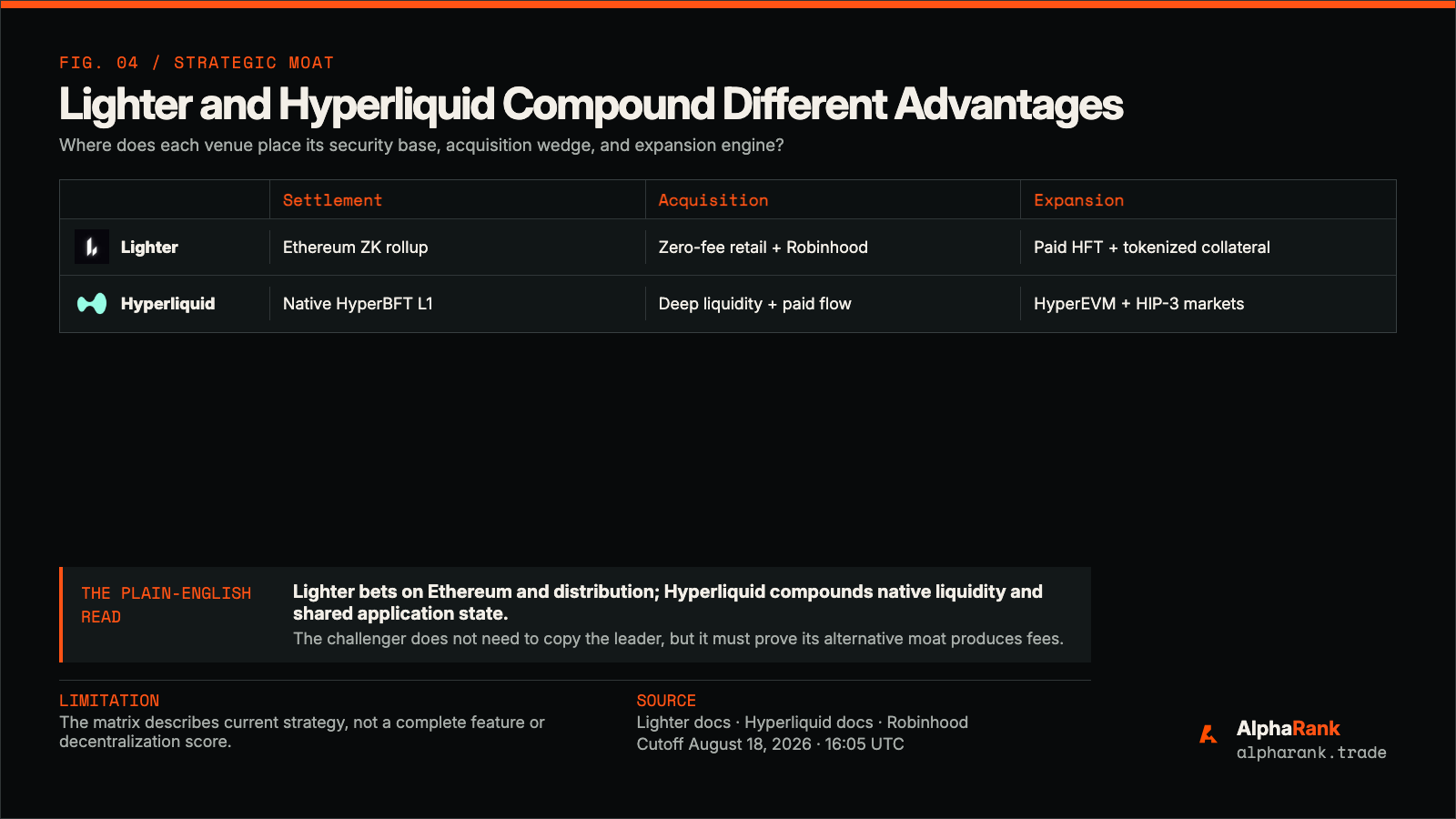
The fee strategies are just as different. Hyperliquid normally charges both sides of a trade, with discounts and rebates for larger users. Lighter makes standard trading free, then charges professional accounts for speed and capacity.
| Metric | Lighter | Hyperliquid perps | Lighter share |
|---|---|---|---|
| 30-day trading volume | $35.65B | $196.31B | 18.2% |
| Open positions | $0.95B | $12.25B | 7.8% |
| 30-day token-buyback revenue | $1.66M | $28.88M | 5.8% |
| Token market cap | $0.60B | $13.22B | 4.5% |
| Fully diluted token value | $2.38B | $59.44B | 4.0% |
Volume counts trades as they happen. Open interest counts positions that remain open. Lighter's 18.2% volume share falling to 7.8% open-interest share suggests that much of its activity turns over quickly instead of leaving capital on the exchange.
Revenue tells the same story. Hyperliquid produced roughly three times as much token-related revenue per dollar traded and about 17 times as much in total.
This is the correction to the “cheap Hyperliquid” story. Lighter is valued at about 4% of HYPE, but it also produces only about 6% as much token-buyback revenue. The valuation gap is real. So is the business gap.
Buybacks and useful staking benefits, not company ownership.
LIT has two clear jobs today. Lighter uses fee revenue to buy LIT in the market each day. Staking LIT also improves access to the product: one staked LIT allows up to 10 USDC of deposits into the Lighter Liquidity Pool, while larger stakes can lower professional fees and raise account limits.
Staking rewards attract buyers too, but part of the current yield is a subsidy. Lighter says company funds and revenue earned before the token launch help pay it. A planned marketplace could eventually let traders pay stakers for unused fee benefits. It was not live at the cutoff.
LIT has a maximum supply of one billion tokens, with 250M circulating. The team received 26% and investors 24%. Those allocations have a one-year lock followed by three years of gradual release. Ecosystem tokens can enter circulation too.
The founder has said that the old company shareholders no longer have an economic claim and that Lighter's value will flow to LIT. That is a strong promise. Public records show the buybacks and staking benefits, but they do not show a legal agreement that turns LIT into Elliot Technologies stock.
At the cutoff, LIT's circulating value was $595.7M and its fully diluted value was $2.383B. That equals about 27 times current protocol revenue using circulating value, or 109 times using the full token supply. These ratios compare price with activity. They do not give tokenholders ownership of the company.
Robinhood can bring customers. It does not own Lighter.
Robinhood is the clearest reason Lighter may grow faster than its current numbers suggest.
The relationship has four important parts. Robinhood invested in Lighter's $68M financing round through equity and token warrants. Robinhood Crypto lists LIT. Eligible users can trade Lighter perpetuals inside Robinhood Wallet. Lighter also set aside 11M LIT to reward Robinhood users.
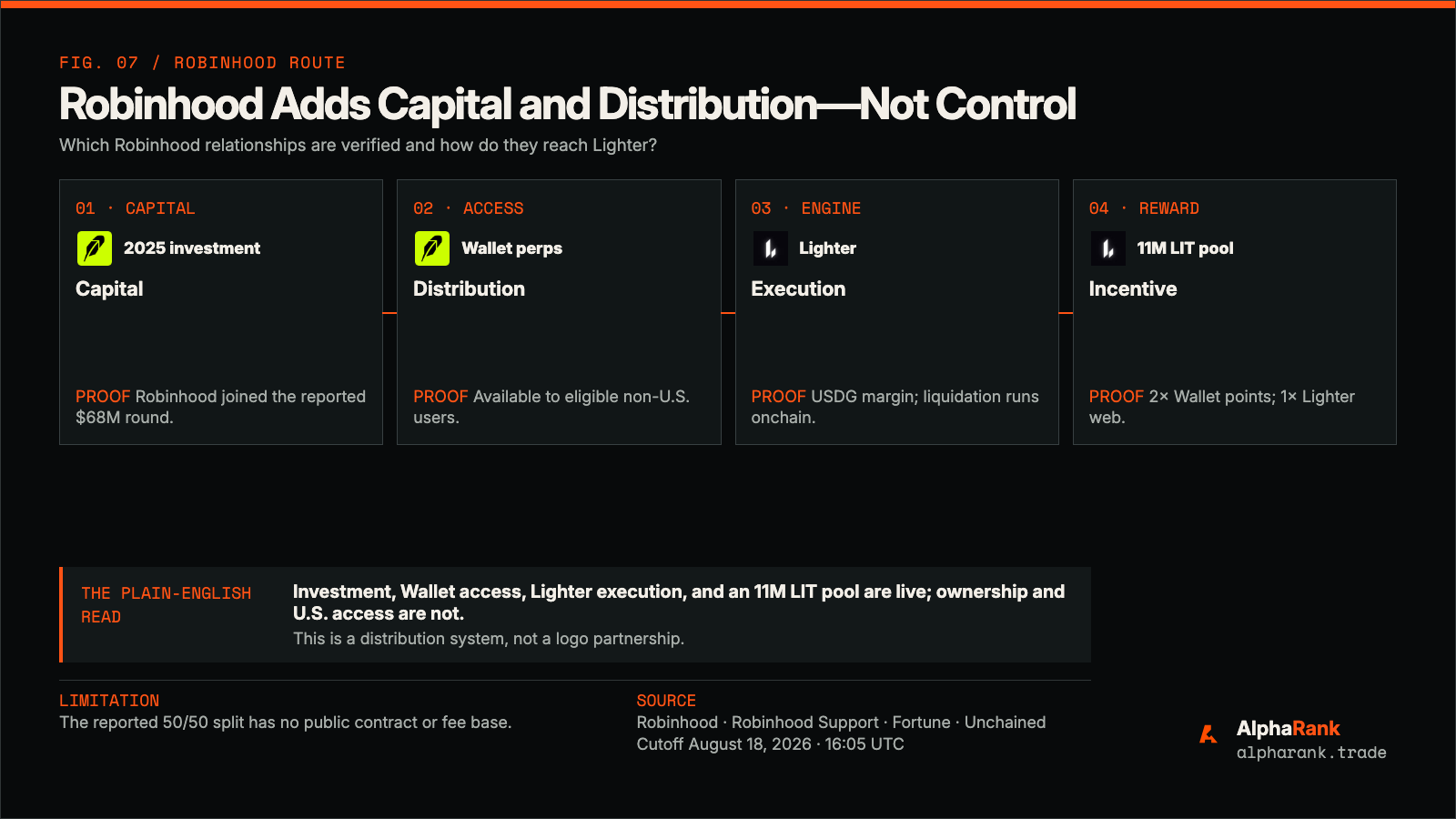
The Wallet product runs through Robinhood Chain, but Lighter handles the trading engine, margin, and liquidations. Robinhood says it cannot reverse a liquidation. Robinhood supplies the customer doorway while Lighter runs the exchange behind it.
The personal connection is real too. Vladimir Novakovski says he attended high school with Robinhood co-founder Vlad Tenev and advised Robinhood early. That history helps explain why the companies can work closely. It does not create ownership or control.
Novakovski has said the Wallet deal splits revenue equally. No public contract shows which fees are included, which costs come out first, how long the deal lasts, or where LIT fits. Tokenized stocks as Lighter collateral remain a future idea, not a material live business.
Robinhood says its non-custodial business is not affiliated with Lighter. The Wallet perps product excludes users in the United States, United Kingdom, Canada, Switzerland, the UAE, Singapore, and other restricted places.
Robinhood is an investor, a listing venue, a distributor, and a technical partner. The current product does not give Lighter legal access to U.S. customers.
A seat at the table is not a license.
Three separate facts often get compressed into “Lighter has a CFTC connection.”
First, Novakovski sits on the CFTC's Innovation Advisory Committee. The group brings industry leaders into policy discussions. Robinhood CEO Vlad Tenev and executives from Coinbase, Uniswap, CME, Cboe, and Nasdaq also sit on it.
That seat gives Lighter access to the conversation. It is not a license, approval, registration, exemption, or endorsement.
Second, Novakovski says Lighter is working toward a U.S. path for perpetual futures and hopes Robinhood could use it. No public filing identified the applicant, registration type, products, or case number at the cutoff. Work may be happening privately. The public record does not support saying an application is pending.
Third, the House passed the CLARITY Act in July 2025. The Senate listed a step toward debate in August 2026, but the bill had not become law at the evidence cutoff.
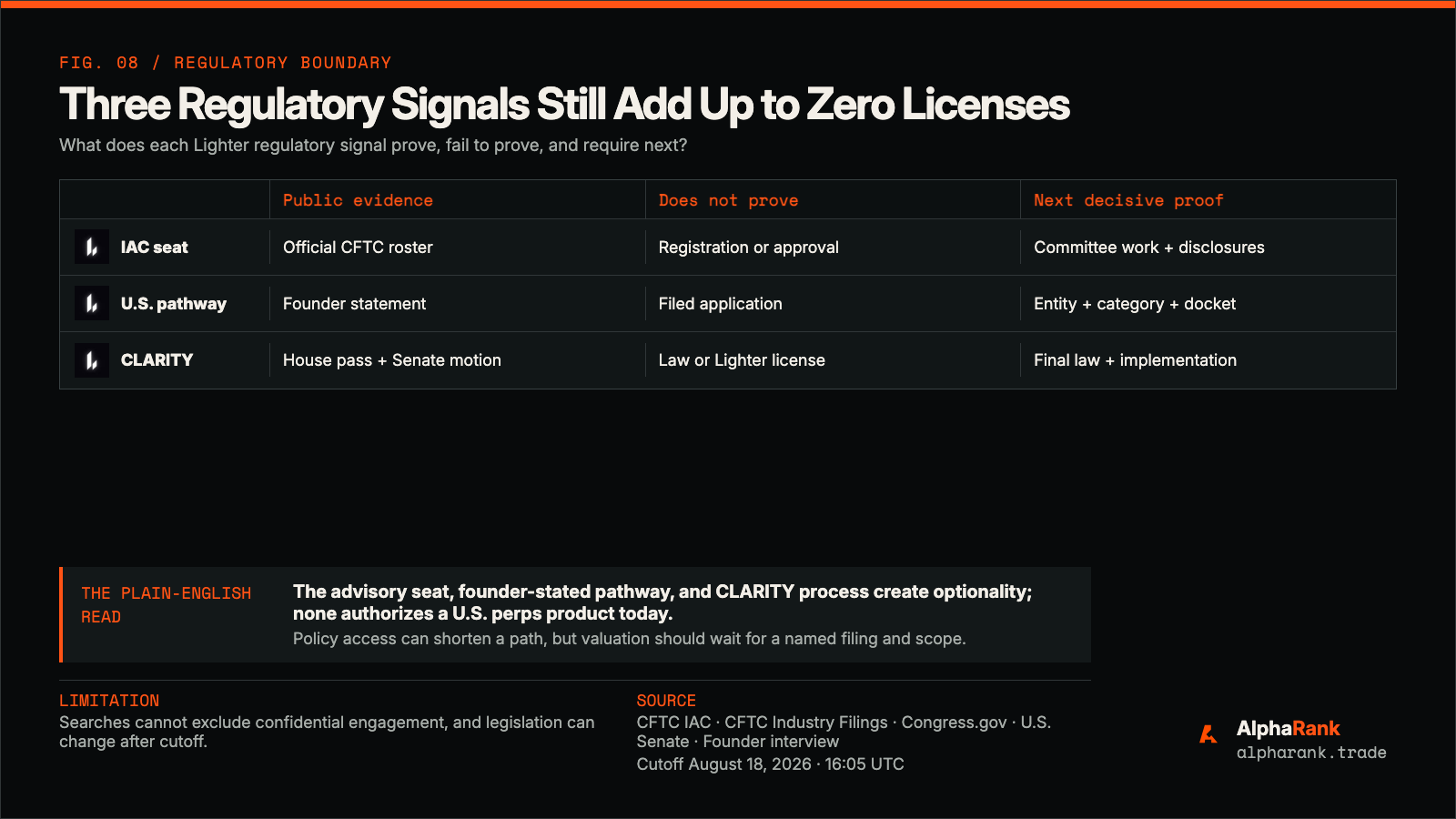
Even if a final law passes, Lighter would still need rules and approvals for its exact product. It may need new systems for customer checks, market surveillance, custody, clearing, and capital.
The optimistic case is easy to see. If the United States creates a workable path for crypto perpetuals, a U.S. company already talking with regulators and working with Robinhood could move faster than an offshore rival.
For now, that is a possible advantage, not permission to operate.
Lighter has three unusual ways to close the gap.
Exchange speed comes with proofs posted to Ethereum, a familiar home for crypto assets and institutions.
Standard users trade free, while professionals pay for better speed and capacity.
Robinhood brings investment, a token listing, Wallet placement, infrastructure, and a large customer doorway.
Buybacks and staking already connect exchange activity to LIT.
If Lighter takes even a modest share from Hyperliquid while preserving these links, a token worth about 4% as much as HYPE has room for a powerful rerating story.
Each strength has a matching risk. Free trading can disappear with rewards. Ethereum proofs do not remove operator control. Robinhood can rent users with an 11M LIT promotion without keeping them. Buybacks can lose to new supply. Regulatory work can take years.
Hyperliquid is not standing still. It already has deeper liquidity, more money in open positions, more applications, and a fee engine that can keep buying HYPE. Liquidity attracts more liquidity.
Lighter does not need to become as large as Hyperliquid for LIT to perform well. It does need to show that its advantages produce lasting customers and paid use, not just cheap volume.
Watch open interest and fee revenue first.
Those two numbers reveal whether free activity is becoming a durable business.
Protocol revenue grows faster than trading volume.
Open interest holds after the Robinhood rewards fade.
Buybacks beat unlocks, rewards, and other new supply.
A public record names the company, registration, products, customers, and status.
Mainnet moves beyond Stage 0 and every version has a safe independent withdrawal path.
Lighter currently supports about $22M of annualized protocol revenue and about $20M of annualized LIT buybacks. It has a real Robinhood partnership and a real voice in CFTC policy discussions.
It does not have a disclosed CFTC license. The CLARITY Act was not law at the cutoff. Robinhood does not disclose ownership or control of the protocol. LIT is not publicly documented as company stock.
Hyperliquid has already turned liquidity into a large, self-reinforcing financial network. Lighter has built a credible challenger with a different route to market.
LIT works if Lighter converts free volume into paid trading, Robinhood access into loyal users, and policy access into a legal product. If open interest and fees do not grow after incentives, the low valuation describes a smaller business, not a bargain.
Sources & methodology Official documentation, government records, independent technical reviews, frozen market data, and source-blind internal lead discovery · cutoff August 18, 16:05 UTC
Direct public evidence controls every promoted claim. Private research and model runs supplied leads only; their identities and raw text remain outside the report.
- Lighter website · PRIMARY
- Lighter Core architecture · PRIMARY DOCS
- Lighter account types and fees · PRIMARY DOCS
- LIT utility · PRIMARY DOCS
- Lighter mainnet review · INDEPENDENT TECHNICAL
- Lighter on Robinhood review · INDEPENDENT TECHNICAL
- Lighter fees, revenue, volume, and OI · INDEPENDENT · FROZEN
- Hyperliquid perps metrics · INDEPENDENT · FROZEN
- Hyperliquid architecture · PRIMARY DOCS
- Hyperliquid fee schedule · PRIMARY DOCS
- LIT market snapshot · INDEPENDENT · FROZEN
- HYPE market snapshot · INDEPENDENT · FROZEN
- Robinhood global expansion · PRIMARY
- Robinhood Wallet perps · PRIMARY SUPPORT
- Lighter financing · INDEPENDENT PRESS
- Founder interview on Robinhood · ATTRIBUTED INTERVIEW
- CFTC Innovation Advisory Committee · GOVERNMENT
- CFTC industry filings · GOVERNMENT
- H.R. 3633 status · GOVERNMENT
- Senate cloture table · GOVERNMENT
- Supplied Lighter / CLARITY thesis · SENTIMENT · TESTED
Revenue. Annualized values equal frozen window totals divided by complete days and multiplied by 365. They are run rates, not company guidance.
Comparison. Volume and OI use matching provider definitions. The report labels protocol revenue and holder revenue separately instead of treating them as GAAP sales.
Regulation. Advisory membership, legislation, filings, registrations, and approval are separate evidence states. Public zero-result searches cannot exclude confidential work.
Token rights. Buybacks and staking are economic mechanisms. They do not create a legal equity claim without corporate instruments.
Privacy. Private source identities, exact evidence mappings, raw transcripts, post text, and timestamps remain outside the public report.