HYPE: The Perps Leader Building a Financial Chain
Hyperliquid already owns the deepest onchain perpetual market. HIP-3, HyperEVM, and new distribution partners are testing whether that lead can become a broader financial network before specialized rivals peel away its users.

- Coverage
- Hyperliquid / HYPE / Perps
- Evidence cutoff
- August 3 · 16:00 UTC
Chapters
Hyperliquid has already won the first race. The second is much harder.
- The lead is real, but the popular headline is too simple.Hyperliquid represented about 39% of the full provider-tracked 30-day volume universe and roughly 62% of open interest at the cutoff. Inside the frozen seven-venue peer set used here, its volume share was 68.5%. The moat looks strongest in risk that stays, not notional that briefly passes through.
- HIP-3 is already a second engine.Builder-deployed markets held about $3.83 billion of open interest and produced $4.23 billion of observed daily volume. Almost all of that activity sat inside one deployment, XYZ, so the product works before the builder economy is diversified.
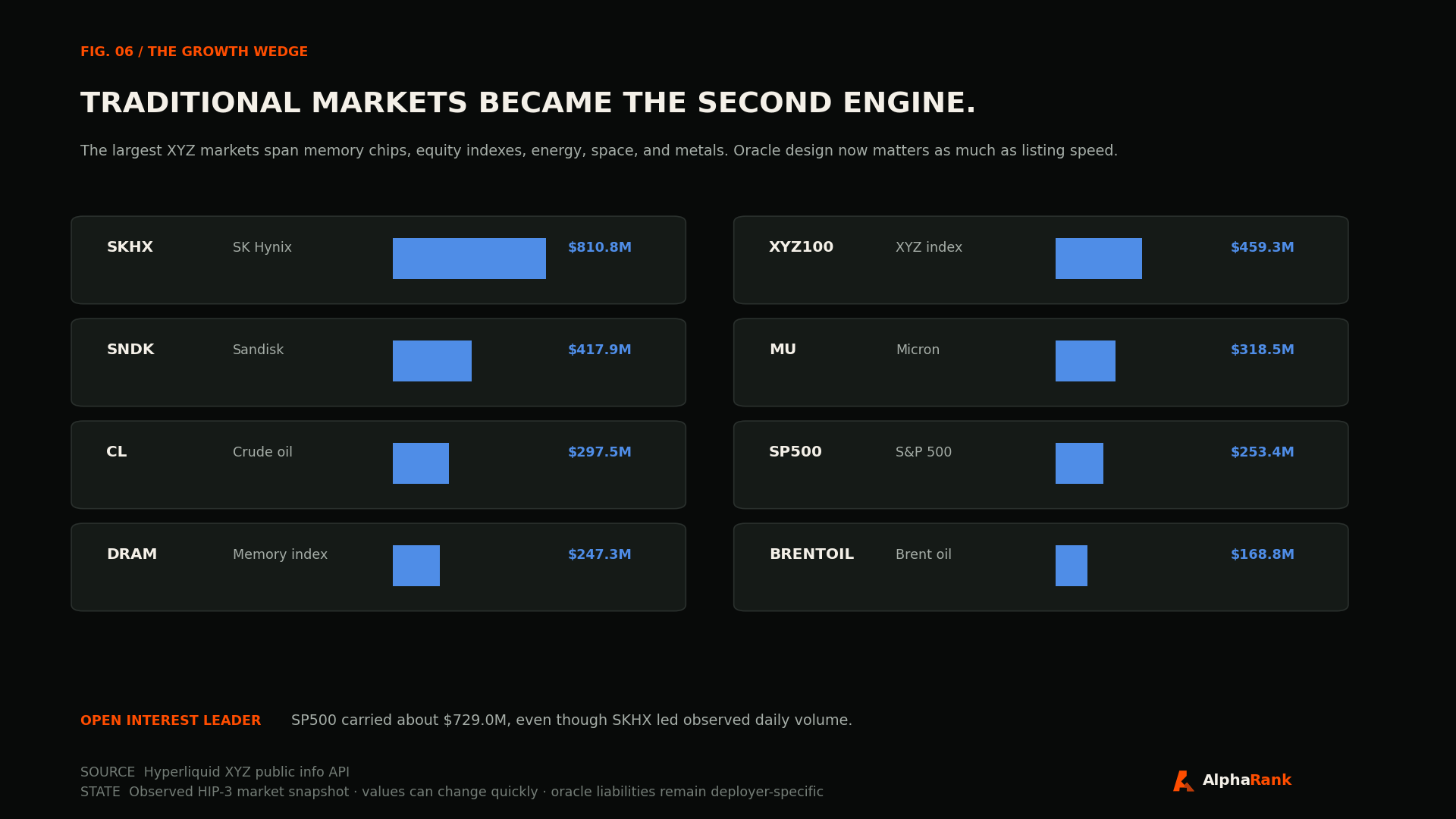
- Traditional markets became the growth wedge.Semiconductors, equity indexes, energy, metals, and space-related markets led XYZ activity. Hyperliquid is no longer competing only for crypto-native leverage.
- The HYPE loop is powerful but often overstated.Trading fees can flow into the Assistance Fund and support HYPE purchases. Purchases, burns, staking rewards, and new token issuance remain different accounting lines. Gross value capture is clear. Net deflation still needs a complete supply bridge.
- The competitors are attacking different parts of the stack.Aster competes on cross-chain reach and fees. Lighter competes on proof systems and zero-fee standard accounts. Jupiter and Velocity attack from Solana distribution. GMX uses pool liquidity. dYdX remains an appchain order book. One league table hides those product differences.
- Institutional access is moving from theory to distribution.Coinbase and Circle aligned Hyperliquid markets around USDC, while Cboe launched a HYPE-linked ETF. Access is widening without removing custody, governance, oracle, or regulatory risk.
- The next proof is distribution beyond the native interface.Hyperliquid becomes financial infrastructure when external apps, builders, and exchanges deliver meaningful recurring order flow. Until then, it is a durable exchange franchise with an emerging, not fully proven, financial-chain identity.
The product began as an exchange. It now wants to become the market underneath other products.
Most decentralized exchanges rent their execution environment from a general-purpose chain. Hyperliquid built the exchange, the matching system, the margin engine, and the chain around the same product.
HyperCore runs native spot and perpetual order books, margining, liquidations, and staking. HyperEVM lets general-purpose applications share the same underlying chain. HIP-3 lets outside builders deploy new perpetual markets after posting a large HYPE stake and accepting an isolated risk model.
The distinction is more than branding. HyperCore and HyperEVM share HyperBFT, but they serve different workloads. The native exchange can prioritize order entry, cancellations, and risk checks while applications use an EVM-compatible environment. Hyperliquid documents median transaction latency near 0.2 seconds, a 0.9-second 99th percentile, and capacity of roughly 200,000 orders per second. Those are protocol targets and reported operating characteristics, not guarantees that every user receives identical execution.
That design explains both the bull case and the risk. A vertically integrated system can be faster, cheaper, and economically tighter than contracts spread across unrelated infrastructure. It can also concentrate important decisions in one validator set, one bridge design, one oracle framework, and one governance path.
Can Hyperliquid turn exchange liquidity into a reusable financial network before specialized rivals win the next products and users?
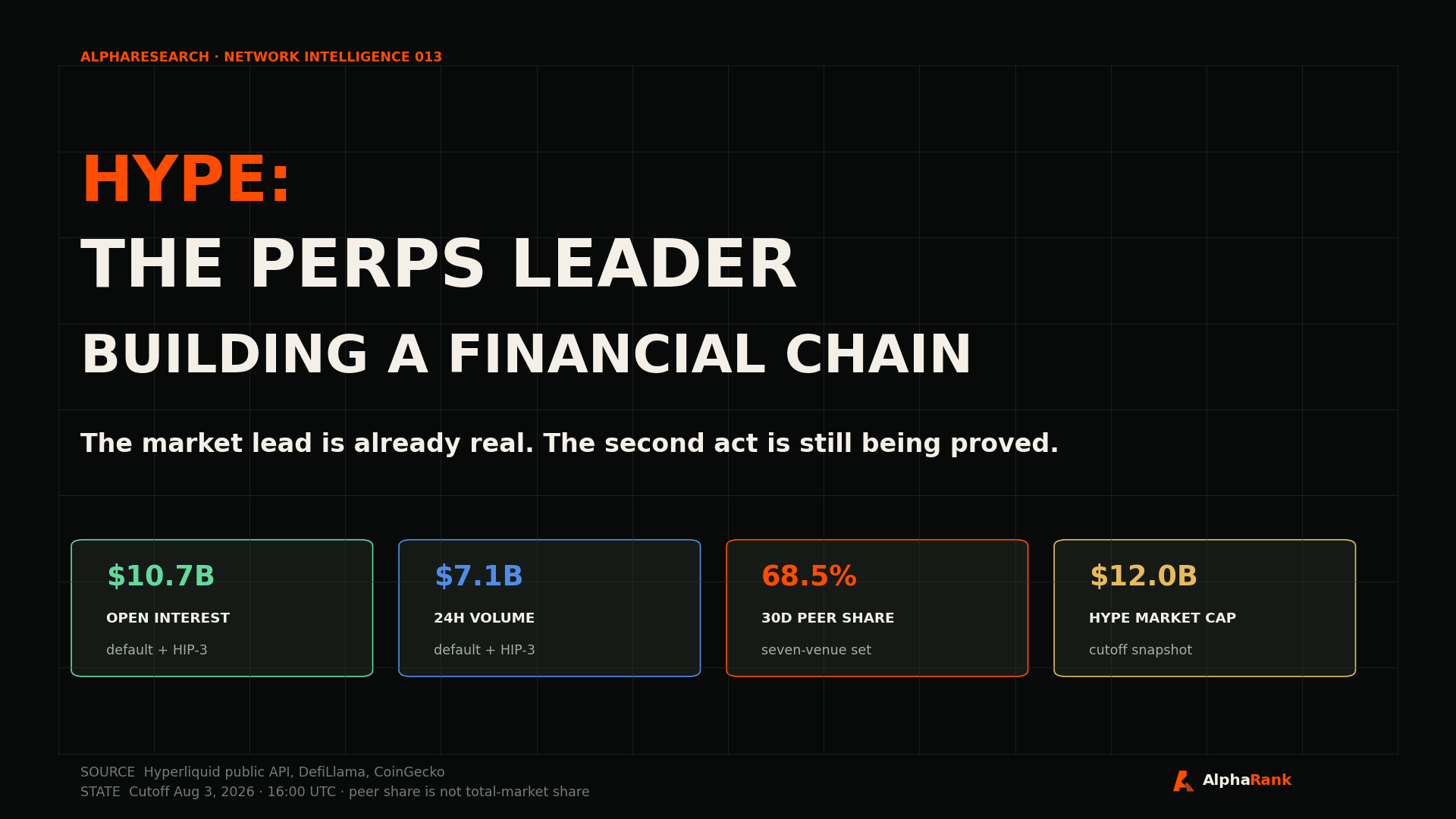
Hyperliquid leads the market that matters most: capital traders are willing to leave at risk.
At the cutoff, the default Hyperliquid book held about $6.89 billion of open interest. HIP-3 deployments added about $3.83 billion. Together, the system carried roughly $10.72 billion of open perpetual risk.
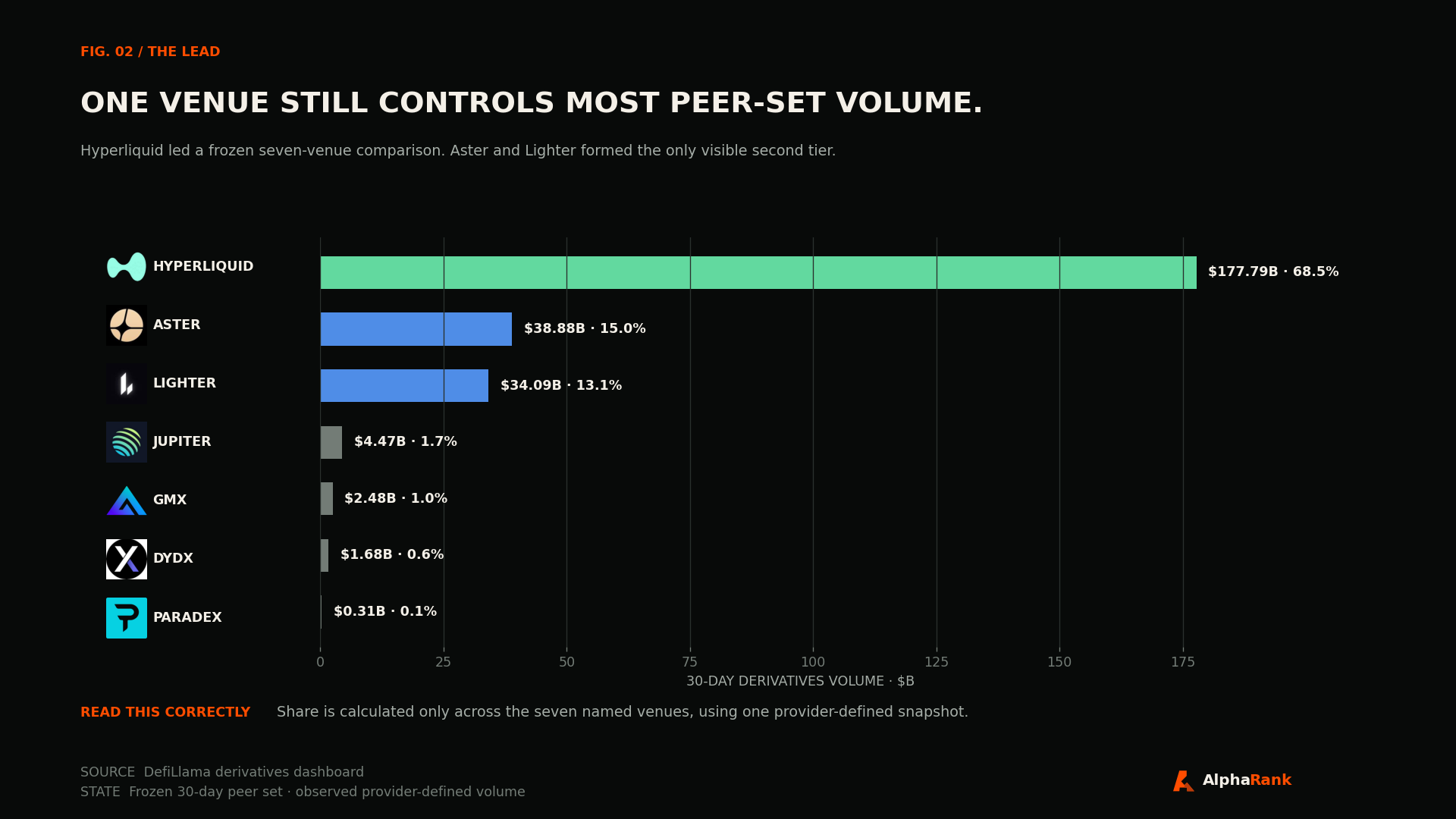
Volume tells a more contested story. The default book produced about $2.87 billion of observed daily volume and HIP-3 produced about $4.23 billion. Across the full provider-tracked market, Hyperliquid's share of 30-day notional was closer to 39% than the frequently repeated 70% claim. The wider universe includes more venues and more short-lived turnover.
Our seven-venue comparison freezes Hyperliquid, Aster, Lighter, Jupiter, GMX, dYdX, and Paradex under one provider methodology. Hyperliquid accounted for 68.5% of that set's volume. This is a peer-set comparison, not a claim about every derivatives venue in existence.
Revenue confirms that the lead is more than wash-prone notional. Under the same provider definitions, Hyperliquid generated about $33.5 million of protocol revenue over the preceding 30 days. edgeX V2 and Lighter were near $2.2 million and $2.0 million, while Jupiter, GMX V2, and dYdX V4 were lower. Revenue definitions vary across protocols, so the comparison is directional. It still shows a much wider economic lead than a volume-only table suggests.
Hyperliquid is an exchange, a chain, and a permissionless market-creation layer.
The easiest mistake is to treat those three jobs as one feature. Each expands the addressable market in a different way.
HyperCore is the exchange and risk engine. HyperEVM gives applications a programmable environment that can interact with the chain's native financial state. HIP-3 lets builders create isolated perpetual markets after self-delegating 500,000 HYPE. Builders choose important market parameters and remain responsible for oracle design and settlement.
At the cutoff price, that HIP-3 stake represented roughly $27 million. The gate aligns builders with the network and creates demand for HYPE, but it also limits who can experiment. HIP-3 markets remain isolated from one another, which contains contagion but gives up some of the capital efficiency of a single fully shared margin pool.
The full stack gives builders something most chains cannot: an existing pool of traders, collateral, matching infrastructure, and portfolio context. The price is dependence on Hyperliquid's rules and a large HYPE capital gate.

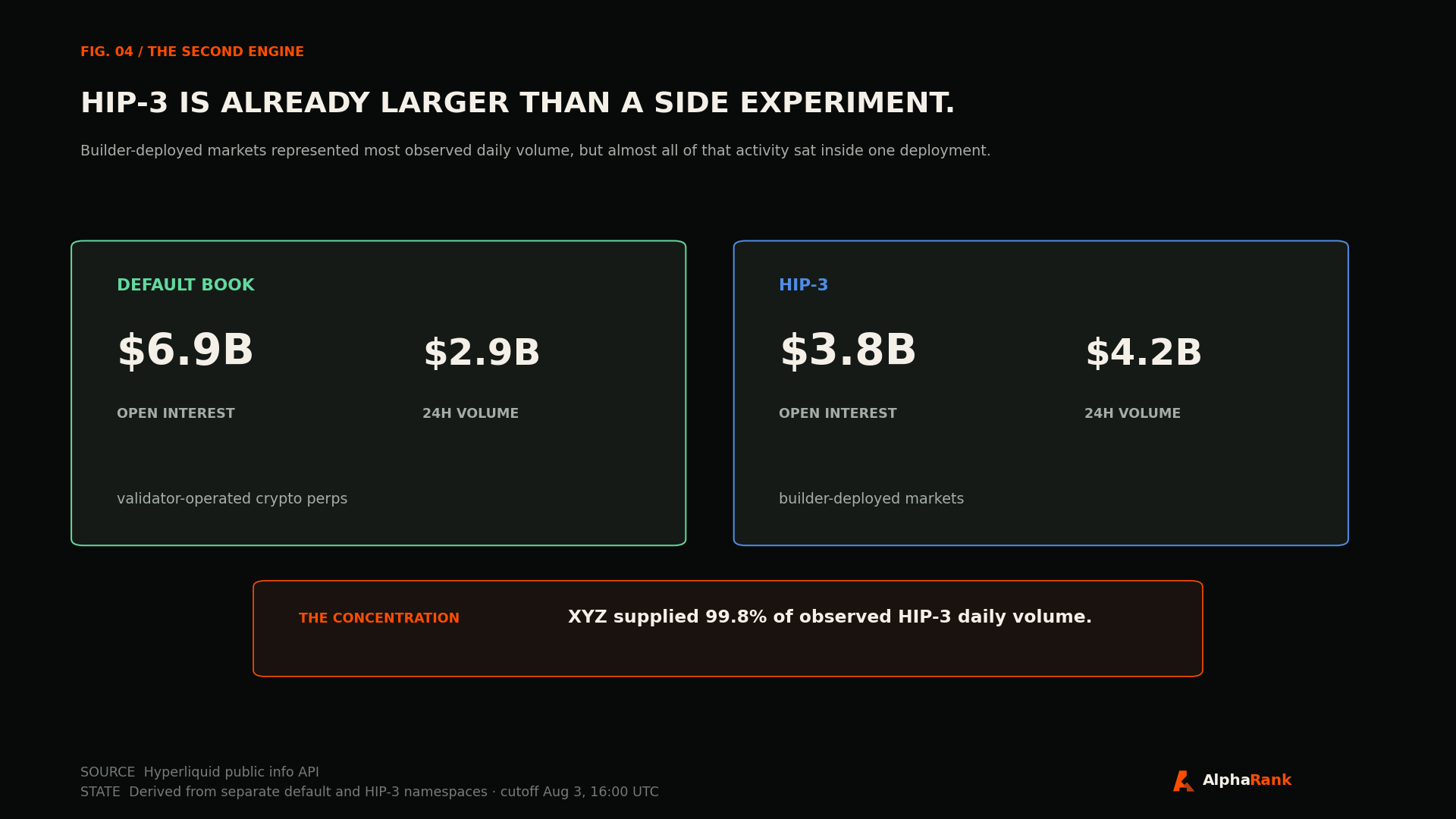
HIP-3 is already material. It is not yet a diversified builder economy.
The builder-deployed side of Hyperliquid was larger than the default book in observed daily volume at the cutoff. That is an extraordinary result for an extension that is still early.
But the concentration matters. XYZ represented almost all active HIP-3 open interest and volume. The other observed deployments were small. The evidence proves one capable builder can use Hyperliquid to create a large new market category. It does not yet prove many independent builders can do it.
The concentration also changes how the headline should be read. HIP-3 did not suddenly create a broad permissionless marketplace with dozens of equally successful operators. It created a mechanism through which one builder found a strong product wedge. That is a significant platform proof, but only the first one.
This is the decisive bridge in the infrastructure thesis. If several builders develop distinct markets, attract external order flow, and retain users, Hyperliquid becomes a platform. If one deployment remains the engine, the system is a larger vertically integrated exchange.
Trading creates a visible token sink. The complete earnings bridge is still unfinished.
A token thesis needs more than a large exchange. It needs a clear answer to what the business earns, where the cash goes, and what changes for each token holder.
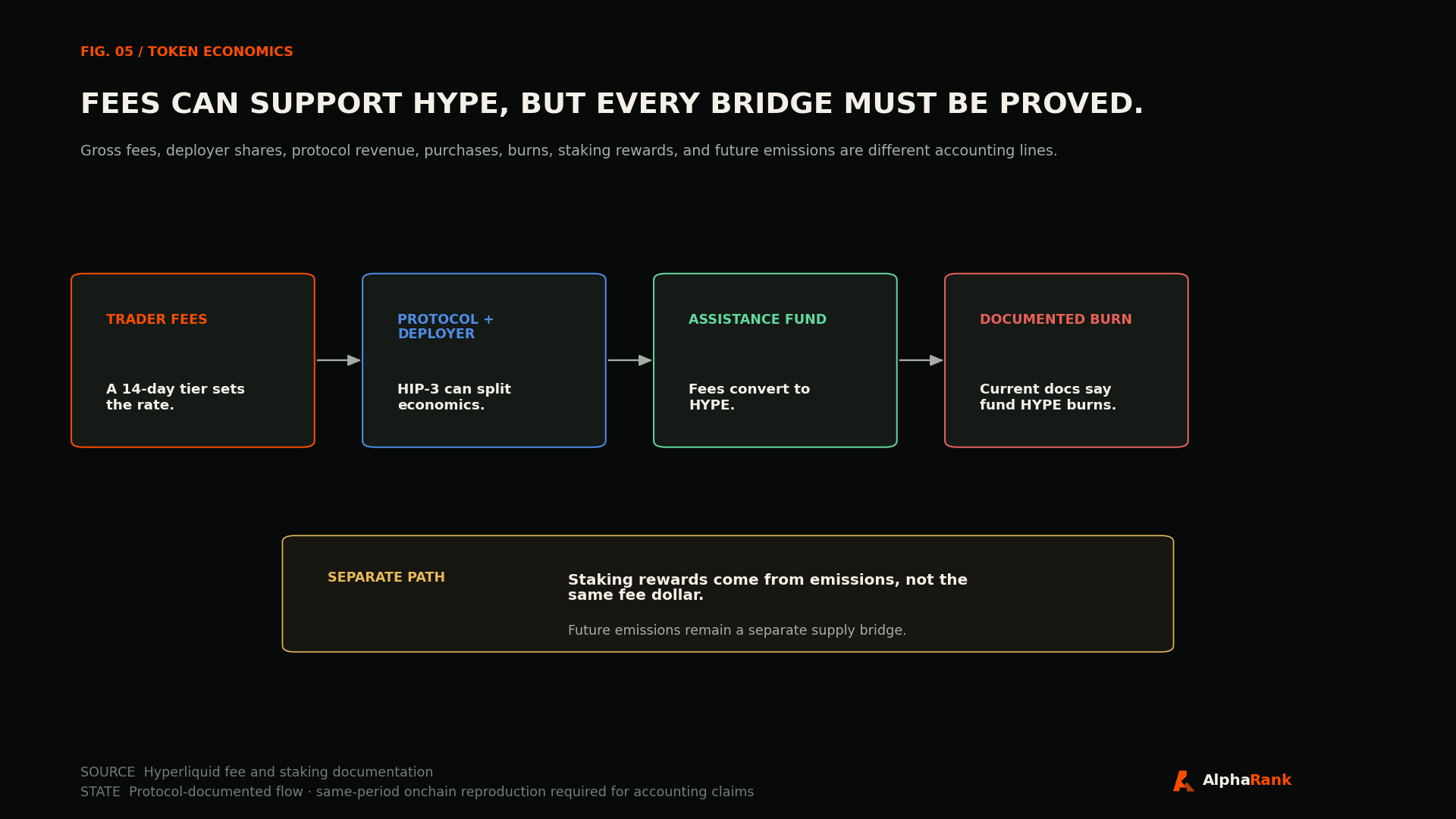
Hyperliquid uses a rolling 14-day fee schedule, with a documented base taker fee of 0.045% and maker fee of 0.015%. HIP-3 deployers can receive part of the economics, and growth mode can sharply reduce fees. The Assistance Fund uses protocol revenue to acquire HYPE.
The language must stay precise. Gross trading fees are not protocol revenue. Protocol revenue is not the same as Assistance Fund purchases. Purchases are not automatically identical to independently verified burns. Burns do not establish net deflation unless they exceed all new issuance and other supply changes.
The supply side is material. HYPE traded near $53.93 with about 222.4 million tokens circulating, compared with roughly 955.3 million total units and a one-billion maximum. That produced a market value near $12.0 billion and a fully diluted value near $53.9 billion. Unlocks, rewards, treasury movements, and Assistance Fund activity therefore matter alongside exchange earnings.
The strongest defensible statement is that Hyperliquid has one of crypto's clearest gross token-support mechanisms. The stronger statement, that HYPE is durably net deflationary, still requires a reconciled supply bridge over time.
The busiest new markets look less like crypto and more like a 24-hour global broker.
HIP-3's largest XYZ markets were linked to memory chips, equity indexes, energy, space, and metals. SKHX alone produced roughly $811 million of observed daily volume, followed by the XYZ100 index, Sandisk, Micron, crude oil, and the S&P 500 market.
That matters because traditional assets expand Hyperliquid beyond a fixed pool of crypto leverage. They also create new operational liabilities. Equity-market hours, price gaps, corporate actions, contract specifications, and oracle failures can produce losses that a standard crypto perpetual does not.
A late-July SK Hynix incident made the risk concrete. Public reporting described a price-feed problem and tens of millions of dollars of liquidations before the deployer committed to cover losses. The event did not prove HIP-3 failed. It proved builder-level oracle design is part of the product.
The next Hyperliquid is not one project. It is four different attacks on the same profit pool.
The trading screens look similar. The underlying products are not.
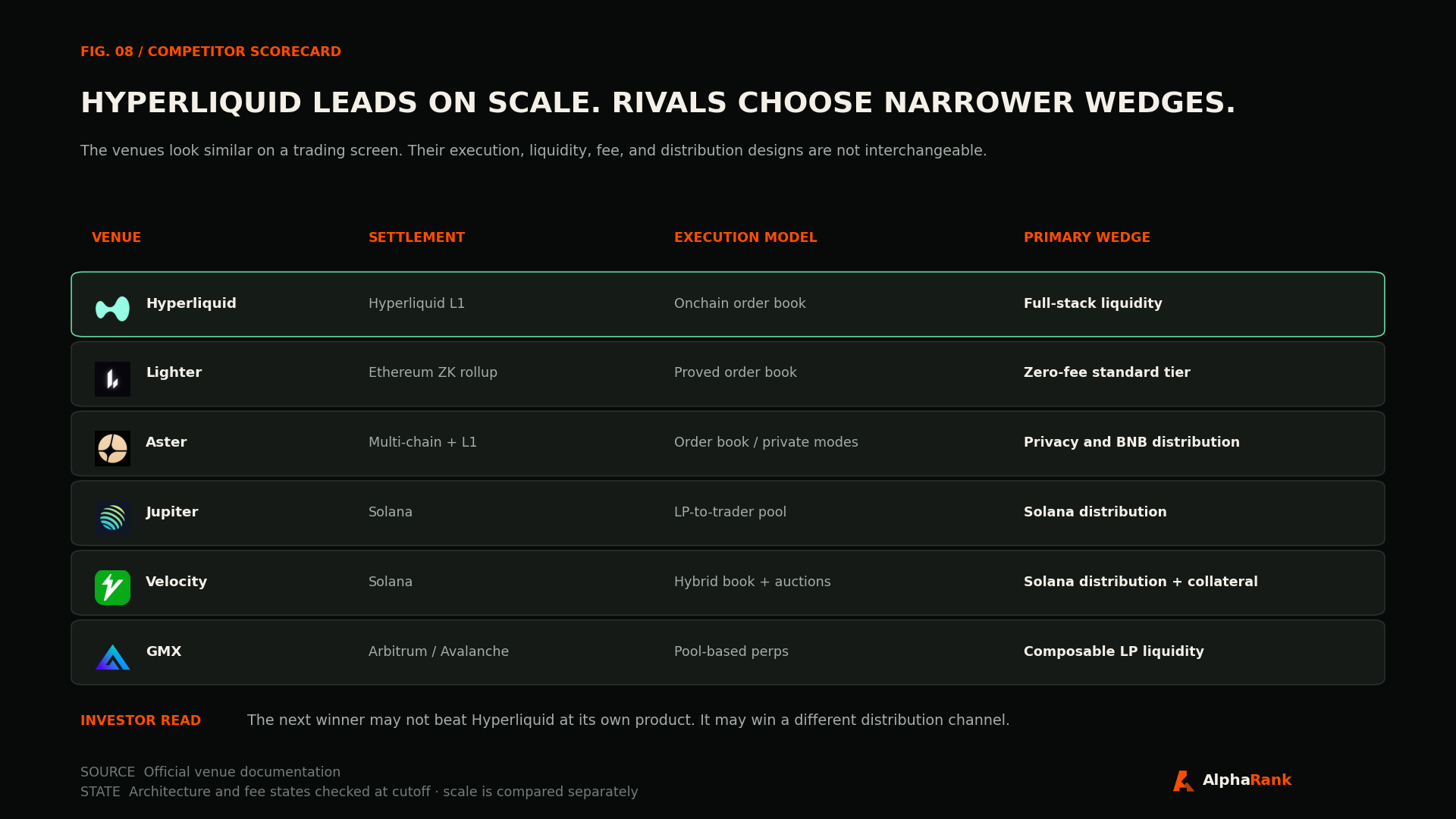
Appchain order books such as Hyperliquid and dYdX control their execution environment. Lighter uses a custom Ethereum zero-knowledge rollup and competes on verifiability and zero-fee standard accounts. Aster spans multiple chains and attacks fees, distribution, and privacy. Jupiter and Velocity use Solana's native users and liquidity. GMX uses liquidity pools instead of a conventional central limit order book.
This fragmentation changes how traders should think about beta. A competitor can grow without replacing Hyperliquid. It can win one chain, one account type, one distribution channel, or one market structure. The useful question is not “who is next?” It is “which part of the stack is vulnerable next?”
Aster attacks access and headline price. It places perpetual markets across BNB Chain, Ethereum, Solana, and Arbitrum, and its published schedule lists a zero maker fee and a 0.04% taker fee for the relevant tier. The tradeoff is a product spread across several execution environments rather than one native liquidity system.
Lighter attacks verifiability and active-trader cost. Its custom Ethereum rollup uses zero-knowledge proofs and offers zero-fee standard accounts. Premium accounts pay for additional capabilities. This makes Lighter a direct test of whether transparent execution and fee compression can pull high-frequency flow away from a vertically integrated L1.
Jupiter and Velocity attack distribution. Both begin with Solana users, wallets, collateral, and routing rather than asking traders to adopt a new chain first. Jupiter uses an LP-to-trader model. Velocity combines a decentralized order book, auctions, keepers, and automated liquidity. It is a new deployment with no state carried over from the paused legacy Drift program. Their wedge is not a generic claim to be faster. It is being available where a large trading community already lives.
GMX, dYdX, and Paradex preserve three other models. GMX remains a pool-liquidity venue on Arbitrum and Avalanche. dYdX remains an appchain order book with its own integration and governance path. Paradex builds around a Starknet-based appchain and privacy-oriented market design. The category is converging on the same trading demand while diverging on how liquidity, proofs, and control are organized.


HYPE is the leader. The next trade depends on which advantage the market decides to reward.
Crypto rotations usually begin with a leader, then search for cheaper or earlier versions of the same story. The danger is assuming every perps token is interchangeable beta.
Aster and Lighter are the closest volume challengers in the frozen peer set, but their narratives are different. Aster offers cross-chain reach and low headline fees. Lighter offers Ethereum alignment, proofs, and a zero-fee standard tier. Jupiter and Velocity are Solana distribution trades. GMX is a pool-liquidity and fee-economics trade. dYdX is an appchain recovery trade. Paradex is a Starknet-native product and privacy bet.
For HYPE, the next upside narrative is no longer “perps are growing.” The market already knows that. The stronger catalyst is proof that external distributors and independent builders can turn Hyperliquid liquidity into new products. The risk is that fee compression and specialized competitors grow faster than the platform expands.
The token map is also uneven. HYPE gives traders a direct liquid claim on the leader's network economics. Some competitors have liquid tokens with different fee rights and emissions. Others offer product exposure without a clean token proxy. That makes a simple market-cap comparison misleading. The better sequence is product adoption, retained open interest, protocol revenue, token destination, then valuation.
Follow the leader for scale, then follow the constraint. If the constraint is fees, watch Aster and Lighter. If it is chain-native distribution, watch Jupiter and Velocity. If it is new markets, watch HIP-3 builders. If it is institutional access, watch the USDC and listed-product channels.
The moat and the failure modes come from the same full-stack control.
Liquidity, low-latency execution, unified margin, builder distribution, and the fee-to-HYPE loop can compound together. So can oracle, validator, bridge, governance, and fee-compression risk.
The system remains dependent on a comparatively concentrated validator and software path. HIP-3 shifts some responsibilities to builders, but it does not remove the platform's reputational exposure when a builder market fails. HyperEVM and distribution partnerships increase surface area. They also give competitors more places to attack with specialized products.
Regulation can cut both ways. Perpetual futures remain restricted in several major markets, while synthetic exposure to equities and commodities introduces another layer of legal and market-structure questions. Listed HYPE access and institutional USDC distribution broaden the audience. They do not make the underlying derivatives venue equivalent to a regulated futures exchange.
The bull case does not require Hyperliquid to eliminate every rival. It requires the native liquidity network to remain the best place to launch, distribute, and margin new financial markets. The bear case begins when volume migrates faster than builders, collateral, and recurring fees can defend that network effect.

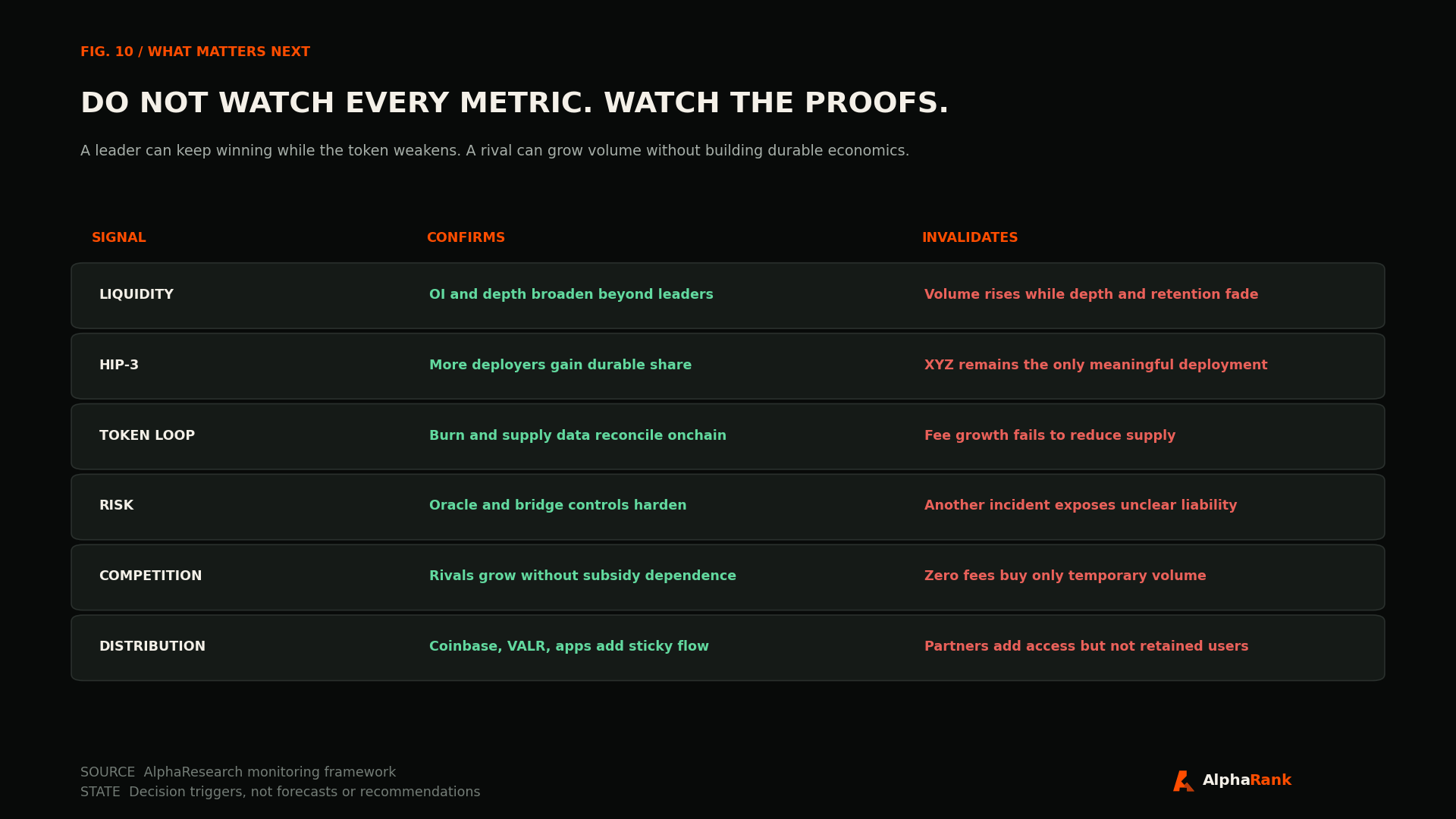
Do not watch every number. Watch the proof that the exchange is becoming infrastructure.
Six signals would make the broader financial-chain thesis materially stronger.
HIP-3 activity spreads beyond XYZ into several independent deployments with durable open interest.
Third-party apps and exchanges contribute measurable recurring order flow rather than announcements alone.
HyperEVM and new market types generate meaningful fees without weakening the core trading experience.
Assistance Fund purchases and burns exceed issuance on a complete, reproducible HYPE supply bridge.
Oracle, validator, bridge, and upgrade controls become more transparent as the system expands.
Hyperliquid preserves open interest and recurring fee share even if rivals win low-fee volume.
Sources & methodologyPublic protocol, market, and regulatory evidence · source-blind internal synthesis · cutoff August 3, 16:00 UTC
Reader-facing claims link directly to publishable evidence. AlphaRank's private transcript and X library was used to find recent developments, disagreements, and missing questions. Public claims were then checked independently. Private source identities and exact internal provenance remain outside the public report.
- Hyperliquid protocol documentationPRIMARY
- Trading fees and Assistance FundPRIMARY
- HyperCore architecturePRIMARY
- HIP-3 builder-deployed perpetualsPRIMARY
- Cross-venue perpetual market dashboardDEFILLAMA
- Hyperliquid collateral and revenueDEFILLAMA
- HYPE market and supply snapshotCOINGECKO
- Coinbase and Circle USDC alignmentCOINBASE
- Cboe HYPE-linked ETF circularCBOE
- SK Hynix HIP-3 oracle incidentCOINDESK
- Aster perpetual productPRIMARY
- Aster fee schedulePRIMARY
- Lighter architecturePRIMARY
- Velocity execution and liquidity designPRIMARY
- Jupiter perpetual exchangePRIMARY
- GMX V2 pool-based perpetualsPRIMARY
- dYdX chain and integration documentationPRIMARY
- Paradex appchain architecturePRIMARY
- AlphaRank source-blind market synthesisINTERNAL
Market data. Dynamic API and provider values were frozen at the report cutoff. Figures may differ from live dashboards.
Peer set. The seven-venue comparison is intentionally narrower than the full DeFiLlama universe and is labeled as such.
HIP-3. Default-book and builder-deployed activity are reported separately before they are combined.
Fees. Gross fees, protocol revenue, deployer revenue, purchases, burns, staking rewards, and issuance are separate lines.
Private research. Evidence IDs, source identities, timestamps, hashes, and exact context remain in the internal audit ledger.
Use. Observations and scenarios are research, not investment advice or a recommendation.