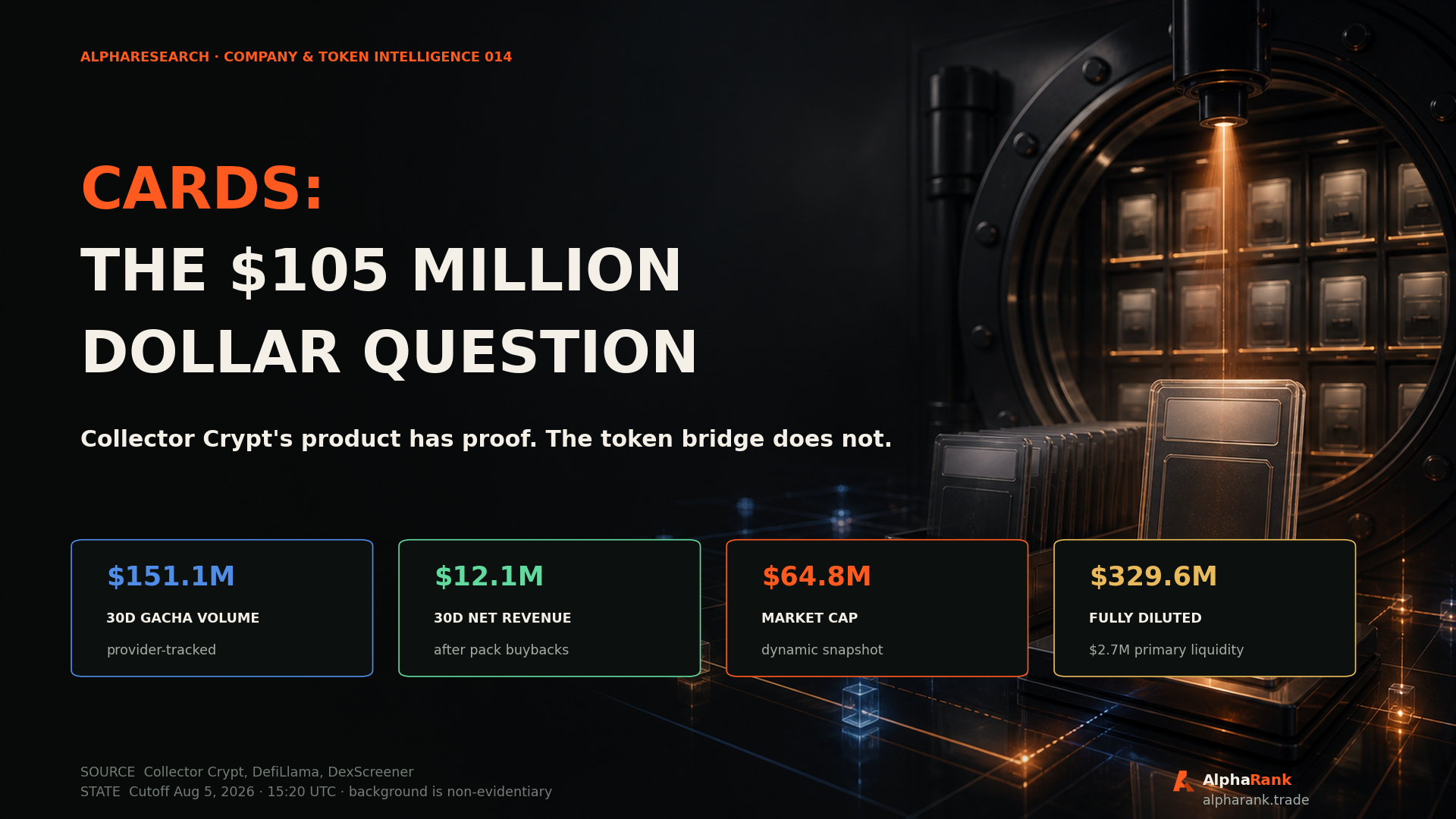
CARDS: The $105 Million Dollar Question
Collector Crypt has built a fast-growing onchain collectibles engine and expanded it through Solflare, Rarible, and Jupiter. The harder question is whether CARDS owns any durable claim on that engine before dilution and legal ambiguity arrive.

- Coverage
- Collector Crypt / CARDS
- Evidence cutoff
- August 5 · 15:20 UTC
Chapters
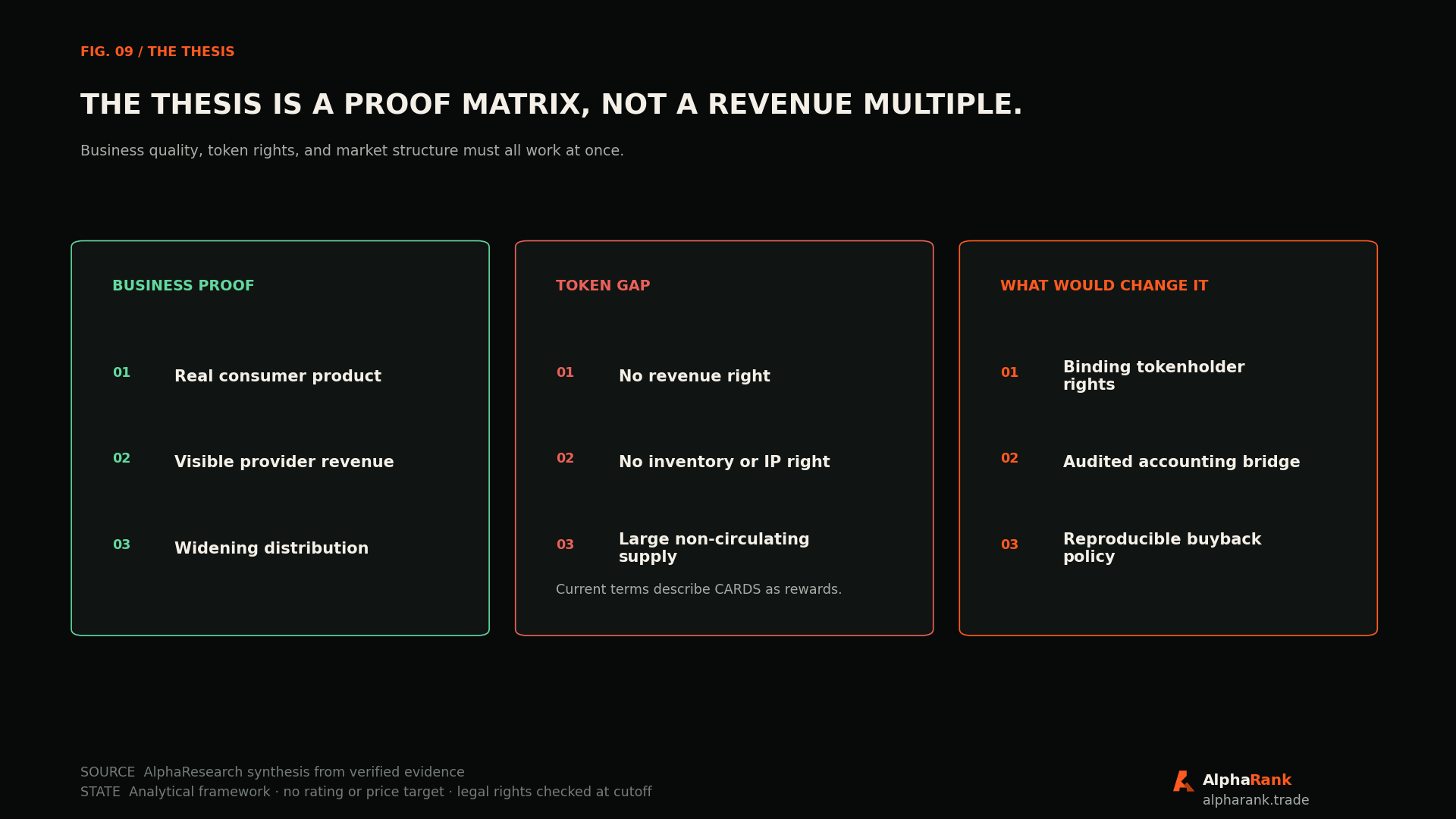
The operating proof is stronger than the token's legal claim.
- Collector Crypt is a real consumer product, not a dashboard narrative.The live marketplace listed 101,060 cards at the cutoff. Official documents describe randomized USDC packs, specific vaulted-card NFTs, instant sellbacks, secondary trading, and physical redemption.
- Accessible economics show rapid growth, but not the headline everyone repeats.DefiLlama reported $151.1 million of 30-day gacha volume and $12.1 million of provider-defined net revenue. That series does not subtract COGS or secondary-market repurchases, so it is not gross profit.
- The $105 million gross-profit run-rate remains unresolved.The user-supplied thesis article discloses that its author holds CARDS and cites a paid dashboard. We verified the methodology but could not reproduce the underlying monthly gross-profit export.
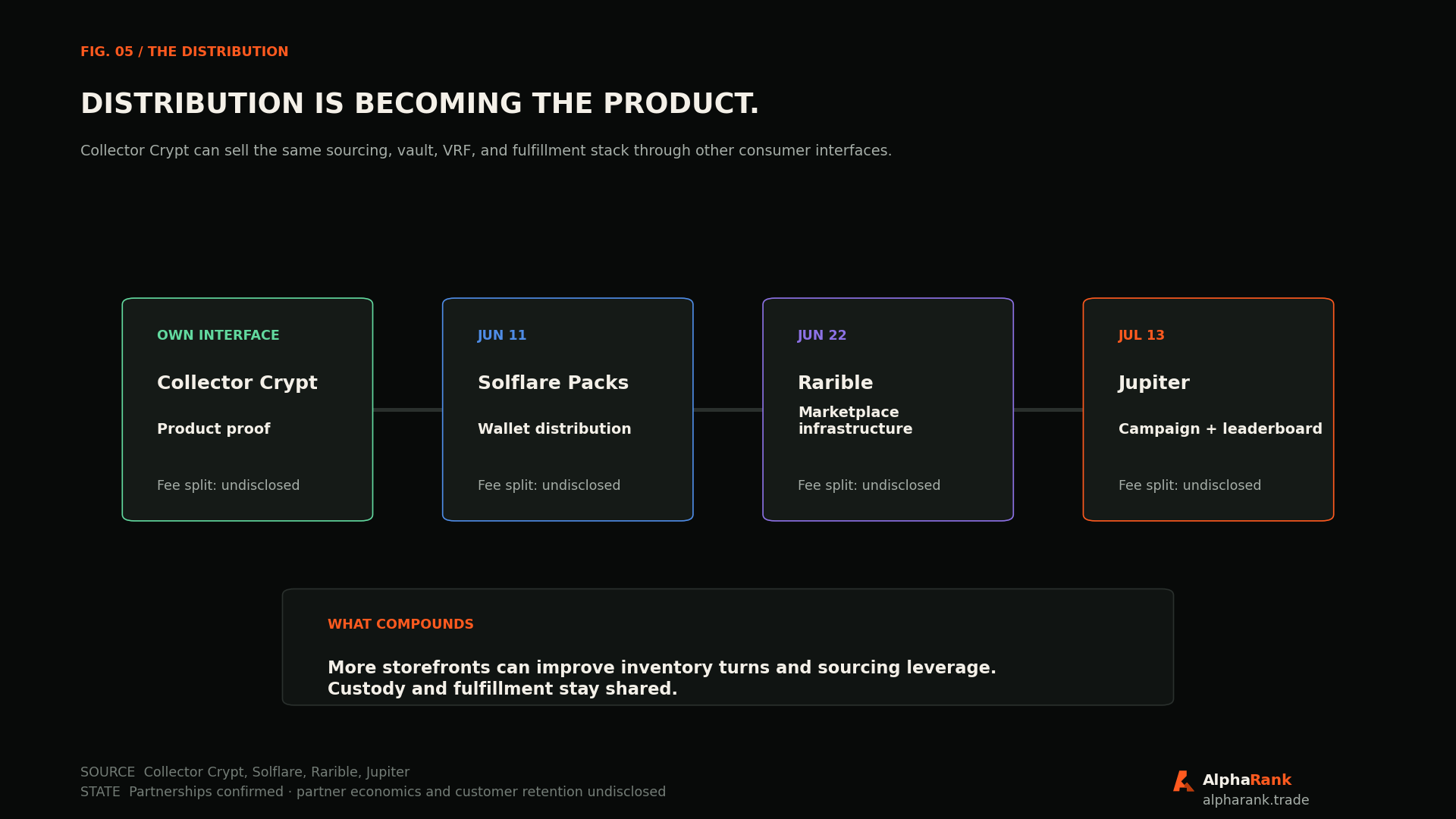
- Distribution can become the moat.Solflare, Rarible, and Jupiter confirm live or announced distribution. None publicly discloses the exact revenue split, customer ownership, or retention economics.
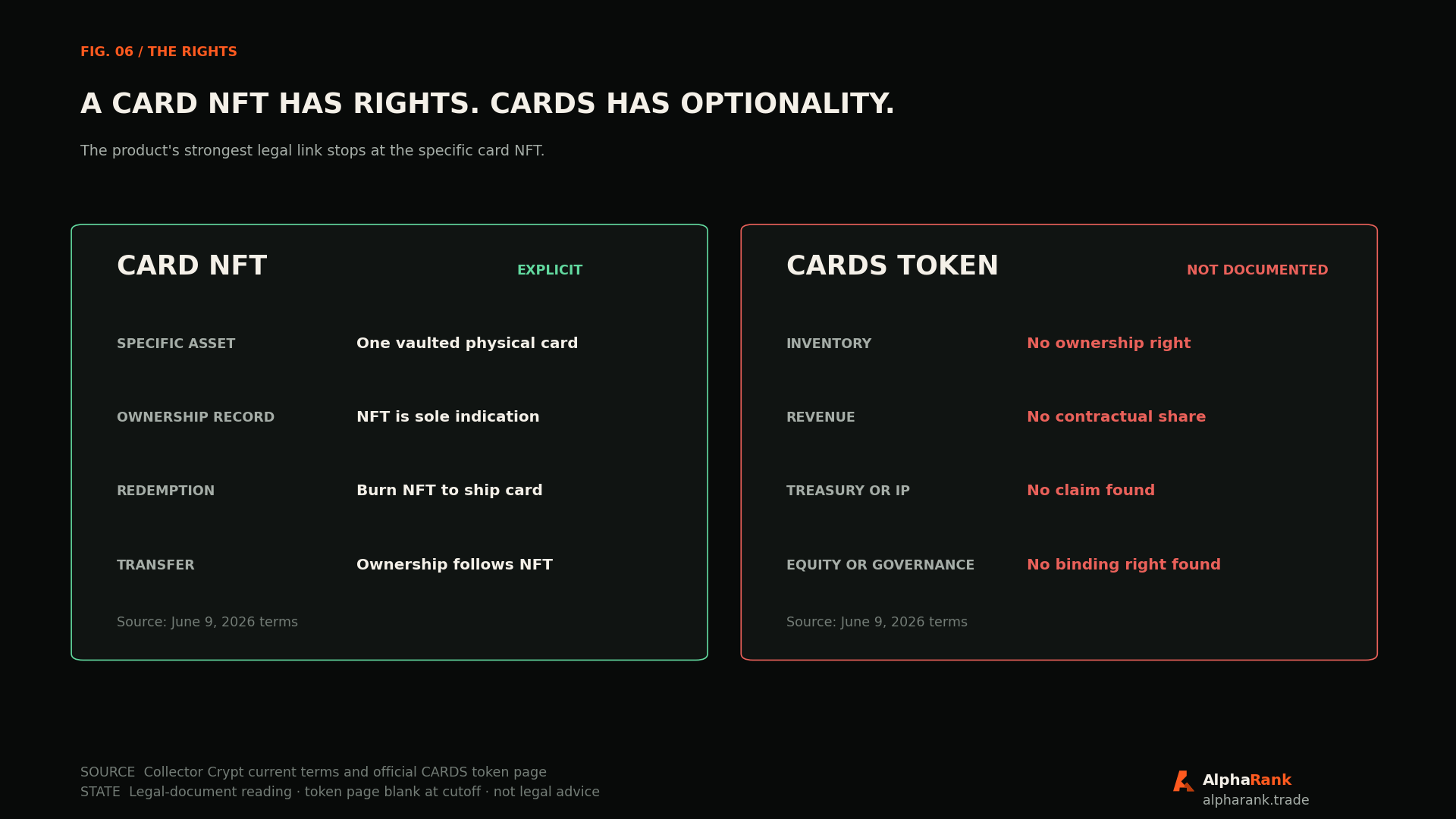
- The card NFT and CARDS are legally different products.Current terms give each card NFT an explicit claim on one vaulted card. The same terms call CARDS a discretionary rewards token and provide no documented right to inventory, revenue, treasury, IP, equity, or governance.
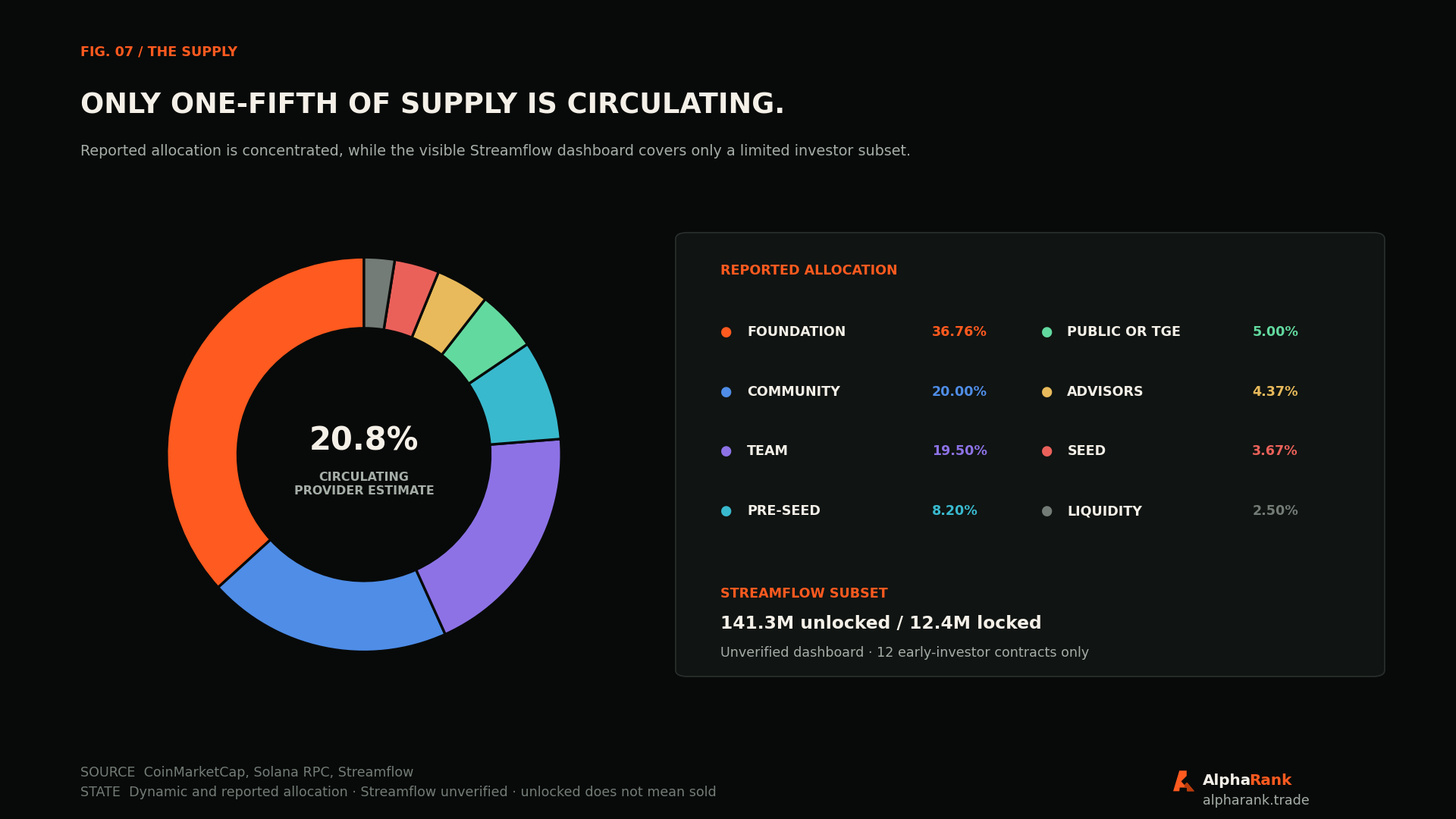
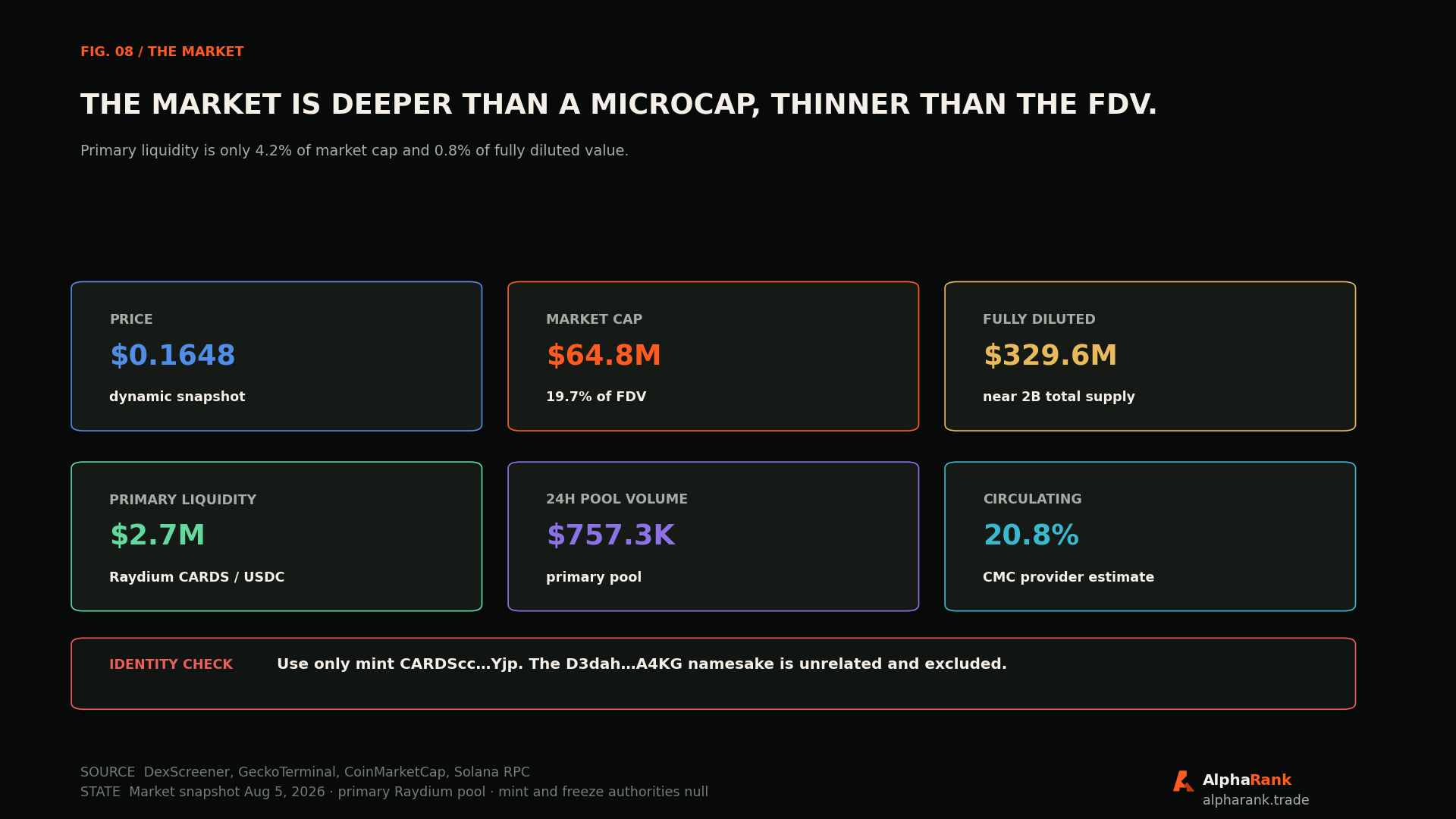
- Supply and liquidity can overwhelm an otherwise good operating story.CoinMarketCap estimated only 415.9 million CARDS in circulation against nearly 2 billion total supply. The primary Raydium pool held about $2.7 million of liquidity against $64.8 million market cap and $329.6 million FDV.
- The correct thesis is optionality, not ownership.CARDS can appreciate if buybacks, disclosure, demand, and future legal linkage improve. At the cutoff, it does not carry an enforceable claim on the business. Revenue multiples that assume otherwise price a bridge that has not been built.
Collector Crypt turns a physical-card supply chain into a consumer crypto loop.
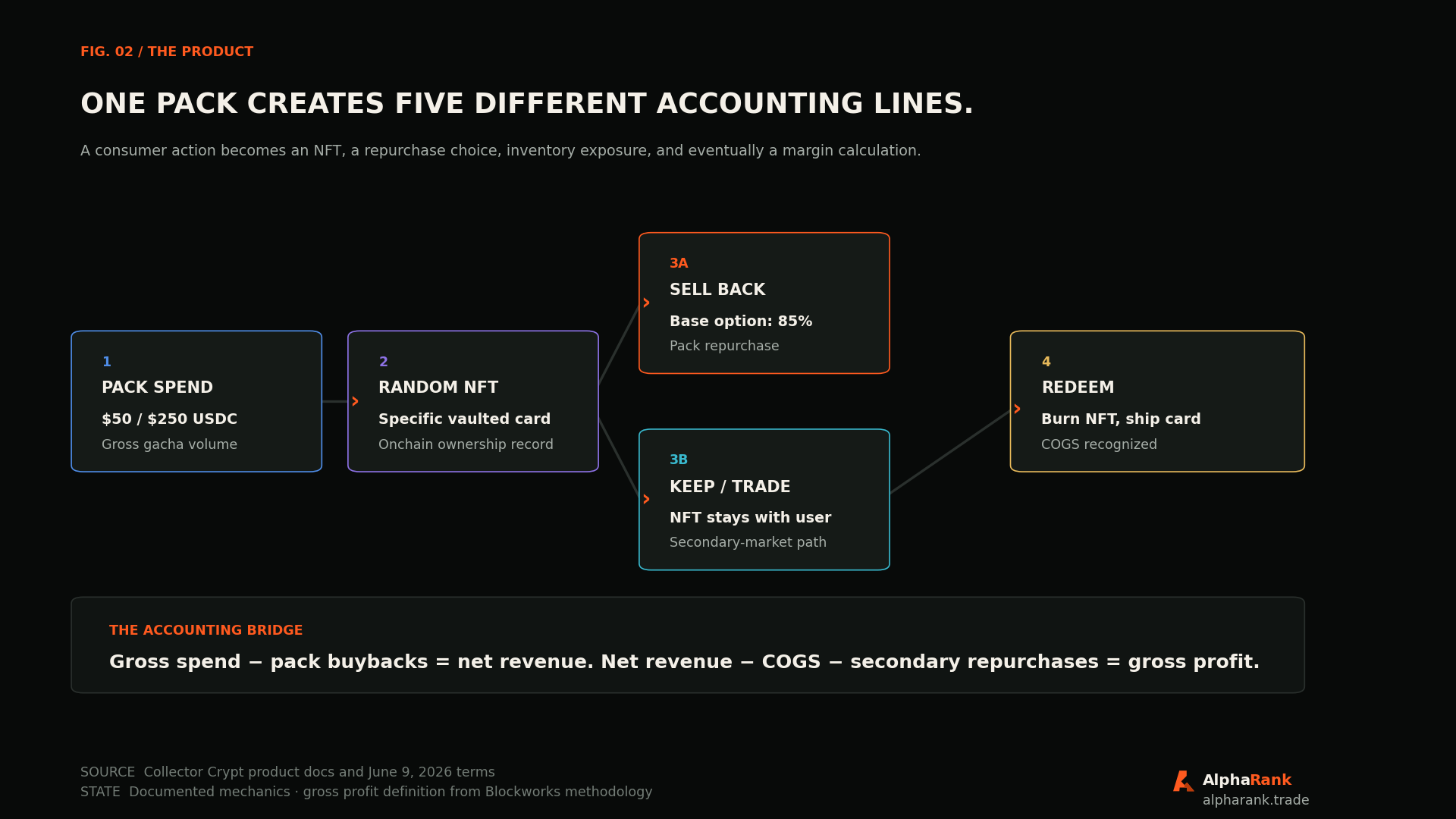
The user pays in USDC, receives a randomly selected NFT tied to a graded physical card, then chooses whether to sell it back, hold it, trade it, or redeem the physical asset.
The core novelty is not tokenization alone. It is the closed loop around sourcing, grading, scanning, vaulting, verifiable randomness, marketplace liquidity, and fulfillment. The official product page documents $50 and $250 packs, an 85% base instant-sellback option, physical redemption, and a marketplace using Solana and EVM infrastructure. Partner storefronts now advertise a wider range of pack prices and buyback rates.
The randomness layer uses an open implementation of RFC 9381. A valid proof prevents an operator from changing a result after committing to it, but an operator can still withhold a proof. The distinction is important: verifiable fairness does not eliminate liveness or inventory-selection risk.
Collector Crypt said in May 2026 that the product had passed $1 billion of cumulative gacha volume, 22,000 users, 4.5 million packs, more than $30 million of tokenized inventory, and physical redemption by more than 30% of users. Those are first-party milestones, not audited financial statements. They are still unusually concrete operating claims for a tokenized-collectibles company.
Is CARDS a claim on this operating engine, or a rewards token that trades beside it?
A simple pack opening hides a complicated balance-sheet machine.
Every pack starts as spend. What happens next determines whether that spend becomes a repurchase, retained revenue, inventory liability, marketplace fee, or cost of goods.
The June 9, 2026 terms say each Collector Crypt NFT represents one specific physical asset held in a third-party vault. Once the NFT exists, it becomes the sole indication of ownership. Burning it starts the physical-redemption process.
The same terms also create a notable separation around liquidity. Collector Crypt says it does not operate or facilitate the secondary market or instant buyback and is not the counterparty, dealer, or market maker. Those functions are attributed to independent third-party liquidity providers. The public interface makes sellback feel like one product, but the legal document divides the roles.
This division matters in stress. If repurchases slow, a third-party provider fails, card values gap, or fulfillment costs rise, the economic burden depends on contracts the public cannot fully see. The user experience is integrated. The legal and accounting stack is not.
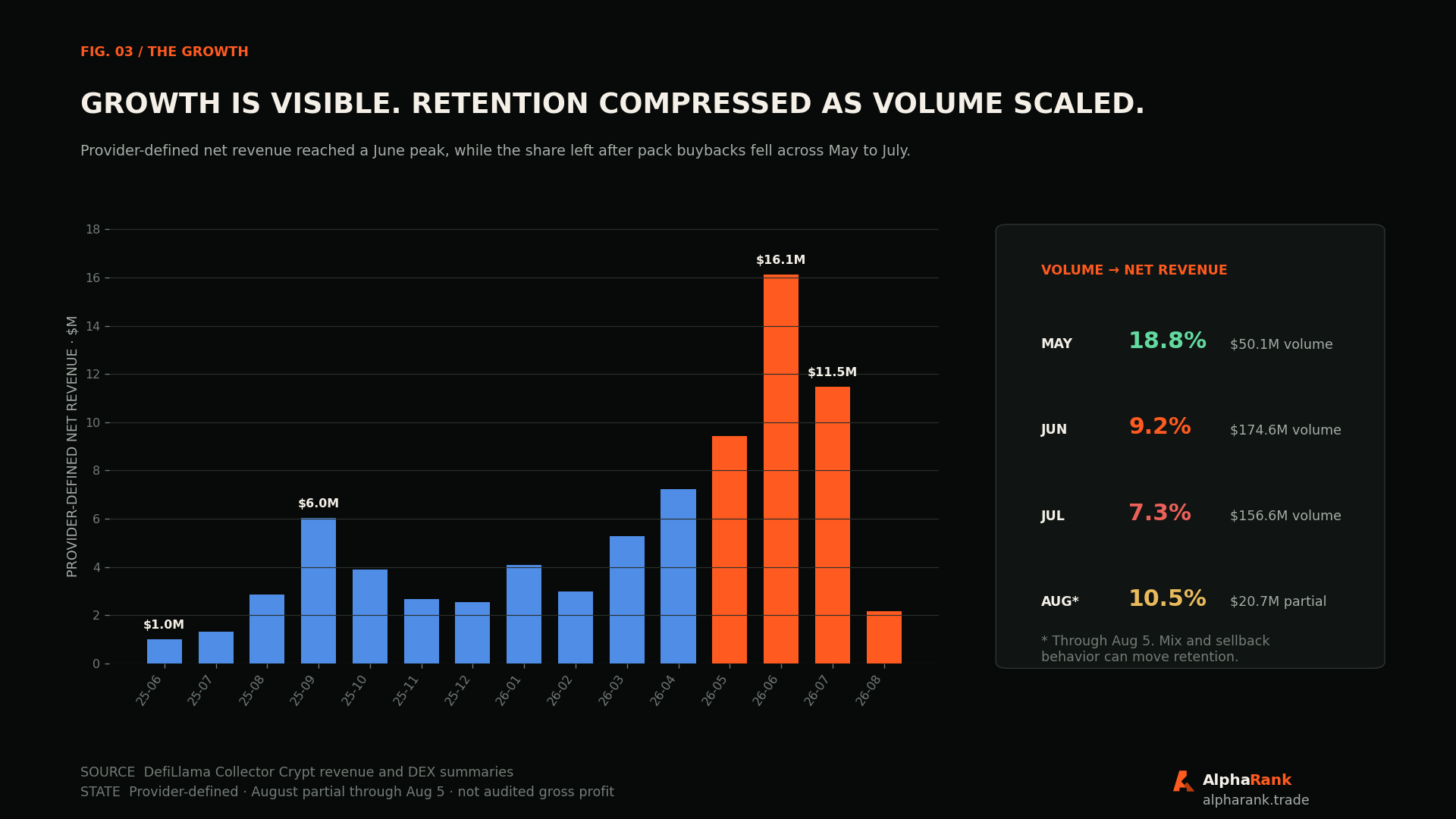
Collector Crypt is growing quickly. The most important number is still missing.
DefiLlama's accessible series shows $79.0 million of all-time and $76.4 million of one-year provider-defined net revenue. The last 30 days were $12.1 million on $151.1 million of tracked gacha volume.
The mechanical annualization is striking: about $1.84 billion of gacha volume and $145.3 million of provider-defined net revenue. It is not a forecast. The 30-day window includes the Jupiter campaign, recent distribution expansion, changing pack mix, and daily volatility.
Monthly net revenue rose from $1.0 million in June 2025 to $16.1 million in June 2026, then fell to $11.5 million in July. The share of volume left after pack buybacks moved from about 18.8% in May to 9.2% in June and 7.3% in July. That does not automatically mean unit economics deteriorated. Higher sellback rates, different pack prices, new storefront mix, or campaign behavior can all move the ratio. It does mean annualizing one period without the bridge is fragile.
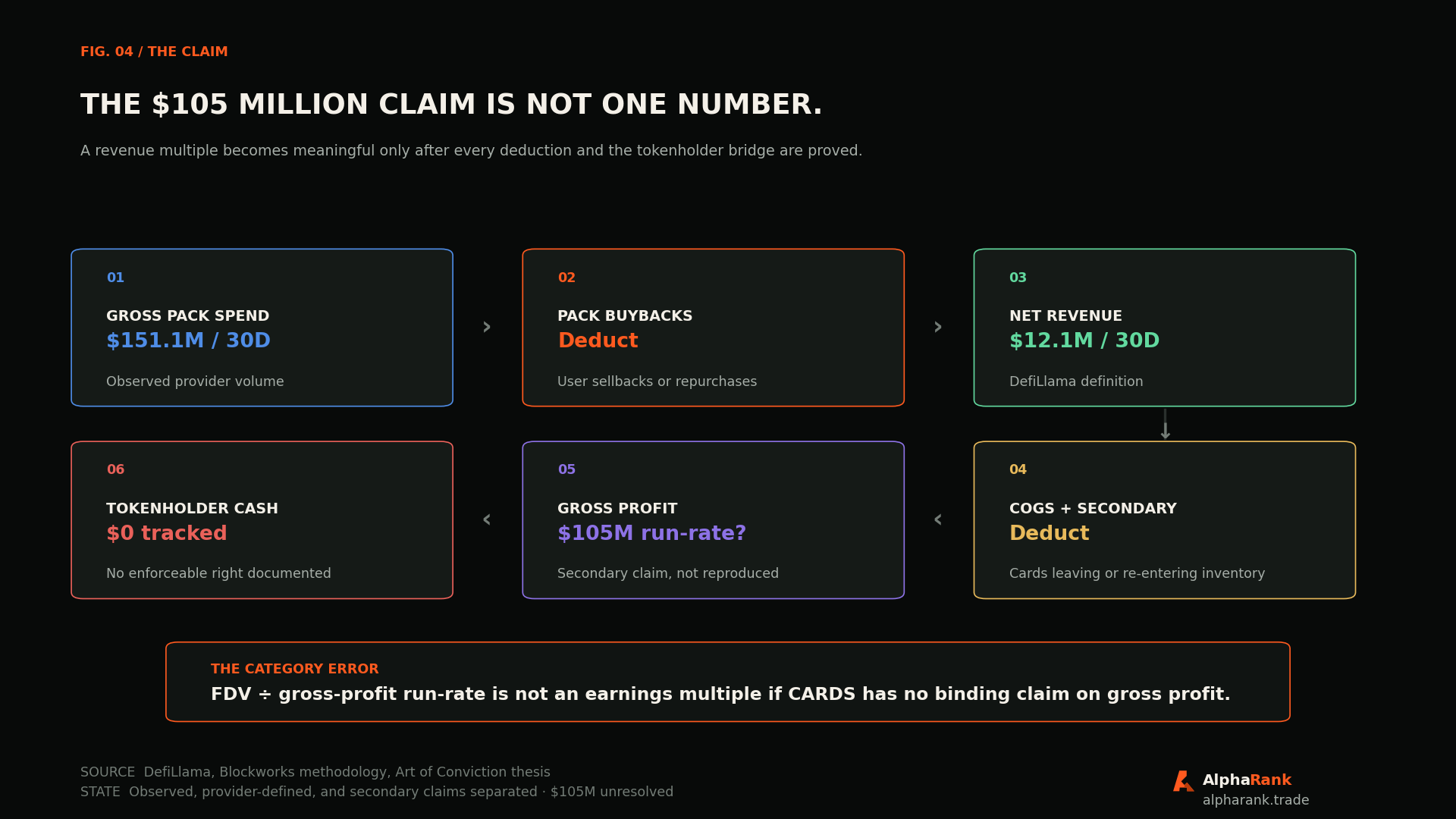
The public Blockworks methodology gives the missing vocabulary. Net revenue equals gross revenue minus gacha repurchases. Gross profit then subtracts cost of goods and secondary-market repurchase cost. DefiLlama stops before those latter deductions.
The Art of Conviction thesis claims about $55 million of trailing gross profit and a $105 million last-three-month annualized run-rate. The author discloses a CARDS position. The methodology is plausible, but the underlying paid monthly export was not accessible for reproduction. This report therefore treats $105 million as an unresolved secondary claim, not a verified operating fact.
Even a verified gross-profit figure would not settle the token thesis. Gross profit is not operating profit, free cash flow, or cash legally owed to CARDS holders. DefiLlama currently reports zero holder revenue and says buyback tracking remains disabled pending confirmation of an official hub.
The strongest moat may be becoming the supplier behind somebody else's interface.
Collector Crypt began by proving the product in its own marketplace. The next stage places the same inventory, vault, randomness, and fulfillment stack inside larger crypto distribution surfaces.
Solflare now offers graded-card packs directly inside its wallet experience and names Collector Crypt as the sourcing, grading, vaulting, and insurance provider. Rarible describes itself as marketplace infrastructure for the partnership. Jupiter launched a four-week campaign with $100,000 of free packs and a spend-based leaderboard.
The strategic logic is strong. More storefronts can increase inventory turns, widen sourcing demand, and spread the fixed cost of vault and fulfillment operations. Because the same card supply can serve several interfaces, distribution can compound without each partner rebuilding the physical stack.
The missing data is equally important. Public primary evidence does not disclose fee splits, working-capital responsibility, loss allocation, customer ownership, repeat behavior after incentives, or whether partner demand is incremental. A partnership logo proves distribution, not margin.
The card NFT is asset-backed. CARDS is not documented that way.
This is the report's decisive distinction. The card NFT has an explicit ownership and redemption contract. The fungible token does not.
The current terms call CARDS the company's native rewards token. They say any CARDS reward is discretionary and not guaranteed. We found no current public term granting CARDS holders ownership of card inventory, company revenue, the stablecoin treasury, intellectual property, equity, liquidation proceeds, or governance rights.
The disclosure gap is unusually visible. The official CARDS documentation page is blank apart from its heading. The current terms point the no-purchase alternative method of entry to official sweepstakes rules whose destination says “content coming soon.” Neither fact proves misconduct. Both are material omissions for a product built around chance mechanics and a token valued partly on future economic linkage.
GLEIF records an active Panama entity, COLLECTOR CRYPT CORP., with “Collector Crypt Foundation” as an operating name. That registry entry confirms an entity. It does not say CARDS holders own it or any of its assets.
The supplied thesis argues that the foundation holds the valuable economics and could become equity-like after U.S. market-structure reform. Current primary evidence does not establish that bridge. The Senate Banking Committee advanced H.R. 3633 by 15 to 9, and a merged Senate draft appeared July 22, 2026. The bill was not enacted at the cutoff. Proposed legislation cannot create present token rights.
Most of the token supply is not circulating yet.
Solana RPC returned approximately 1.9997 billion total CARDS, while CoinMarketCap estimated 415.9 million circulating. The mint and freeze authorities were null, which limits future minting and freezing but says nothing about economic rights or distribution.
Reported allocation assigns 36.76% to the foundation, 20% to community, 19.5% to the team, and the remaining 23.74% across pre-seed, seed, advisors, public or TGE, and liquidity. The percentages sum cleanly. The official token page does not currently explain them, so this is a reported allocation rather than an audited cap table.
The canonical Streamflow dashboard is marked unverified. It showed 12 labeled early-investor vesting contracts with 153.75 million tokens deposited, 141.30 million unlocked, and 12.44 million locked. That covers a subset. It does not cover team or foundation supply, and “unlocked” does not mean “sold.”
The float gap is still the core market risk. A business can compound while the token underperforms if circulating supply grows faster than net demand. Foundation, team, community, and advisor movements matter at least as much as the last month of revenue.
CARDS is liquid enough to trade and thin enough for dilution to matter.
At the cutoff, CARDS traded near $0.1648. DexScreener showed about $64.8 million market cap, $329.6 million FDV, $2.71 million of liquidity, and $757,000 of 24-hour volume in the primary Raydium CARDS/USDC pool.
Primary liquidity was about 4.2% of market cap and 0.8% of FDV. That is not an illiquid microcap, but it is narrow relative to the fully diluted valuation and reported future supply. Large sales, unlocks, market-maker changes, or a reversal in campaign demand can move price much faster than operating data changes.
Identity risk is real because a separate token uses the same name. This report uses only the canonical mint CARDSccUMFKoPRZxt5vt3ksUbxEFEcnZ3H2pd3dKxYjp. The unrelated namesake at D3dahHV5oytVoSjngKCerrvE1usq4st1DrLxHXCeA4KG is excluded.
The popular valuation shortcut divides roughly $330 million of FDV by the claimed $105 million gross-profit run-rate. That produces a superficially low multiple. It is not an equity multiple because CARDS has no documented claim on gross profit. It also ignores operating costs, working capital, inventory markdowns, taxes, legal costs, buyback discretion, and dilution.
A more honest framing is three simultaneous bets. First, the consumer business keeps growing. Second, cash or buybacks create durable net demand for CARDS after dilution. Third, legal documents eventually bind token holders to business value. The market can be right on the first and wrong on the other two.
The strongest bull case is operational. The strongest bear case is contractual.
Bull case: Collector Crypt has found a consumer behavior that bridges crypto and physical collecting, then turned the hard parts into reusable infrastructure. Inventory sourcing, grading relationships, vault operations, high-resolution scans, verifiable randomness, fulfillment, and partner distribution can reinforce one another.
If new storefronts bring incremental demand, higher inventory turns can improve sourcing power. A larger card pool can improve pack quality and variety. Better liquidity can make users more willing to open packs. Revenue-funded buybacks can add recurring token demand. At that point, CARDS could become a scarce coordination asset around a profitable network.
Bear case: the business and token remain separate. Partner campaigns drive temporary volume. High sellback rates recycle spend rather than create durable customer value. Inventory and working capital absorb more cash than gross-profit headlines imply. The foundation, team, investors, and community control most supply. Buybacks remain discretionary. The legal documents never grant a claim.
The bear case does not require Collector Crypt to fail. A successful company beside a weakly linked token is enough.
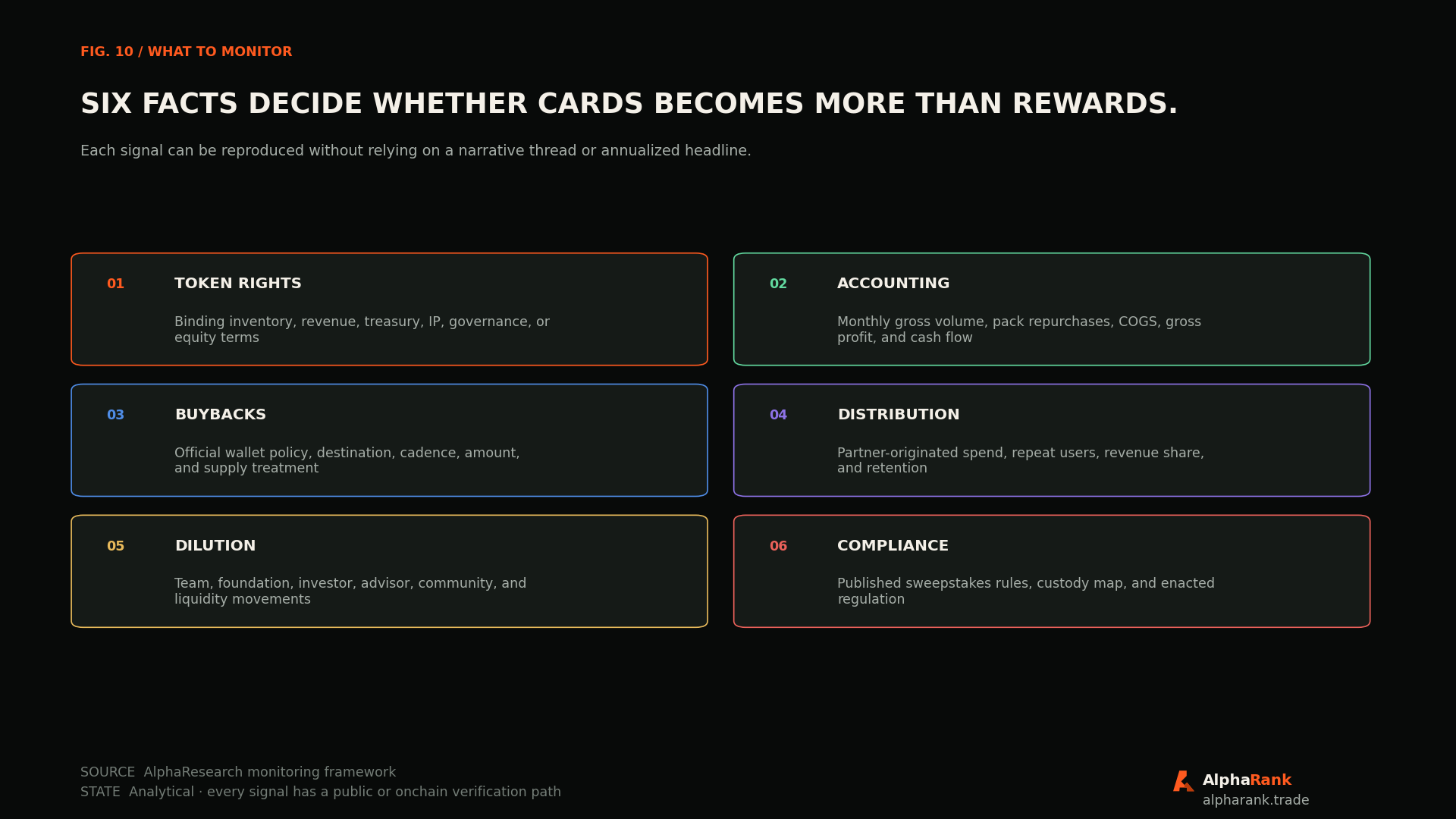
Six facts decide whether CARDS becomes more than rewards.
The next update should not ask only whether revenue went up. It should test whether the token's claim became clearer and whether demand outran dilution.
Binding documents grant or explicitly reject inventory, revenue, treasury, IP, governance, equity, or liquidation rights.
Monthly gross spend reconciles to pack repurchases, COGS, secondary repurchases, gross profit, operating costs, and cash flow.
An official policy names funding, wallets, destination, cadence, discretion, and whether acquired tokens are burned, held, or recycled.
Solflare, Rarible, Jupiter, and future channels disclose attributable spend, fee splits, repeat users, and retention after incentives.
Foundation, team, investor, advisor, community, and liquidity balances are labeled and tracked against market depth.
Official sweepstakes rules replace “content coming soon,” custody roles become explicit, and regulation is tracked as law rather than narrative.
Sources & methodologyProduct, legal, market, and partner evidence · source-blind internal synthesis · cutoff August 5, 15:20 UTC
Reader-facing claims link directly to publishable evidence. AlphaRank's private transcript and X library was searched first for recent product mechanics, sourcing constraints, and disagreements. Public claims were then checked independently. Private source identities and exact provenance remain outside the public report. Grok Heavy and ChatGPT Pro were used only as skeptical lead maps and are not evidence.
- Collector Crypt card marketplacePRIMARY
- Product mechanics and feesPRIMARY
- Official CARDS token pagePRIMARY
- Terms, revised June 9, 2026LEGAL
- Collector Crypt VRF documentationPRIMARY
- Collector Crypt fees and revenueDEFILLAMA
- CARDS market and supply snapshotCMC
- Primary CARDS/USDC poolDEXSCREENER
- Canonical-mint vesting dashboardUNVERIFIED
- Solflare graded-card packsPARTNER
- Rarible partnership announcementPARTNER
- Jupiter gacha campaignPARTNER
- Company operating milestonesFIRST-PARTY
- Panama entity recordGLEIF
- Current CLARITY Act committee statusU.S. SENATE
- July 2026 merged Senate draftU.S. SENATE
- User-supplied CARDS thesisSECONDARY
- AlphaRank source-blind private-library synthesisINTERNAL
Identity. The canonical mint was cross-checked across CoinMarketCap, Jupiter, Solana RPC, and the primary pool. An unrelated namesake was excluded.
Revenue. Gross pack spend, repurchases, provider-defined net revenue, COGS, gross profit, operating cash flow, buybacks, and tokenholder revenue remain separate.
Market data. Dynamic price, supply, and liquidity values were frozen at the report cutoff and can differ from live dashboards.
Legal analysis. Rights statements summarize current public documents and are not legal advice. Absence means no public right was found at cutoff.
Private research. Evidence IDs, source identities, timestamps, hashes, and exact context remain in the internal session record.
AI research. Grok Heavy and GPT Pro found questions and contradictions. Neither model is cited as evidence.