ATH: Is Aethir Really Making $100 Million a Year?
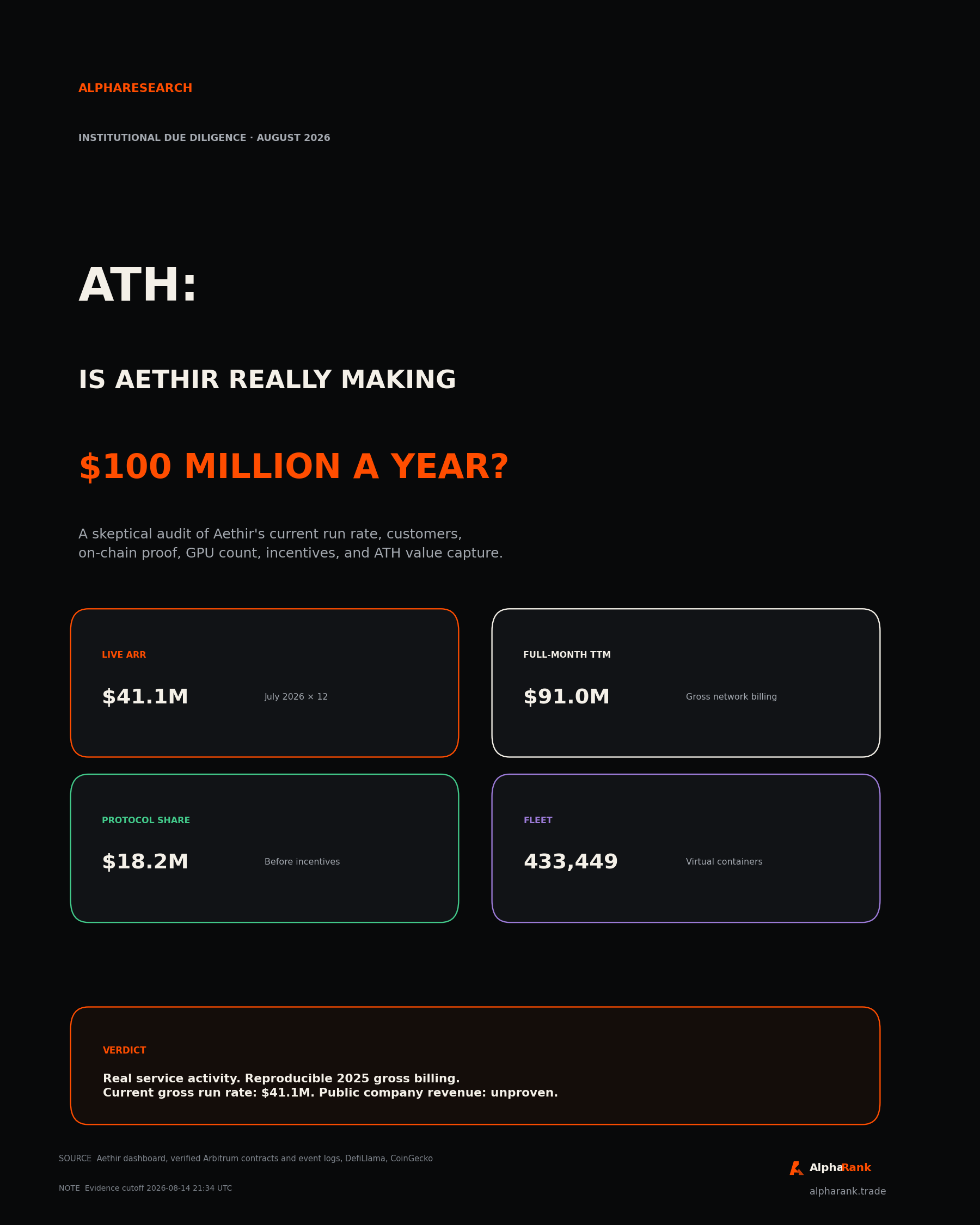
Aethir reported $127.9 million of 2025 network billing. Its current run rate is $41.1 million, and most customer payments go to hosts. We traced the wallets, customers, and GPU count to find what the headline actually proves.

- Coverage
- ATH · Ethereum / Arbitrum
- Evidence cutoff
- August 14 · 21:34 UTC
Chapters
Aethir proves real activity, but not $100 million of current company revenue.
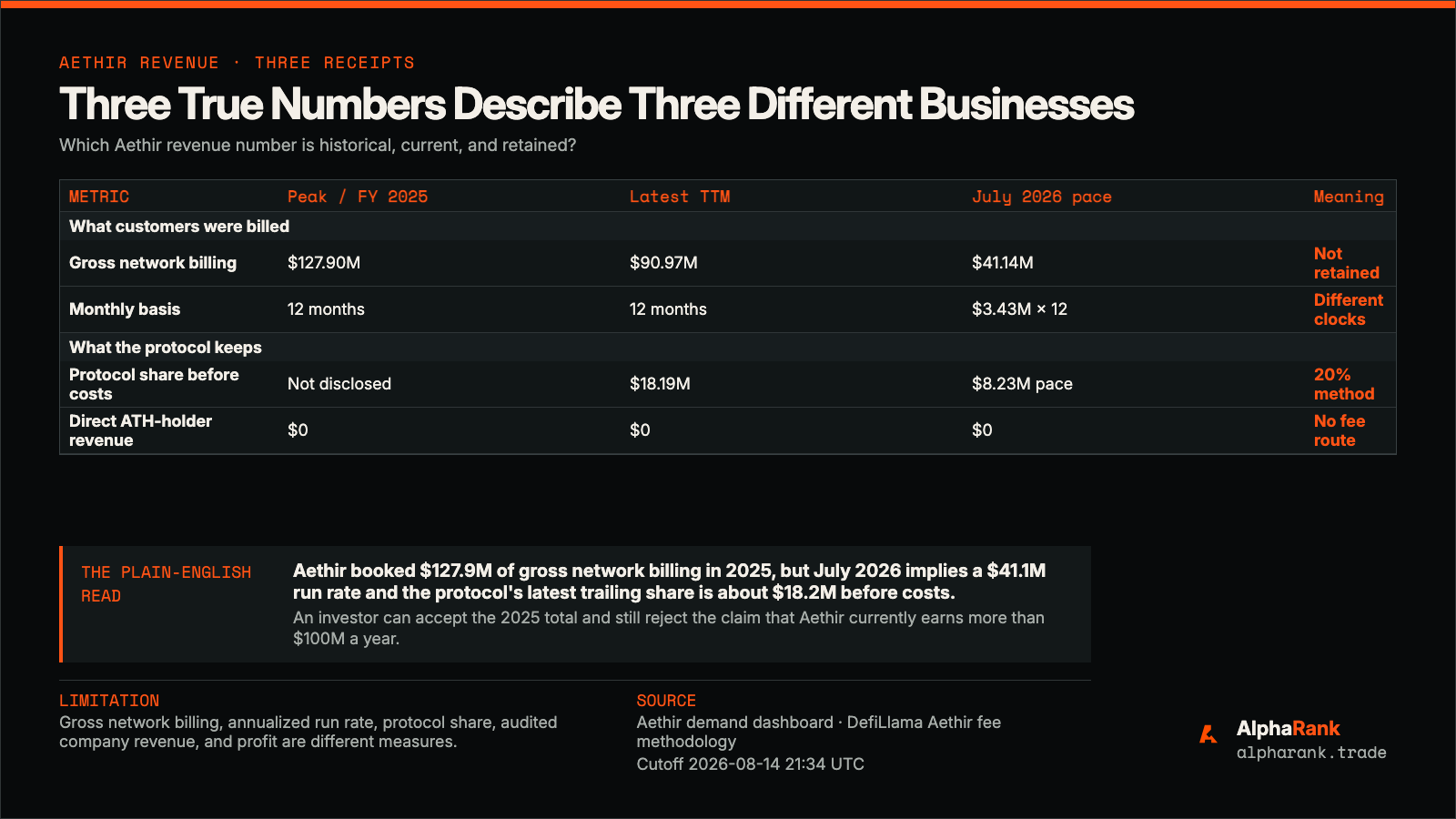
- The completed-year claim reconciles.Aethir's monthly series sums to $127.90M for calendar 2025. It is gross network billing, not Aethir's retained revenue.
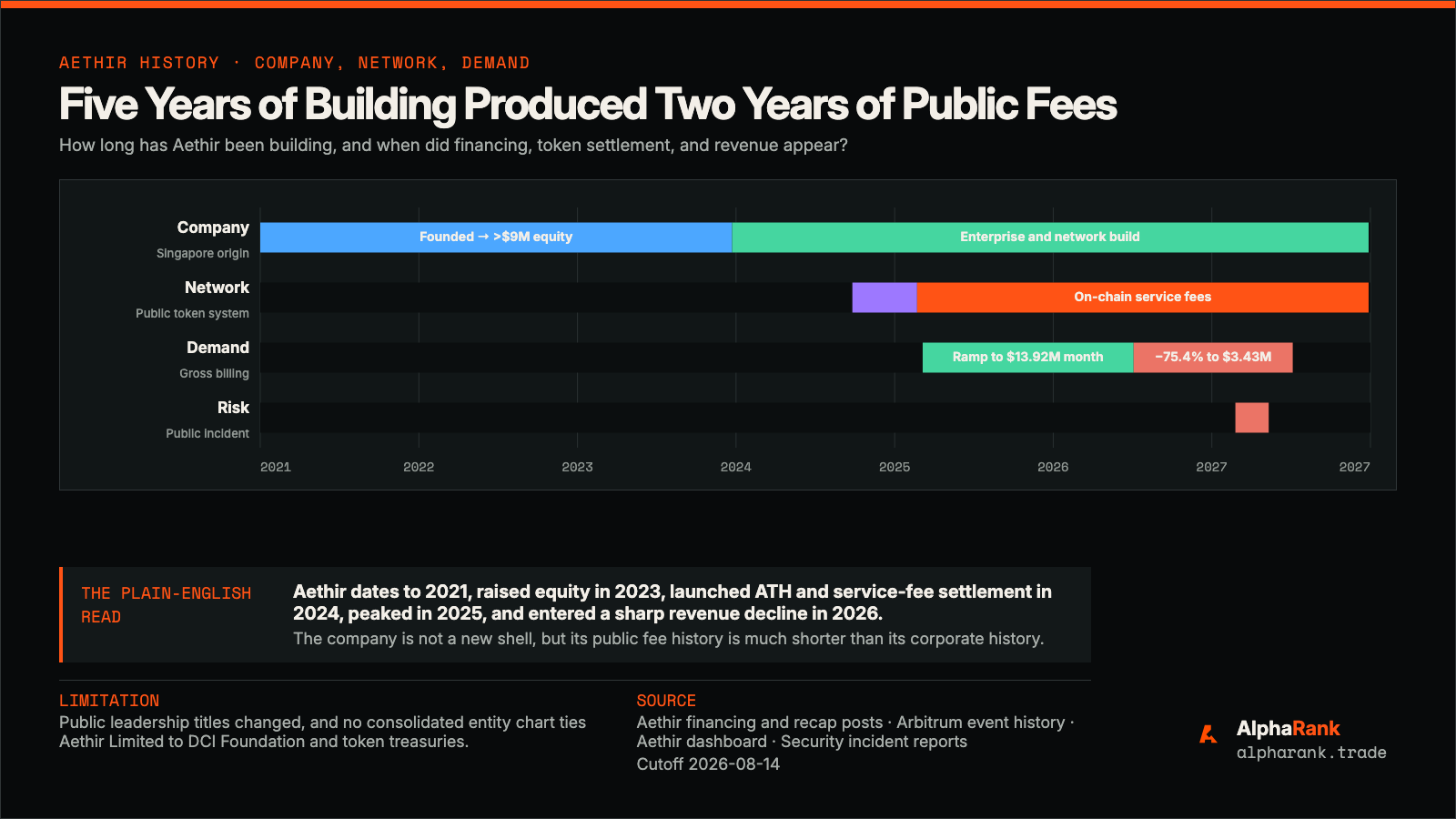
- The live run rate is $41.14M.The dashboard ARR card equals July 2026's $3.428M multiplied by 12. Monthly revenue is 75.4% below the September 2025 peak.
- The latest full-month TTM is $90.97M gross.DefiLlama assigns 80% to compute suppliers and 20% to protocol revenue, implying $18.19M for the protocol before incentives and operating costs.
- The chain proves token deposits, not GPU jobs.The active deposit handler does not require an approver signature or workload proof. Sixty-one addresses produced 1,250 deposits, and the top ten represented 95.5% of approximate net value. Wallets are not customers.
- The public fleet count is virtual.Aethir defines a Container as a virtual endpoint. The physical GPU inventory and model mix remain unaudited.
- The customer headline mixes economic relationships.TensorOpera confirms a deployment. Most other names are supplier case studies, integrations, channels, or projects supported by grants and subsidies.
- We found gaming paths, not proof of manipulation.Gross deposits, ecosystem funding, channel demand, token bonuses, and virtual endpoints can widen the gap between dashboard activity and outside customer economics.
Three receipts, one business, and a missing customer.
In September 2025, Aethir looked like crypto's rarest creature: a distributed GPU network running at $167M a year. Ten months later, its own dashboard implied $41.1M.
The old number is accurate arithmetic. Aethir's completed 2025 total also reconciled to $127.9M, while an independent methodology implied that only about one fifth of recent billings stayed with the protocol before costs. Three correct receipts can still describe very different businesses.
We followed each receipt backward. What period did it cover? Who supplied the money? What work did the chain prove? Who kept the payment? And how many physical GPUs sat beneath the largest supply number?
Who supplied the money, and was the buyer unrelated and unsubsidized?
What GPU workload ran, when, and on which verified hardware?
How much entered the service-fee system after refunds and credits?
How much paid Cloud Hosts, Checkers, grants, and other incentives?
Which legal entity recognized the residual and under what policy?
Which rule directs cash or net demand to tokenholders?
One peak month became a $167 million annual rate.
Aethir's own monthly history shows exactly how the headline rose, and why it no longer describes the current business.
September 2025 reached $13.916M. Multiplying that month by 12 produces $166.99M, the source of Aethir's $166M ARR headline. The later $147M figure came from annualizing October instead.
Calendar 2025 totals $127.90M. That is the strongest historical version because it covers a completed year. The latest twelve complete months total $90.97M.
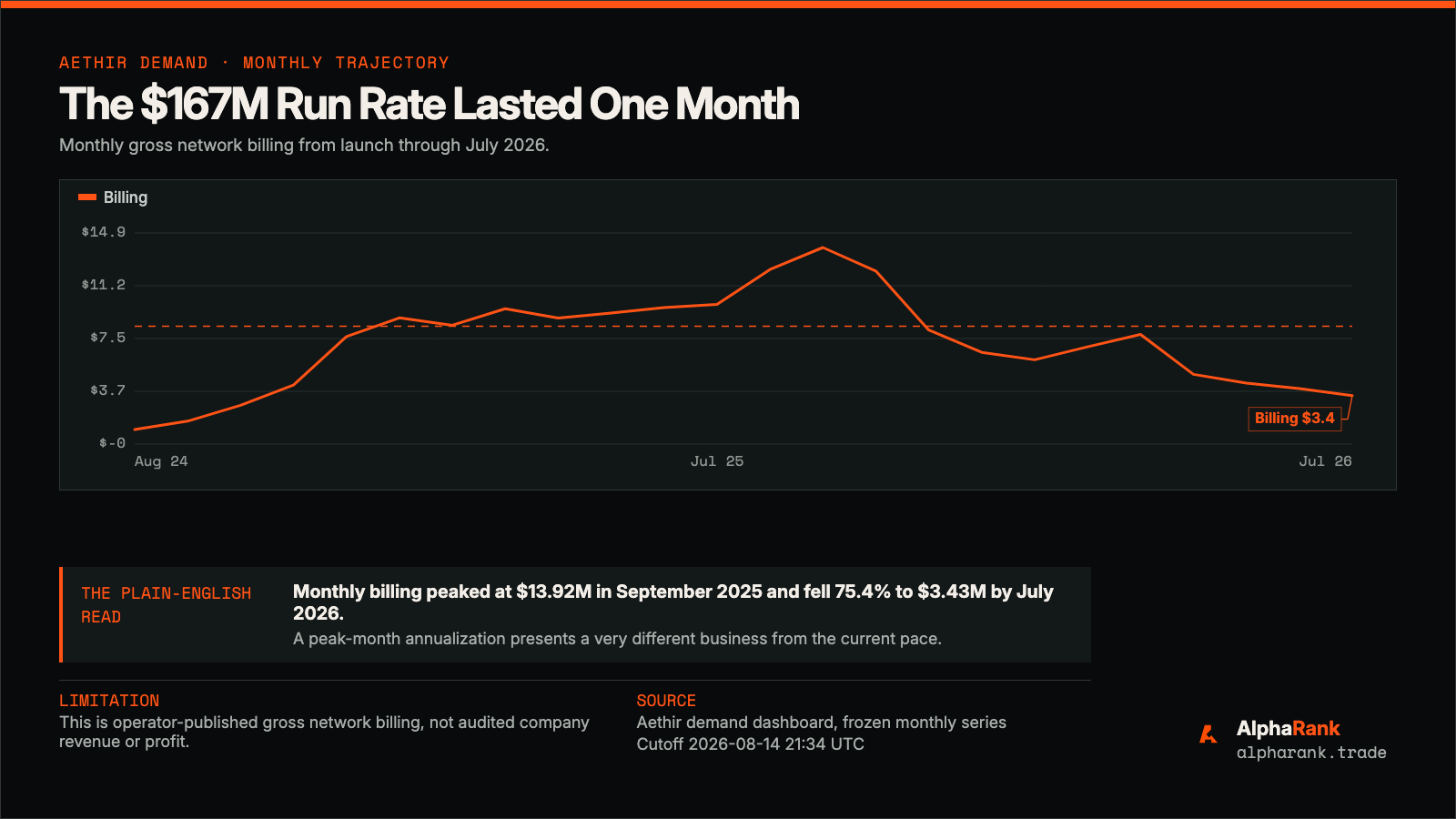
July's $3.428M multiplied by 12 equals the live $41.14M ARR card. The current dashboard itself rejects a current $100M-plus rate. That solved the first mystery, the clock. It opened a harder one: who kept the money?
Most service fees belong to the compute suppliers.
The marketplace can be large while the protocol and token retain far less than the headline.
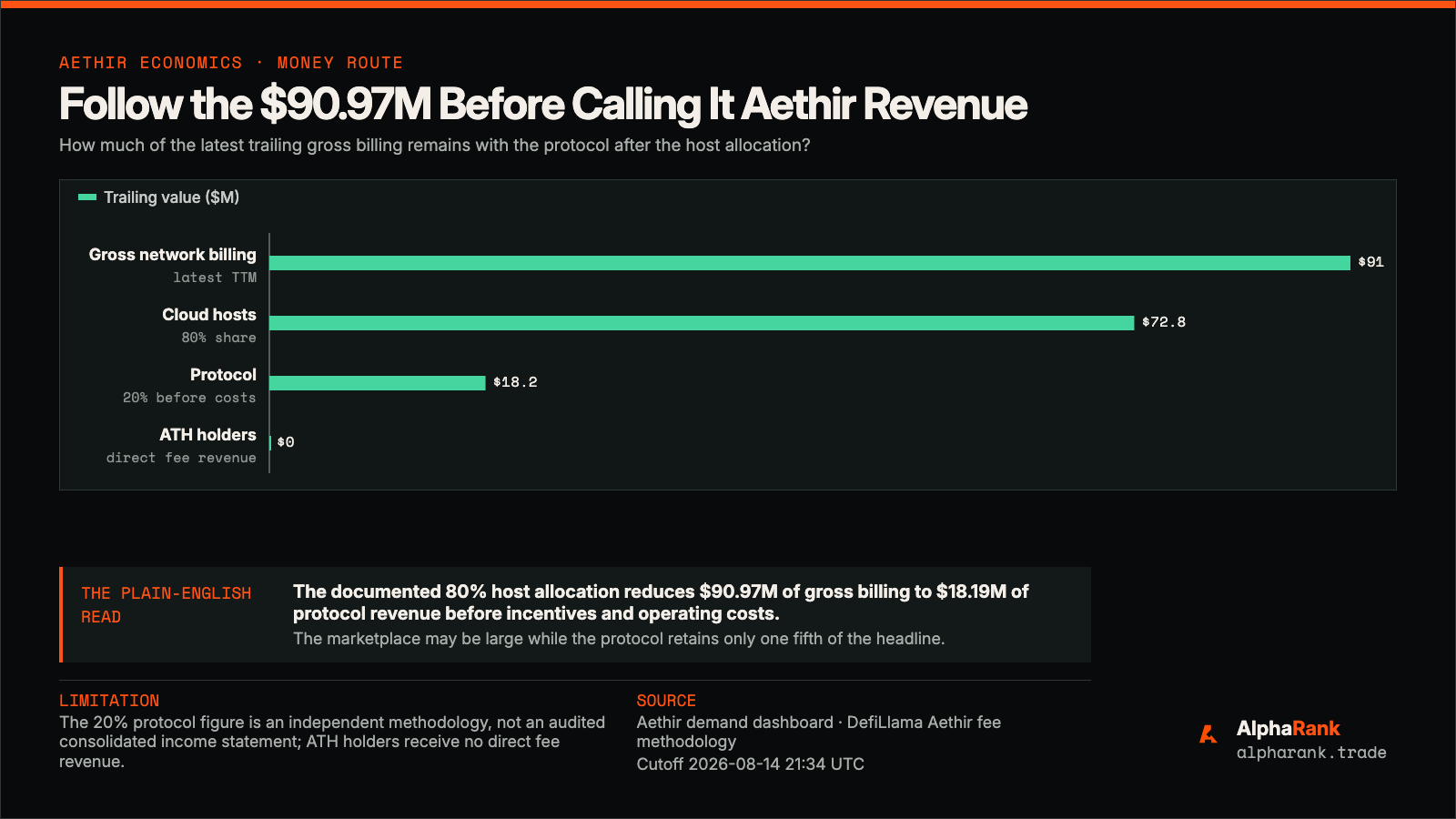
The implied $18.19M protocol share still sits above checker rewards, token incentives, engineering, sales, support, security, legal, and corporate overhead. DefiLlama's historical quarterly view reported negative earnings when checker incentives exceeded protocol revenue. Its “earnings” field is not a complete income statement, but it shows why a gross fee number cannot establish profitability.
Aethir's reward documentation also deducts a 5% protocol fee from Cloud Host rewards. That is a different base from the independent 20% allocation of customer service fees. The two rates are not contradictory; they need labels so readers do not combine them.
Aethir's supply dashboard reports both service fees and token-funded host rewards. Customer spending and subsidy coexist, so the next question is whether public records identify the outside buyers.
A deposit event is real and economically incomplete.
The complete Arbitrum history through block 494,581,561 contains 1,250 DepositServiceFee events totaling 9.7865B ATH. That total matches Aethir's “gross on-chain compute purchases” card. Sixty-five withdrawal events removed 28.68M ATH; the dashboard gross count does not subtract them.
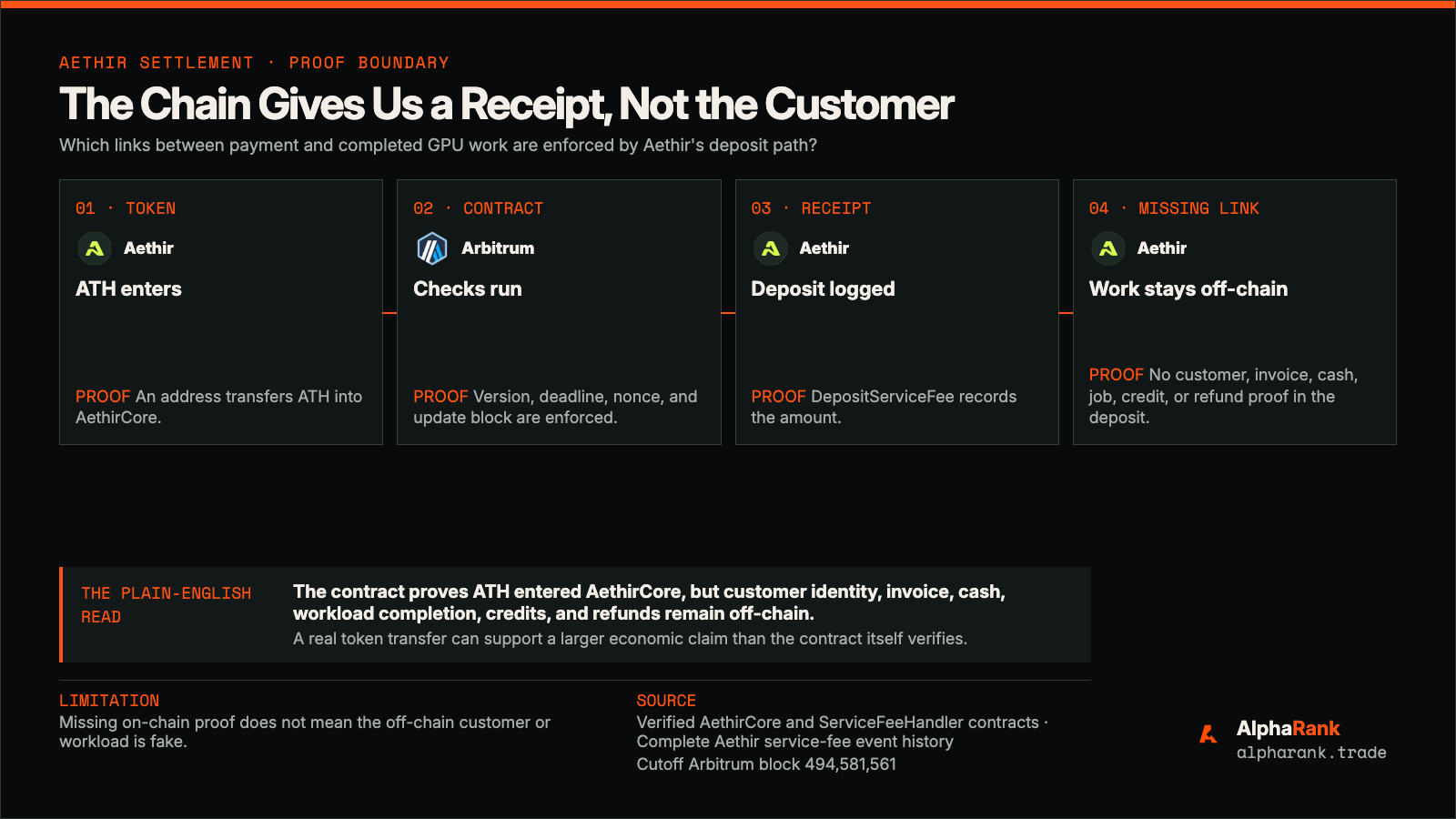
The handler's withdrawal and host-claim paths require stronger signatures. The deposit path does not. It supports one exact statement: an address transferred ATH into Aethir's settlement contract. Customer identity, invoice, fiat receipt, completed compute, refunds, rebates, and related-party status remain off-chain.
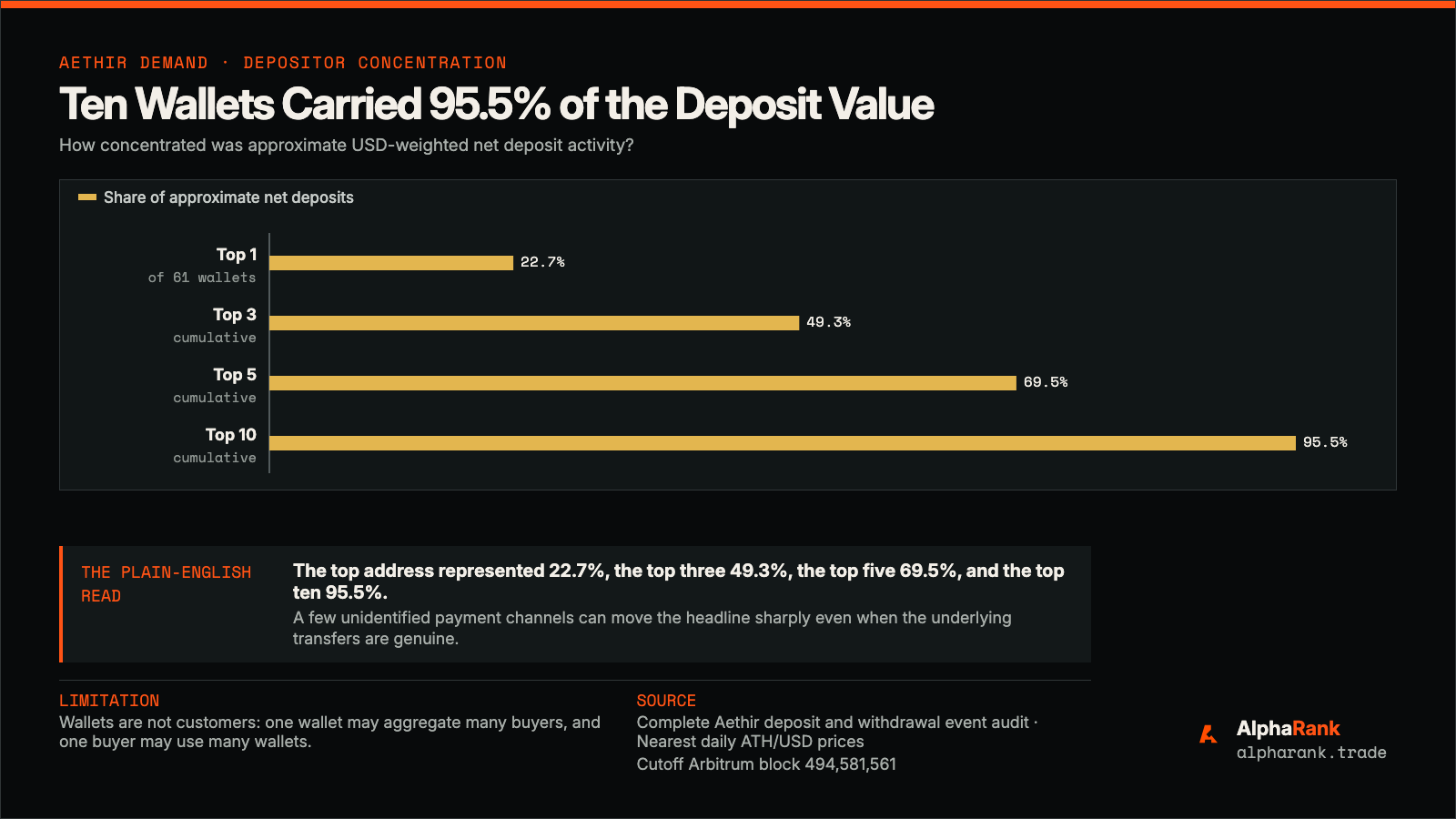
The top address represented 22.7%, the top three 49.3%, and the top five 69.5%. Some large addresses received ATH from common upstream wallets, but that does not establish common control. The chain gave us receipts without names, so the trail moved to the public customer roster.
There are real deployments. The 150-plus count is not a customer count.
Aethir groups paying clients with partners, channels, integrations, grant recipients, and other ecosystem projects.
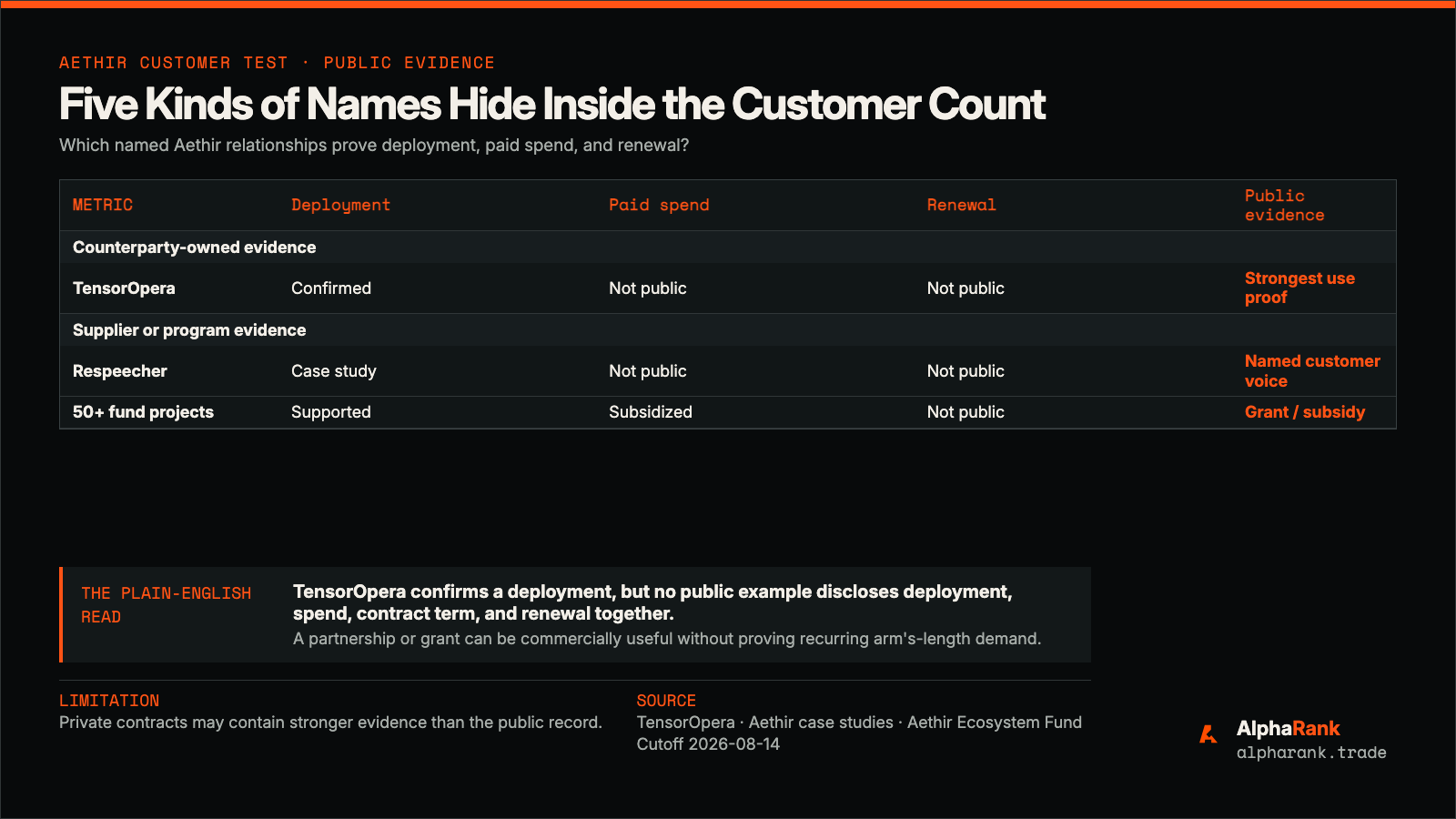
TensorOpera is the strongest counterparty confirmation. The deployment is credible; contract value and renewal are not public. Respeecher is the strongest supplier case study and includes a named employee describing comparable performance at roughly one-third of AWS capacity cost. We found no Respeecher-owned disclosure of spend.
SuperScale independently confirmed a partnership to use Aethir cloud streaming for play-before-download gaming flows. It confirms integration intent, not deployed scale, spend, or renewal.
Kluster.ai, OpenLedger, Inferium, Raiinmaker, Attentions.ai, Mondrian AI, Velvet Capital, and others appear in Aethir case studies. They describe plausible workloads but rarely disclose contract value, payment, duration, or renewal.
The $100M Ecosystem Fund explicitly supplies compute grants, subsidies, tokens, and discounted credits. Aethir says 50-plus projects entered the ecosystem through those programs. Subsidized use can prove a product works; it does not prove willingness to pay the same amount without support. The customer trail was real but incomplete. Then we reached the biggest number in the report and discovered it was the least physical.
The defensible count is 433,449 virtual containers.
Aethir defines a Container as a virtual endpoint where a cloud-service workload executes. Physical GPU owners map chips into those endpoints. A container can represent real capacity without being a unique physical GPU.
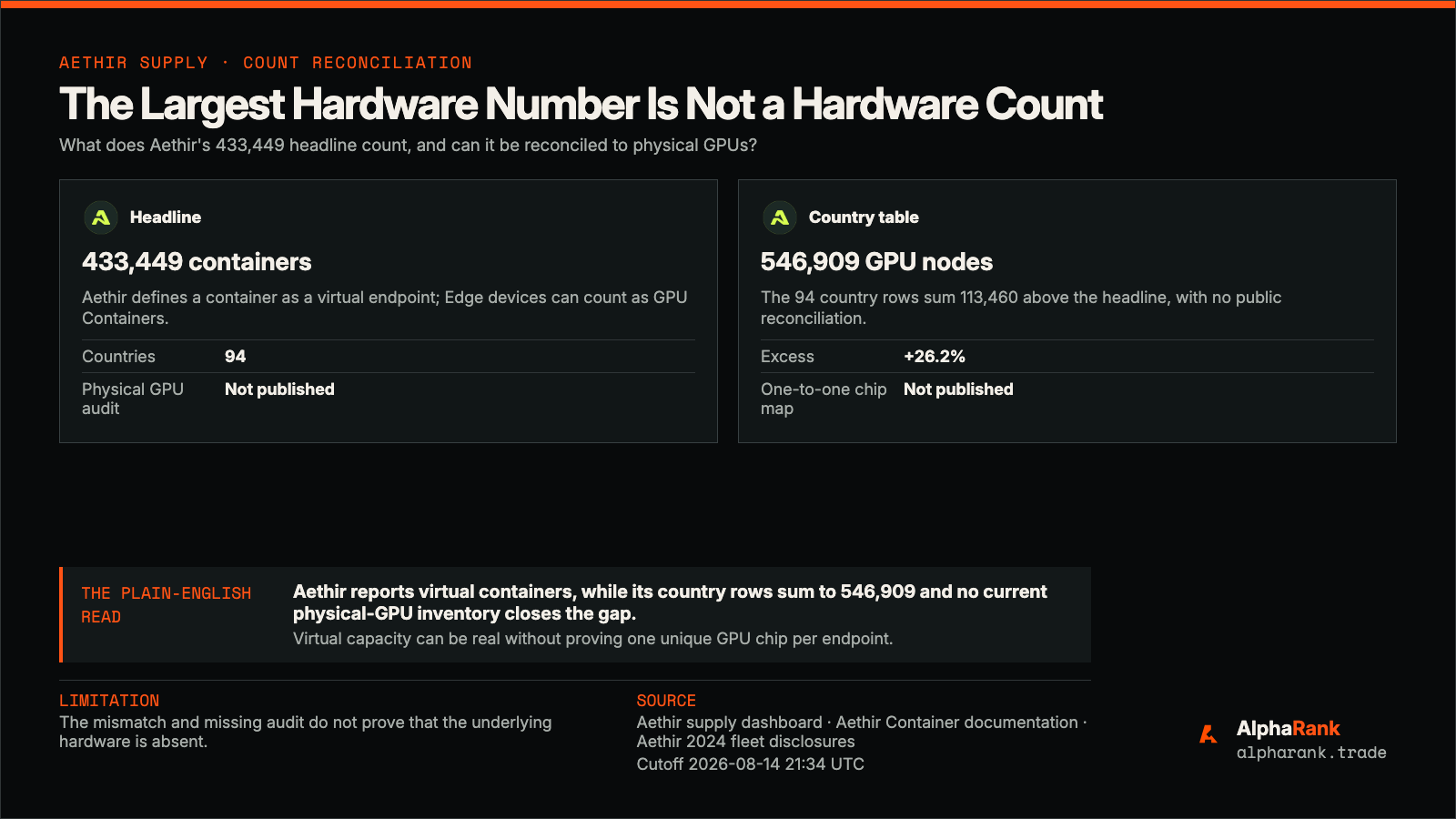
A 2024 article reported 43,000 high-end GPUs, including 3,000 H100s, plus 32,000 Edge devices. The 2024 wrap explicitly said Edge devices count as GPU Containers. Later pages said the 430,000-plus total included tens of thousands of Edge devices and thousands of H100, H200, GB200, B200, or similar high-end models.
The live country rows sum to 546,909 GPU Nodes, 113,460 above the 433,449 headline. The 26.2% excess has no public reconciliation. Different clocks, duplicated endpoints, mixed definitions, or another methodology may explain it.
Aethir separately markets average GPU utilization above 95%, but does not publish the eligible-fleet denominator or measurement window. Its other public totals do not reproduce that percentage because the fleet ramp, workload mix, and concurrency remain unknown. The supply number is large; its physical meaning is still unverified.
Four documented paths can make the headline outrun outside demand.
An on-chain event can be authentic while the ultimate economic interpretation remains weak.

Gross deposits
The dashboard counts ATH deposited before workload proof and before subtracting withdrawals. The token movement remains real.
Subsidized demand
Grants, tokens, credits, and compute subsidies can finance a real workload using Aethir's own ecosystem budget. The result demonstrates use more strongly than independent customer demand.
Channels and token treasuries
A reseller can aggregate customers and prepay service. A token treasury can buy ATH, receive bonus ATH, and use Aethir-sourced compute. The deposit does not reveal the end customer's cash.
Virtual capacity
One physical system can expose several endpoints. Edge devices count as containers. The headline can grow faster than unique high-end physical GPUs while remaining consistent with Aethir's internal definition.
A public reseller shows how compute demand and token support can overlap.
Axe Compute was Predictive Oncology until December 2025. Its 2025 10-K says it sources compute primarily through Aethir. At year-end it held 2.837B unlocked ATH and rights to another 3.511B locked ATH.
The headline $343.5M financing included $50.8M of cash and $292.7M of notional ATH. Axe also received bonus ATH after an open-market token purchase. That structure can support both Aethir compute demand and ATH demand, while providing weaker outside-customer evidence than an unrelated buyer paying cash without a token incentive.
Axe's Q1 2026 10-Q describes a 36-month, $260M take-or-pay contract with an unnamed customer for 2,304 B300 GPUs. Deployment was expected in Q3 2026, after the cutoff. It was an Axe contract awaiting deployment, not current Aethir recognized revenue.
Aethir has built since 2021. Its corporate revenue perimeter is still unclear.
Aethir says it was established in Singapore in 2021 and had raised more than $9M by July 2023 at a $150M valuation. Backers included HashKey, Animoca Brands, Maelstrom, Framework Ventures, IVC, and others.
Dan Wang and Mark Rydon are the public co-founders. Aethir's 2023 material presented Mark as CEO. By the 2024 wrap, Dan was CEO and Mark was Chief Strategy Officer. Kyle Okamoto joined as CTO after senior Ericsson and Verizon roles; Paul Thind served as Chief Revenue Officer.
LinkedIn describes Aethir Limited as a Singapore company. Official terms identify DCI Foundation, a Panama foundation company, as the service operator. Public sources do not provide consolidated ownership, intercompany agreements, or financial statements connecting Aethir Limited, DCI Foundation, the Aethir Foundation, token treasuries, and other operating entities.
Product use creates ATH demand without paying fees to holders.
Customers can pay fiat while Aethir converts service settlement into ATH. Cloud Hosts stake ATH and receive service fees plus rewards. Checker rewards and staking products also create token demand and lockup.
ATH has a 42B maximum supply, with half allocated to checker and compute-provider rewards. At cutoff, CoinGecko reported 20.129B circulating and an 89.0% one-year price decline. Large network billing has not overcome rewards, unlocks, and supplier selling pressure.
The official vesting schedule projected about 22.54B circulating by August 2026, 2.41B above CoinGecko's snapshot. Bridge, locked-contract, treasury, and methodology differences may explain the gap. It needs a cross-chain reconciliation.
Governance appears transitional. The FAQ says ATH holders can vote on proposals, while the token-utility page says Aethir is moving toward establishing a DAO. We did not identify a current proposal portal, vote history, quorum, execution contract, or binding scope.
A bridge exploit shows where public verification still stops.
An April 2026 bridge-adapter exploit produced roughly $423K of estimated gross impact. Aethir said canonical Ethereum supply remained intact, actual user losses were below $90K, and affected users would be compensated. Independent security reporting described the exploit mechanics and larger gross figure.
The incident does not invalidate the service-fee event series. It does show how customer settlement, rewards, bridges, treasuries, and circulating supply depend on several systems with different proof boundaries. Completion of all compensation was not independently verified.
The public audit trail was inconsistent at cutoff. Aethir's FAQ says CertiK audited the smart contracts, while CertiK's project page showed the token and checker contract audit in progress or remediating and no available audit report. The dynamic page can change; the cutoff-specific issue is that readers could not inspect the final report and remediation record implied by the FAQ.
The evidence supports a strong operating case and a weak disclosure case.
Nearly $128M of calendar-2025 gross activity reconciles to month-level and on-chain records.
TensorOpera confirms model training; Respeecher describes a concrete price and performance advantage.
Aethir has spent five years assembling hosts, Edge devices, Checkers, settlement, and enterprise channels.
Monthly revenue fell 75.4%, while $100M-plus marketing continued to circulate without a current date.
Deposits are concentrated and unattributed. Grants, resellers, bonuses, and related ecosystem capital are not separated.
Virtual container counts and gross billing are not reconciled to physical GPUs or consolidated legal-entity financials.
The operating network is real. Its headline still compresses gross billing, supplier income, token subsidy, ecosystem capital, and company revenue into one number.
Public evidence supports a $41.1M current gross run rate, not $100M of company revenue.
Aethir operates a real network. Its headline overstates what the public evidence proves.
Aethir processed real ATH deposits, delivered credible workloads, attracted serious partners, and built a large distributed supply base. Its 2025 gross billing claim is reproducible. The current run rate is $41.1M, the latest full-month TTM is $91.0M gross, and the implied protocol share is about $18.2M before incentives and operating expenses.
The public evidence cannot show how much came from unrelated repeat customers, how much Aethir's operating entities recognized, how many unique physical GPUs supplied it, or how much economic value reached ATH holders.
Gross deposits, grants, channels, token bonuses, and virtual containers can all make the public number look larger without forging an on-chain event. We found mechanisms and missing controls, not evidence of deception.
Publish the invoice-to-cash-to-deposit-to-workload chain, top customers by beneficial owner, and physical GPUs by model and utilization for three consecutive quarters.
Sources & methodologyPrimary records, verified contracts, complete event logs, counterparty evidence, and frozen market data · cutoff August 14, 21:34 UTC
Every promoted claim links to publishable evidence. Direct sources control the report.
- Aethir protocol overviewPRIMARY · DYNAMIC
- Aethir demand metricsPRIMARY · FROZEN
- Aethir supply metricsPRIMARY · FROZEN
- Aethir fee methodology and seriesINDEPENDENT
- DefiLlama Aethir adapterINDEPENDENT CODE
- AethirCore events and sourcePRIMARY ON-CHAIN
- Active ServiceFeeHandlerVERIFIED CONTRACT
- Aethir 2025 wrapPRIMARY · FIRST-PARTY
- Aethir Q3 2025 reportPRIMARY · FIRST-PARTY
- Container definitionPRIMARY DOCS
- Aethir network architecturePRIMARY DOCS
- Aethir 95% utilization claimPRIMARY · FIRST-PARTY
- Cloud Host reward feePRIMARY DOCS
- DCI Foundation termsPRIMARY LEGAL
- TensorOpera deploymentCOUNTERPARTY
- SuperScale integrationCOUNTERPARTY
- Respeecher case studySUPPLIER CASE
- $100M Ecosystem FundPRIMARY PROGRAM
- 2023 Pre-A financingPRIMARY ANNOUNCEMENT
- Axe Compute 2025 10-KREGULATORY FILING
- Axe Compute Q1 2026 10-QREGULATORY FILING
- April bridge incident analysisINDEPENDENT SECURITY
- Bridge incident reportingINDEPENDENT PRESS
- CertiK audit statusINDEPENDENT · DYNAMIC
- Aethir FAQPRIMARY DOCS
- ATH tokenomicsPRIMARY DOCS
- ATH utility and DAO statusPRIMARY DOCS
- ATH vesting schedulePRIMARY DOCS
- ATH market snapshotINDEPENDENT · FROZEN
Revenue. Calendar and trailing values sum Aethir's frozen monthly gross network-revenue series. ARR equals the named month multiplied by 12.
On-chain audit. The event set covers blocks 234,689,726 through 494,581,561. USD concentration uses nearest daily ATH prices and is approximate.
Identity. Wallets are not customers. Containers are not assumed to be physical GPUs. A partner is not assumed to be a paying customer.
Accounting. Gross service-fee deposits are not assumed to be corporate revenue. Protocol revenue is not profit. Token settlement is not holder revenue.
Gaming analysis. The report identifies mechanisms the public evidence cannot exclude. It does not allege fabricated revenue or fraud.
Privacy. Private library identities, evidence mappings, raw transcript text, and private timestamps remain outside the public report.